- China has for years tried to position itself as a helpful party to promote talks between Pakistan and Afghanistan
- Pakistan and China have since 2017 been discussing that Afghanistan join multibillion-dollar CPEC project
ISLAMABAD: Beijing and Islamabad have reaffirmed their commitment to extending the China-Pakistan Economic Corridor to Afghanistan, the foreign ministry said in a statement on Monday.
China has for decades tried to position itself as a helpful party to promote talks between Pakistan and Afghanistan, both uneasy neighbors ever since Pakistan’s independence in 1947.
Pakistan and China have since at least 2017 been discussing that Afghanistan join the multibillion-dollar China-Pakistan Economic Corridor (CPEC) project, a central part of the Belt and Road Initiative, under which Beijing has pledged over $60 billion for infrastructure and energy projects in Pakistan, much of it in the form of loans.
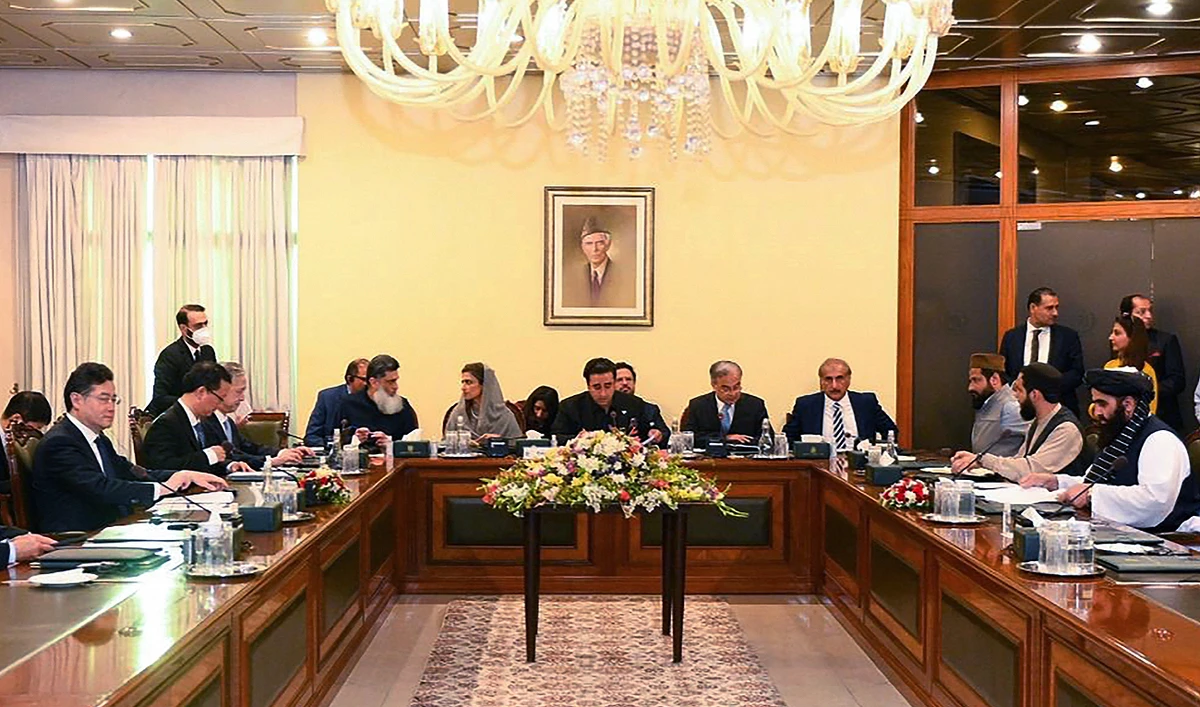
“The three sides reaffirmed their resolve to fully harness Afghanistan’s potential as a hub for regional connectivity,” the foreign ministry statement, which comes after the conclusion of the 5th China-Afghanistan-Pakistan Foreign Ministers’ Dialogue in Islamabad, said.
“Reaffirming their commitment to further the trilateral cooperation under the Belt and Road Initiative (BRI), and to jointly extend the China-Pakistan Economic Corridor to Afghanistan.”
The three sides also emphasized the importance of existing projects including the Turkmenistan–Afghanistan–Pakistan–India (TAPI) pipeline, CASA 1000 (Central Asia-South Asia power project), the Trans-Afghan Railways project among others, saying they would enhance regional connectivity as well as ensure economic uplift and prosperity for the peoples of the region.
“The three sides agreed to enhance transit trade through Gwadar Port.”
Since the Taliban took over Afghanistan in 2021, the country has been plunged into economic crisis as the nation’s international assistance has been largely cut off. Billions of dollars in central bank assets held abroad have also been frozen, which has put pressure on the banking system and prevented most transactions involving US dollars, which has hampered trade.
The United States and other Western nations are reluctant to provide the Taliban with funds until the movement provides assurances that it will uphold human rights, and in particular the rights of women. Since coming to power, the Taliban have tightened controls on women’s access to public life, including barring women from university and closing girls’ high schools.
Pakistan, which shares a border with Afghanistan and hosts millions of Afghan refugees from decades of conflict, is concerned about the economic crisis hitting its neighbor. Its officials have urged the international community not to isolate the Taliban administration, saying aid should be provided to prevent economic collapse and a wave of refugees.
Pakistan has had deep ties with the Taliban in the past and has been accused of supporting the group as it battled the US-backed government in Kabul for 20 years — charges denied by Islamabad.
However, Pakistan has not yet formally recognized the Taliban-led administration.
“Expressing solidarity with the people of Afghanistan, the three sides stressed the importance of sustained and urgent humanitarian support to the people of Afghanistan including the imperative to bridge funding gaps for humanitarian operations,” the foreign ministry said.
“The Ministers underlined that humanitarian support to the people of Afghanistan must remain delinked from any political considerations.”