- Agrees on zero interference from neighboring and regional countries in Afghanistan
- US to "give up Afghanistan militarily" if there are no threats, Khalilzad says
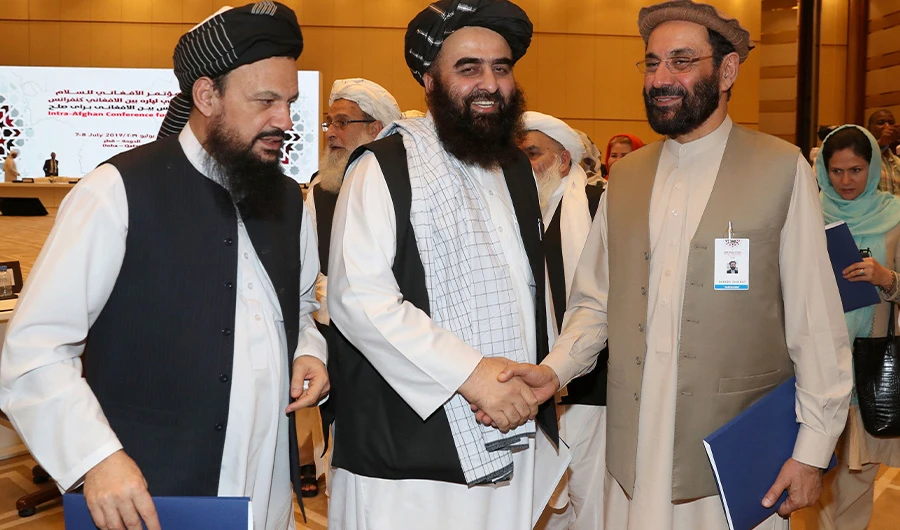
DOHA: The Taliban political representatives, Afghan government officials, politicians, women and civil society activists, who wrapped up their two-day intra-Afghan conference in Doha late Monday, agreed on a roadmap for peace and underscored the need to “minimize civilian casualties to Zero.”
“Civilians should not be affected, war continues, but our aim is to reduce civilian casualties,” read the joint resolution passed at the end of the Intra-Afghan Peace Conference.
The joint statement pledged to “guarantee the security of public institutions like schools, religious madrassas, hospitals, markets, water dams and other working locations.”
Although, not binding in nature, the statement further urged the stakeholders to take confidence-building measures, including “unconditional release of elderly, disabled and ill inmates,” ahead of the direct negotiations.
Doha conference, which was jointly hosted by Qatar and Germany, witnessed the attendance of Afghan government representatives for the first time but the three officials spoke in their personal capacity.
“The parties in the conflict shall avoid threats, vengeance and provocative words, shall use soft terminologies and words during their official gatherings, and shall not fuel conflict and revenge,” the statement said.
The call to end civilian casualties came days after Taliban deadly attacks in Ghazni and Kabul also killed and injured dozens of civilians, including school children.
The participants stressed continuation of dialogue and said they have “full consensus that achieving sustainable, far-reaching and a dignified peace, which is the demand of the Afghan people, is the only possible through Afghan inclusive negotiations.”
The conference announced full support for peace negotiations currently underway between the Taliban and the US in Qatar to find out a political solution to the conflict.
“The Doha peace conference participants strongly supports the current peace talks in Doha and believe that an effective and positive outcome from the negotiations will be fruitful for Afghanistan,” the resolution further said.
The US and Taliban are scheduled to resume their negotiations later on Tuesday after a two-day pause due to the intra-Afghan conference, sources told Arab News.
The US special envoy for Afghanistan reconciliation Zalmay Khalilzad was also in the attendance when the resolution was read out.
Khalilzad told reporters in Doha that three of the four issues had been resolved and substantial progress was made on the fourth one. He did not offer more comments calling the subject “sensitive.”
Taliban sources, however, told Arab News that both sides have differences over the time-frame for troop withdrawal. The Taliban seek an early withdrawal while the US wants more time.
“If there is no threat to the US from the Afghan soil and the Afghans do not want the US forces to stay in Afghanistan, then we are ready to give up Afghanistan militarily,” Khalilzad said.
A 10-member committee comprising Taliban and delegates from Kabul drafted the resolution after hours of deliberation owing to differences over certain issues, sources privy to the development claim.
The Afghan delegates accepted Taliban demand to approve a resolution adopted during the Moscow’s intra-Afghan conference in February that had endorsed the Taliban calls for complete withdrawal of the foreign forces, lifting international sanctions on senior Taliban leaders, release of their prisoners, support US-Taliban talks in Qatar and recognition of their office in Doha.
Taliban consider Doha resolution as their “victory” since it backed the Moscow declaration alongside endorsing Taliban calls for Islamic system and release of prisoners, the group’s political spokesman Suhail Shaheen told Arab News.
“It is our official policy to avoid civilian casualties and we reiterated our position during the conference,” he said, adding that a Taliban commission will probe civilian casualties.
Afghan government representative Ahmad Nadir Nadri said the delegates from Kabul gave up some of their demands just to keep the peace process on track and to find solution to problems through dialogue.
Nadri told reporters that face-to-face two-day talks with the Taliban enabled the Afghan delegates to know what Taliban want, adding that the representatives of the government, who spoke in personal capacity, and other participants defended the constitution, democracy, basic rights of the people and their freedom.
Doha conference urged the Islamic Conference, UN, Security Council, EU and other neighboring countries to support the peace conference held in Moscow and Doha.
The participants assured women rights in political, social, economic, educational, cultural affairs as per within the Islamic framework of Islamic values.
The participants of Doha conference agreed on a roadmap for peace – institutionalizing Islamic system in the country for the implementations of comprehensive peace and to start of the peace process simultaneously with the accomplishment of all terms and conditions set forth.
The conference also sought assurance on zero interference from the neighboring and regional countries in Afghanistan. No country was mentioned in the statement.