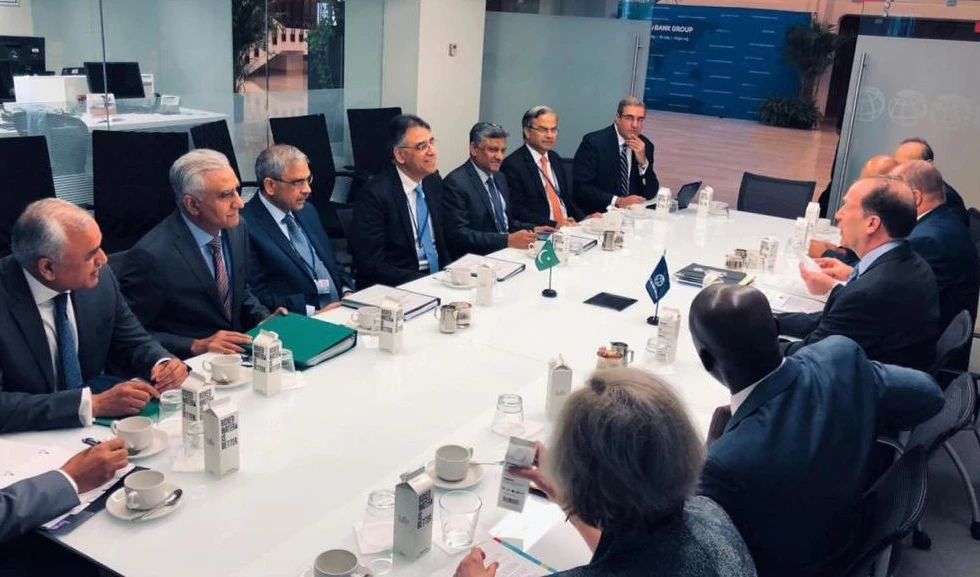
- Meets new World Bank president in Washington, briefs him about macroeconomic situation
- Discusses ongoing negotiations for a financial assistance package with IMF First Deputy Managing Director
ISLAMABAD: Pakistan’s Finance Minister Asad Umar on Wednesday held discussions with senior officials from the International Monetary Fund (IMF) to secure a bailout package and also met the top official of the World Bank in Washington.
This will be Pakistan’s thirteenth IMF bailout since the late 1980s. The country is currently struggling to stave off a balance of payments crisis.
“Pakistan’s delegation led by Asad Umar, Finance Minister, participated in the IMF/WB spring meetings 2019 and attended a number of bilateral meetings on the sidelines,” Islamabad’s Embassy in Washington said in a statement.
Umar met with the new president of the World Bank, David Malpass, and briefed him about Pakistan’s macroeconomic situation and discussed the country’s ongoing engagement with the Bank.
“Malpass appreciated the reform process in the country and assured continued World Bank support,” the statement read.
Umar also met with the First Deputy Managing Director of the IMF, David Lipton, and talked about ongoing bailout negotiations.
He also had a business round-table with members of the US Pakistan Business Council. The companies present included PepsiCo, Coca Cola, Procter & Gamble, Uber and Facebook.
“The companies expressed their strong interest in Pakistan’s market and shared their future plans as well as issues where they needed support from the government,” the statement added.
Umar said the Pakistani government was completely focused on improving the ease of doing business in Pakistan and explained that Prime Minister Imran Khan was personally monitoring the reforms process.
Last month, IMF mission chief for Pakistan, Ernesto Ramirez-Rigo, visited Islamabad and Karachi for introductory meetings with authorities and to review ongoing discussions toward an IMF-supported program.
Talks with the IMF began soon after Khan was appointed prime minister last August but stalled over austerity conditions imposed by the Fund, which has pressed Pakistan to improve tax revenue collection, bolster foreign currency reserves and narrow a current account deficit expected to top 5 percent of gross domestic product this year.
Pakistani officials say they agree on the need for reforms but do not want to sign up to conditions that would derail the economy, with growth set to slow this year to around 4 percent from 5.2 percent last year.
Pakistan and the IMF are expected to finalize the bailout package during spring meetings.