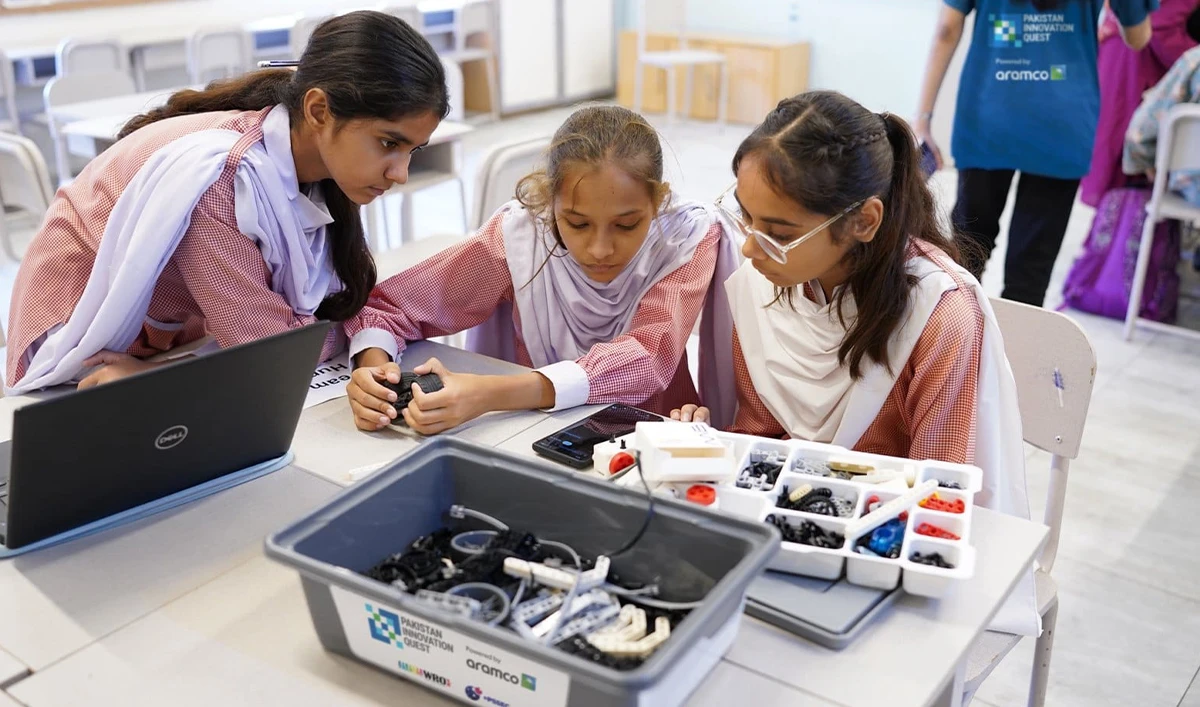
- Pakistan Innovative Quest, launched in June, aims to provide robotics education at low-income schools
- Program is funded by Aramco and spearheaded by Pakistan’s first space science and STEM education center
KARACHI: A program supported by Saudi oil giant Aramco aims to provide free robotics training to 10,000 Pakistani schoolchildren in low-income schools by the end of this year, the chief executive of the country’s first dedicated space science and STEM education center said this week.
The Pakistan Innovation Quest (PIQ) is being implemented by the Pi Space Science Education Center (PSSEC), located in the southern port city of Karachi. It has partnered with Robot Olympiad Association for the initiative, which is funded by Saudi Arabia’s Aramco.
PIQ was launched by PSSEC with Aramco’s help on Jun. 15 this year and is expected to end on Dec. 31. PSSEC’s chief executive and co-founder Zartaj Ahmed told Arab News on Sunday that out of the 10,000 schoolchildren that will be provided free robotics trainings, the center will try to ensure 40 percent of these are girls.
Ahmed said PSSEC’s STEM trainers provide the education to these children and schools free of cost.
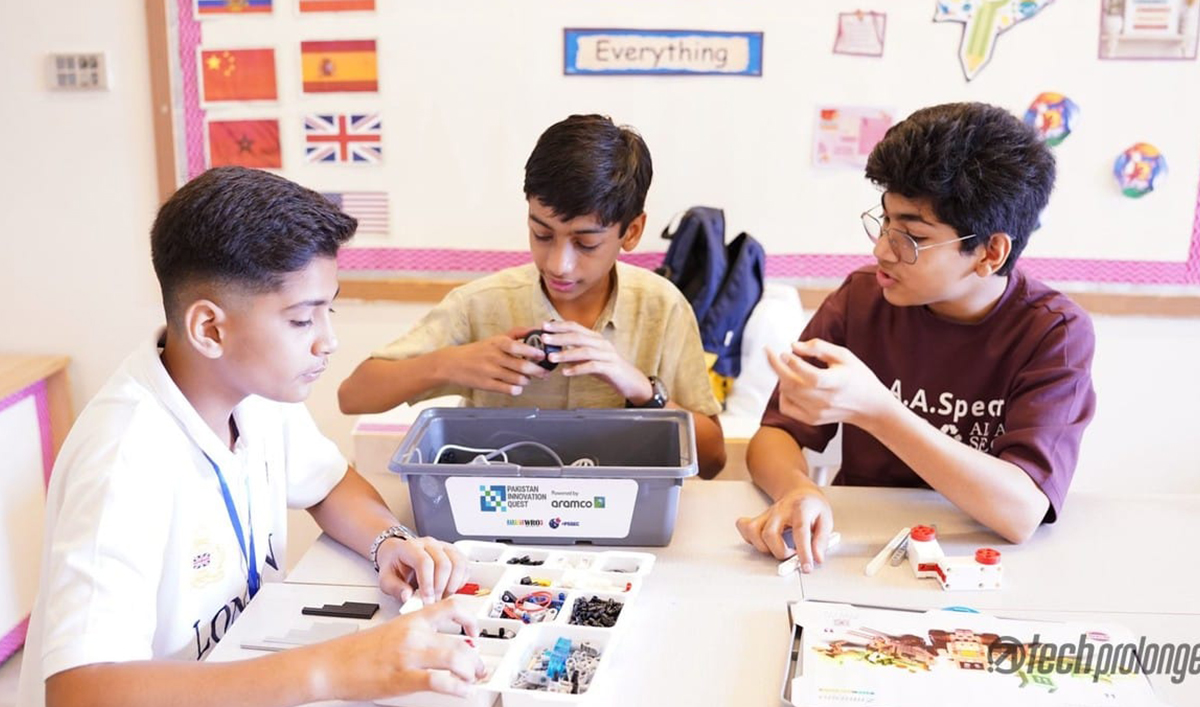
“Aramco’s support has helped us overcome that financial barrier, allowing us to provide robotics education to schools free of charge,” Ahmed said, noting that schools were enthusiastic about the initiative as they did not have to pay for the trainings.
“We pay the trainers ourselves because they are responsible for visiting schools and conducting the training sessions.”
Arab News reached out to Hussain N. Hanbazazah, Aramco’s vice president of communications operations and corporate citizenship, but did not receive a response till the filing of this report. However, Hanbazazah confirmed Aramco’s participation in the program earlier this week in a press release issued by the PIQ.
According to a program update published on Nov. 5, PIQ said it has trained more than 6,000 children and 518 teachers, with around 60 institutions participating across Karachi, Lahore, Hyderabad, Gujranwala and Kasur cities.
The initiative includes training in public and private schools, girls’ schools and institutions serving low-income communities. Its plans also include donating 100 robotics kits to underserved institutions.
Among its participants are learners at the Deaf Reach, a program of the non-profit Family Educational Services Foundation that provides education, vocational training and other support to deaf children and young people in Pakistan.
Maydda Nabeel, a PIQ trainer, conducted training sessions at the Deaf Reach in Lahore on Aug. 21–22 and in the eastern city of Jhelum on Oct. 29.
The Lahore training involved 135 participants, she said. During the sessions, students proposed a robot that could help hearing people better understand deaf individuals.
“The idea came from their own experiences and their desire to use technology to address a real-life challenge,” Nabeel told Arab News.
She described the proposal as a student-generated design concept, rather than a fully functional prototype built or demonstrated during the training.
Interpreters supported communication during the sessions at both cities, while trainers used visual demonstrations and practical activities to explain robotics and coding.
“Together, we explored new ways of communicating the vocabulary and concepts of robotics and coding through sign language, visual demonstrations and practical activities,” Nabeel said.
She said the experience highlighted the need to adapt technical instructions, while students demonstrated an ability to connect robotics with challenges in their own lives.
PIQ also provides teacher trainings intended to help institutions continue robotics activities beyond the visiting trainers’ sessions.
Aramco’s involvement comes within a broader collaboration with the World Robot Olympiad Association, which announced their global innovation partnership in March 2024. The partnership supports robotics education and the Future Innovators competition category, in which students aged eight to 19 develop solutions to real-world problems.
For Nabeel, making such learning accessible requires instructors to adapt alongside their students.
“We also recognized that inclusive STEM education requires trainers to be flexible and willing to learn from their students,” she said.