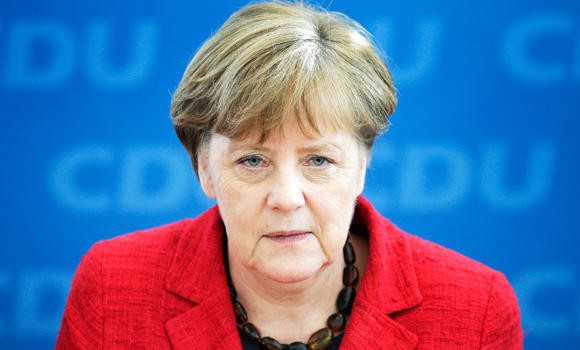
Merkel sticks to migrant course after German polls

Updated 14 March 2016
Follow

Merkel sticks to migrant course after German polls

BERLIN: Chancellor Angela Merkel said Monday she would stick to her course in Europe’s migrant crisis following state elections that sent conflicting signals about Germans’ opinion of her liberal approach and highlighted divisions in her conservative bloc.

Merkel acknowledged that Sunday’s three elections, which produced painful losses for her conservative Christian Democratic Union, were dominated by the migrant issue and many voters believed there is “no conclusive and satisfactory solution.”
However, “I am firmly convinced, and that wasn’t questioned today, that we need a European solution and that this solution needs time,” Merkel said after party leaders met in Berlin.
The nationalist, anti-migration Alternative for Germany, or AfD, powered into three state legislatures after campaigning against Merkel’s welcome for last year’s huge influx of migrants.
That made clear a sizeable minority is uneasy about Merkel’s policies. AfD attracted people who didn’t previously vote, and took votes from established parties.
But many viewed the overall outcome as a sign of support for her approach.
Gero Neugebauer, a political scientist at Berlin’s Free University, said that Merkel’s “refugee policy was supported by the majority of voters,” even if they ended up voting for other parties.
Merkel’s CDU lost two states it had hoped to win back from center-left incumbents. They included Baden-Wuerttemberg, an economic powerhouse and longtime conservative stronghold where the CDU embarrassingly finished second behind the left-leaning Greens.
Victory there went to governors who often sounded more enthusiastic about her migrant policy than Merkel’s own candidates — whose poll ratings slid after they tried last month to put cautious distance between themselves and the chancellor by calling for daily refugee quotas. That came on top of months of attacks from Merkel’s allies in Bavaria’s Christian Social Union, who want a national cap on refugee numbers.
“The central reason (for the losses) is refugee policy — there is no point in talking past it,” said Bavarian governor Horst Seehofer, Merkel’s most prominent internal critic of recent months. He called the results a “political earthquake.”
“The answer to the population after such an election result cannot be that everything continues as it was,” he added.
Merkel appeared unmoved, disputing Seehofer’s contention that the conservative bloc faces an “existential” threat from AfD’s rise and reiterating that she can’t go into negotiations with Turkey on stemming the migrant flow with a national refugee limit. She added that differences between the CDU and Seehofer’s CSU are “always hard to bear” for conservative voters.
“It is good that there is approval from society as a whole but ... I would like my party, the CDU and CSU as a whole, to discuss such questions in great unity,” she said.


Israeli firm loses British Army contract bid

Updated 9 sec ago
Follow

Israeli firm loses British Army contract bid

  • Subsidiary Elbit Systems UK’s campaign for $2.6bn program was marred by controversy
  • Senior govt civil servant overseeing contract was dined, handed free Israel tour

LONDON: A UK subsidiary of Israeli weapons giant Elbit Systems has lost its bid to win a prominent British Army contract, The Times reported.

The loss followed high-profile reporting on controversy surrounding Elbit Systems UK’s handling of the bid.

The subsidiary led one of two major arms consortiums attempting to secure the $2.6 billion bid to prepare British soldiers for war and overhaul army standards.

Rivaling Elbit, the other consortium led by Raytheon UK, a British subsidiary of the US defense giant, ultimately won the contract, a Ministry of Defence insider told The Times.

It had been decided following an intricate process that Raytheon was a “better candidate,” the source said.

Elbit Systems UK’s controversial handling of its contract campaign was revealed in reports by The Times.

A whistleblower had compiled a dossier surrounding the bid that was shown to the MoD last August, though the report was privately revealed to the ministry months earlier.

It alleged that Elbit UK had breached business appointment rules when Philip Kimber, a former British Army brigadier, had reportedly shared information with the firm after leaving the military.

Kimber attending critical meetings at the firm to discuss the training contract that he had once overseen at the ministry, the report alleged.

In one case, Kimber was present in an Elbit meeting and sitting out of view of a camera. He reportedly said he “should not be there,” according to the whistleblower’s report.

In response to a freedom of information request, the MoD later admitted that it had held the dossier for seven months without investigating its claims. Insiders at the ministry blamed the investigative delay on “administrative oversight.”

A month after being pushed on the allegations by The Times, a senior civil servant completed an “assurance review” in September and found that business appointment rules had not been breached.

Other allegations concerned lunches and dinners hosted by Elbit UK in which civil servants at the heart of the contract decision process were invited.

One senior civil servant was dined by the British subsidiary seven times, while rival Raytheon did not host events.

Mike Cooper, the senior responsible owner at army headquarters for the army training program, also traveled to Jerusalem with two senior British military officers.

He took part in a sightseeing tour funded by Elbit Systems, the British subsidiary’s parent company.

In response to the allegations, an MoD spokesperson said in a statement: “The collective training transformation programme will modernise training for soldiers to ensure the British Army can face down the threats of the future.

“We will not comment further until a preferred tenderer announcement is made public in due course.”

Amid mounting criticism of Israel within the British military establishment, four former senior army officers, in a letter to Prime Minister Keir Starmer, recently urged the government to end involvement with Israeli-owned or Israeli-supported weapons companies.

“Now is not the time to return to business as usual with the Israeli government,” they wrote, urging harsher sanctions.