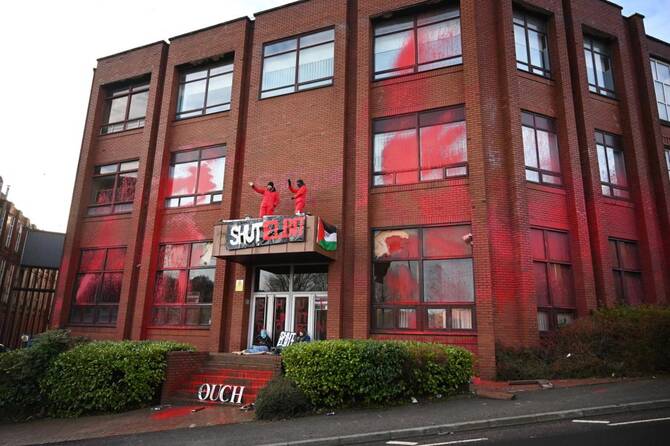
UK pro-Palestinian activist says raid on Elbit factory was about destroying weapons

Activists from Extinction Rebellion North and Palestine Action protest outside the Elbit Ferranti factory in Waterhead, Oldham in north-west England. (File/AFP)
Short Url
Updated 04 December 2025
Follow

UK pro-Palestinian activist says raid on Elbit factory was about destroying weapons

  • Head admitted she drove a repurposed former prison van carrying fellow activists through fences outside the factory and then into a loading bay on August 6, 2024

LONDON: A British pro-Palestinian activist on trial over a raid targeting Israeli defense firm Elbit said on Thursday she and her co-defendants had wanted to “cause as much property damage as we could” but said she was opposed to violence.
Charlotte Head, 29, and five others are on trial at Woolwich Crown Court over what prosecutors have described as a meticulously planned assault by Palestine Action on the Elbit Systems UK facility in Bristol, southwest England, last August.
All six are charged with aggravated burglary, violent disorder and criminal damage, with one of Head’s co-defendants also charged with causing grievous bodily harm with intent for allegedly hitting a police officer with a sledgehammer.
They all deny the charges. Head told jurors she and her co-defendants had decided to take action because “all else had failed.”
Head admitted she drove a repurposed former prison van carrying fellow activists through fences outside the factory and then into a loading bay in the early hours of August 6, 2024.
She said the plan was to “go in and destroy as many weapons as we could find.”
Head was asked by her lawyer Rajiv Menon: “Did you use violence against security guards or a police officer?” She replied: “No, never.”
Head said she was not involved in pro-Palestinian activism until after Palestinian militant group Hamas attacked Israel from Gaza on October 7, 2023, prompting a massive Israeli military response that Head described as a “genocide.”
Prosecutor Deanna Heer told jurors as the trial began last month that one of the six defendants, Samuel Corner, 23, hit a female police sergeant with a sledgehammer in the back, causing a lumbar spine fracture.
Head, asked on Thursday if she would have participated in action targeting Elbit if she knew someone would have used violence, said: “No, it was not a part of the plan.”
The trial continues.


Foreign truckers ‘in God’s hands’ in militant-hit Mali

Updated 3 sec ago
Follow

Foreign truckers ‘in God’s hands’ in militant-hit Mali

KIDIRA: Amath Mboup, a young Senegalese, is haunted by the charred and decomposing bodies of fellow truckers killed by jihadists lying along the highway to the Malian city of Kayes.
Since September, fighters from the Al-Qaeda-linked Group for the Support of Islam and Muslims, known by its Arabic acronym JNIM, have sought to cripple landlocked Mali’s economy and undermine its junta.
They have been blocking and sometimes attacking fuel tankers entering Mali and placing total blockades on certain strategic routes leading to the capital Bamako.
Hundreds of tankers from Abidjan, Ivory Coast’s economic capital, and the Senegalese capital Dakar have been set ablaze.
Dozens of drivers have been killed or kidnapped, particularly on the Kayes-Bamako road in the west of the country, near the border with Senegal.
After waiting two days for routine checks in the Senegalese border town of Kidira, one of the main crossing points between Senegal and Mali, Mboup — who is in his thirties — was preparing to travel onwards to Bamako, his truck loaded with goods.
Alone in the truck, where amulets hang to ward off bad luck, Mboup was apprehensive as he is every time he takes this route.

- ‘Everyone is afraid’ -

“Everyone is afraid to take this road because it’s too risky: You know you’re leaving, but you don’t know if you’ll come back alive,” he told AFP, his face dusty and pale with fatigue.
Malick Bodian, another Senegalese driver, told AFP he is always putting his life “in God’s hands.”
“Your mind is never at peace when you travel this road. You think you could be attacked at any moment,” he said.
Many of the truckers interviewed by AFP said there was no question of quitting their jobs.
“We don’t have a choice. It’s the only job I know how to do to feed my family,” said Mboup, a married father of two.
Behind him, dozens of trucks, engines rumbling, were lined up for several kilometers waiting to leave Senegal for the bumpy Malian roads and all their potential dangers.
Fuel tankers were not among the trucks, however. Last November, JNIM claimed in a propaganda video that all tanker drivers would henceforth be considered “military targets.”
The drivers in line were Senegalese, Malian, Ivorian and Burkinabe and many said they had encountered militants on their journeys.
“They often appear out of nowhere in the forest on motorcycles and are usually wearing turbans and heavily armed,” Malian driver Moussa Traore said.
“When you see them, you’re the one who slows down. Sometimes they stop you to ask for your documents, other times not,” he said.

- Obstacle course -

Mali imports most of its requirements, including fuel, fish, fruit and vegetables, by road from Senegal, Mauritania or Ivory Coast. More than 70 percent of its imports transit through Dakar port.
JNIM is waging a form of “economic jihad” in western Mali, aiming to destabilize the region by “targeting vital logistics routes,” according to a 2025 report by the Timbuktu Institute think tank.
Traveling on certain roads in Mali such as the one to Kayes has become an obstacle course.
“The flow of trucks that used to pass through Kidira is no longer the same,” said Modou Kayere, an official with the West African Truck Drivers Union, which represents some 15 countries.
In late November, Senegalese authorities reported that nearly 2,500 shipping containers filled with goods destined for Mali were blocked at Dakar port due to the security situation.
According to most of the drivers interviewed by AFP, vehicles carrying goods are rarely attacked by militants, unlike fuel tankers.
But the risk is real and the drivers are trying to adapt.
They have decided to stop driving at night and some have even set up alert networks on WhatsApp to warn their peers of danger on the road.