HONG KONG: Hong Kong police dismantled the city’s main pro-democracy protest site Thursday, clearing tents and barricades after more than two months of rallies and leading away more than 200 demonstrators, who vowed their struggle lives on.
Hundreds of police moved in from all sides of the Admiralty camp in the heart of the business district, sweeping away shelters and supply stands before swooping on a core group at the center of the site, including student leaders and lawmakers.
As police cleared the last handful of protesters late Thursday, parts of the site reopened to traffic for the first time since September.
Those making a last stand were the remnants of what once numbered tens of thousands of people at the height of the protest movement, before public support waned.
Some were carried by groups of four officers while others were led off on foot, one by one. Those who remained lay on the road shouting, “We are peaceful,” “We will not resist” and “I want true democracy.”
The call for free leadership elections has underpinned the demonstrations, and protesters have vowed the clearance operation will not end a campaign they say has redefined the city’s vexed relationship with Beijing.
Police would not confirm if any of those taken away had been formally detained but they had threatened in the build-up to the operation to arrest anyone who refused to leave the protest zone.
Protest group Hong Kong Federation of Students (HKFS) said that eight of its members had been arrested.
Media mogul Jimmy Lai, a fierce critic of Beijing, and veteran campaigner Martin Lee were among those led away — Lee holding up a victory salute to reporters.
Singer Denize Ho shouted “Civil disobedience without fear,” as she walked away with officers while lawmaker Claudia Mo sang “We will overcome” and shouted “We will be back” through a megaphone before being escorted off.
Student leaders Nathan Law and Eason Chung were also take away by police, alongside other protesters including an elderly man in a wheelchair.
“This is not the end of the movement. The political awakening amongst the young is irreversible and we will fight on,” Mo told AFP earlier Thursday.
Lee added: “In the heart of every student who has participated in this movement there is now a fire burning, a fire for democracy. This fire cannot be extinguished by an iron fist.”
Earlier in the day, police had announced a “lockdown” after a 30-minute window allowing protesters to voluntarily leave the site — an encampment of tents, supply stations and art installations sprawling along a kilometer of a multi-lane highway through the Admiralty district.
Some managed to leave after the deadline, but were asked to give their identity details to police.
Thousands gathered on Wednesday night for one final mass rally at the site, but the numbers had already dwindled to hundreds by Thursday morning.
Before the police operation, bailiffs descended with cutters and pliers to take down barricades and load them into trucks to enforce court orders taken out by transport companies frustrated at the long-running disruption.
The Admiralty site has been the focal point of the protest movement since rallies erupted in September, after China’s Communist authorities insisted that candidates in Hong Kong’s 2017 leadership election will have to be vetted by a loyalist committee.
Protesters say this will ensure the election of a pro-Beijing stooge, and their struggle has highlighted a litany of frustrations in the former British colony including a yawning income gap and lack of affordable housing.
Some in Admiralty expressed a sense of failure Thursday, after the authorities in Hong Kong and Beijing refused to give any concessions on political reform, but said the occupation had changed Hong Kong for good.
“I feel sad because we haven’t achieved our mission, but I think there can be progress in the future,” said 23-year-old welfare worker Dubi. “I think it’s the start of something long-term.”
Others were still determined to stand their ground.
“I’m not tired (of the campaign). I’ll never be tired, only the government is tired,” said 19-year-old student Alice.
There had been fears that radical splinter groups would dig in for a final stand, following violent clashes outside government headquarters in Admiralty at the end of last month.
But many said they did not want a confrontation and there were no clashes as police swept through.


HK police haul away protesters from rally site
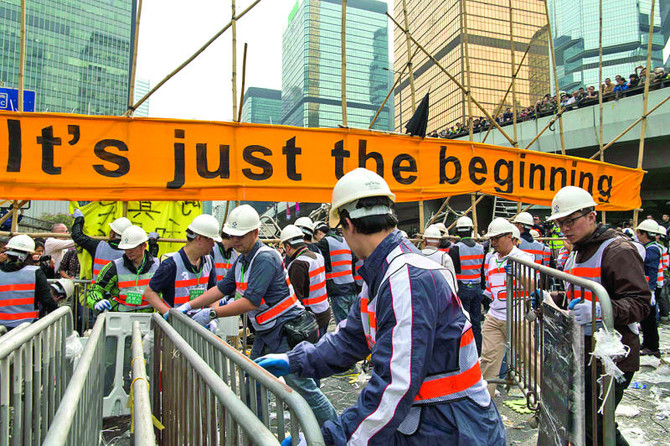
HK police haul away protesters from rally site

Israeli firm loses British Army contract bid
- Subsidiary Elbit Systems UK’s campaign for $2.6bn program was marred by controversy
- Senior govt civil servant overseeing contract was dined, handed free Israel tour
LONDON: A UK subsidiary of Israeli weapons giant Elbit Systems has lost its bid to win a prominent British Army contract, The Times reported.
The loss followed high-profile reporting on controversy surrounding Elbit Systems UK’s handling of the bid.
The subsidiary led one of two major arms consortiums attempting to secure the $2.6 billion bid to prepare British soldiers for war and overhaul army standards.
Rivaling Elbit, the other consortium led by Raytheon UK, a British subsidiary of the US defense giant, ultimately won the contract, a Ministry of Defence insider told The Times.
It had been decided following an intricate process that Raytheon was a “better candidate,” the source said.
Elbit Systems UK’s controversial handling of its contract campaign was revealed in reports by The Times.
A whistleblower had compiled a dossier surrounding the bid that was shown to the MoD last August, though the report was privately revealed to the ministry months earlier.
It alleged that Elbit UK had breached business appointment rules when Philip Kimber, a former British Army brigadier, had reportedly shared information with the firm after leaving the military.
Kimber attending critical meetings at the firm to discuss the training contract that he had once overseen at the ministry, the report alleged.
In one case, Kimber was present in an Elbit meeting and sitting out of view of a camera. He reportedly said he “should not be there,” according to the whistleblower’s report.
In response to a freedom of information request, the MoD later admitted that it had held the dossier for seven months without investigating its claims. Insiders at the ministry blamed the investigative delay on “administrative oversight.”
A month after being pushed on the allegations by The Times, a senior civil servant completed an “assurance review” in September and found that business appointment rules had not been breached.
Other allegations concerned lunches and dinners hosted by Elbit UK in which civil servants at the heart of the contract decision process were invited.
One senior civil servant was dined by the British subsidiary seven times, while rival Raytheon did not host events.
Mike Cooper, the senior responsible owner at army headquarters for the army training program, also traveled to Jerusalem with two senior British military officers.
He took part in a sightseeing tour funded by Elbit Systems, the British subsidiary’s parent company.
In response to the allegations, an MoD spokesperson said in a statement: “The collective training transformation programme will modernise training for soldiers to ensure the British Army can face down the threats of the future.
“We will not comment further until a preferred tenderer announcement is made public in due course.”
Amid mounting criticism of Israel within the British military establishment, four former senior army officers, in a letter to Prime Minister Keir Starmer, recently urged the government to end involvement with Israeli-owned or Israeli-supported weapons companies.
“Now is not the time to return to business as usual with the Israeli government,” they wrote, urging harsher sanctions.


