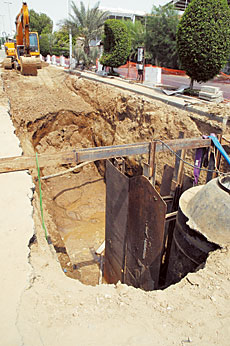
JEDDAH, 22 August 2005 — A few days ago, several tons of sandy soil collapsed on an Egyptian worker — an illegal overstayer — in the Al-Rehab area of Jeddah and crushed the life out of him. Described as an “accident”, it was entirely preventable.
It was an incident — not to be dignified with the euphemism “accident” — waiting to happen. It was not the first; it will not be the last unless drastic action is taken now. With thousands of kilometers of pipes now being laid in Jeddah to update the water and sewage systems, the potential for the avoidable loss of human life is enormous.
In a short, though not exhaustive, tour of some of the excavations in Jeddah, none of the trenches observed were shored or contained movable trench cages.
In one case, the hole was over 20 feet deep — past the suggested un-shored limit for any trench, even with the sides sloped back at an acute angle to prevent slippage. The bottom was knee-deep in water and small pieces of the side wall were slipping quietly into the muddy liquid.
The excavation was in a main road and subject to the vibrations of passing traffic which, when transmitted through the ground to the trench only decreased the time until the wall’s inevitable collapse.
According to Thalah Touqa, an engineer at one of the Kingdom’s prestigious contracting and developing companies, the soil available for use is weak, usually moist, and highly weathered which, if left unsupported in a trench, will easily collapse.
David Dow is vice president of Trench Safety, a Memphis, Tennessee-based company that specializes in educating contractors and their employees on trench safety. “Trenches are one of the highest risk areas in terms of numbers of accidents,” Dow said in an interview with Business First, a respected trade magazine.
“If a guy is in a trench that’s only 6 to 8 feet deep, (1.8 to 2.4 meter) and they’re buried alive, that’s still extremely dangerous. A cubic yard of dirt can weigh 3,000 pounds; if they get a couple of (cubic) yards of dirt on their backs, they’re killed instantly,” Dow said.
A “couple of cubic yards” is about the weight of a GMC Suburban. You do not walk away from that. Falling, hitting your finger with a hammer or being burned with a welding torch are accidents which a worker generally survives. Cave-ins or trench sidewall collapses are not.
In most of the incidents involving trench wall collapses, a worker is killed instantly by the weight of the dirt on his back. If he survives the actual cave-in, he will probably suffocate before rescuers can reach him.
“Trench collapses are entirely avoidable,” said Nigel Thorpe of the UK’s Health and Safety Executive (HSE) — a monitoring body that concerns itself with workplace safety. “Without suitable support, any face of an excavation will collapse; it’s just a matter of when. The steeper and deeper the face, the wetter the soil, the sooner the collapse.”
According to Touqa there are safety regulations in the Kingdom which contractors must follow; safety regulation fees are included in the contract. “At least one percent of the contract fees are dedicated to safety procedures, keeping in mind that there are 10 million and 12 million contract deals,” said Touqa. The contracts are signed by all parties yet safety measures are rarely followed. Many engineers believe that this is due to “contractors looking for the quick and cheap way out” — which means safety measures are neglected.
This opinion was supported by an anonymous civil engineer who said that contractors were looking for quick ways to complete the job. “Before they start, contractors have to sign up to safety measures, but there is no follow up. I see dangerous trenches all over Jeddah, especially in the streets. It is the job of traffic police and the municipality to ensure that safety regulations are followed,” the engineer said.
Trenchless technologies are available which avoid many of the hazards of excavation, but if a trench is required, modern systems providing ground support — the shoring that holds the trench walls in place — can be installed without the need to introduce workers into the excavation. Shoring devices do not prevent cave-ins, but they do keep the workers inside their perimeters safe. That is the vital point.
To quote the HSE again: “Without suitable support, any face of an excavation will collapse; it’s just a matter of when. The steeper and deeper the face, the wetter the soil, the sooner the collapse.”
These incidents which kill people are entirely preventable. Regulations exist. The number of accidents that do occur imply that the regulations are not sufficiently enforced or policed. So how many people have to die before the authorities who address health and safety think that the number has passed the “acceptable level of deaths” that the citizens of the Kingdom will tolerate?