- Control of the vital Exports Road gives Sudan’s army a crucial supply route toward Kordofan and Darfur
- But drone attacks and cross-border strikes show how difficult it remains to secure the country’s vital arteries
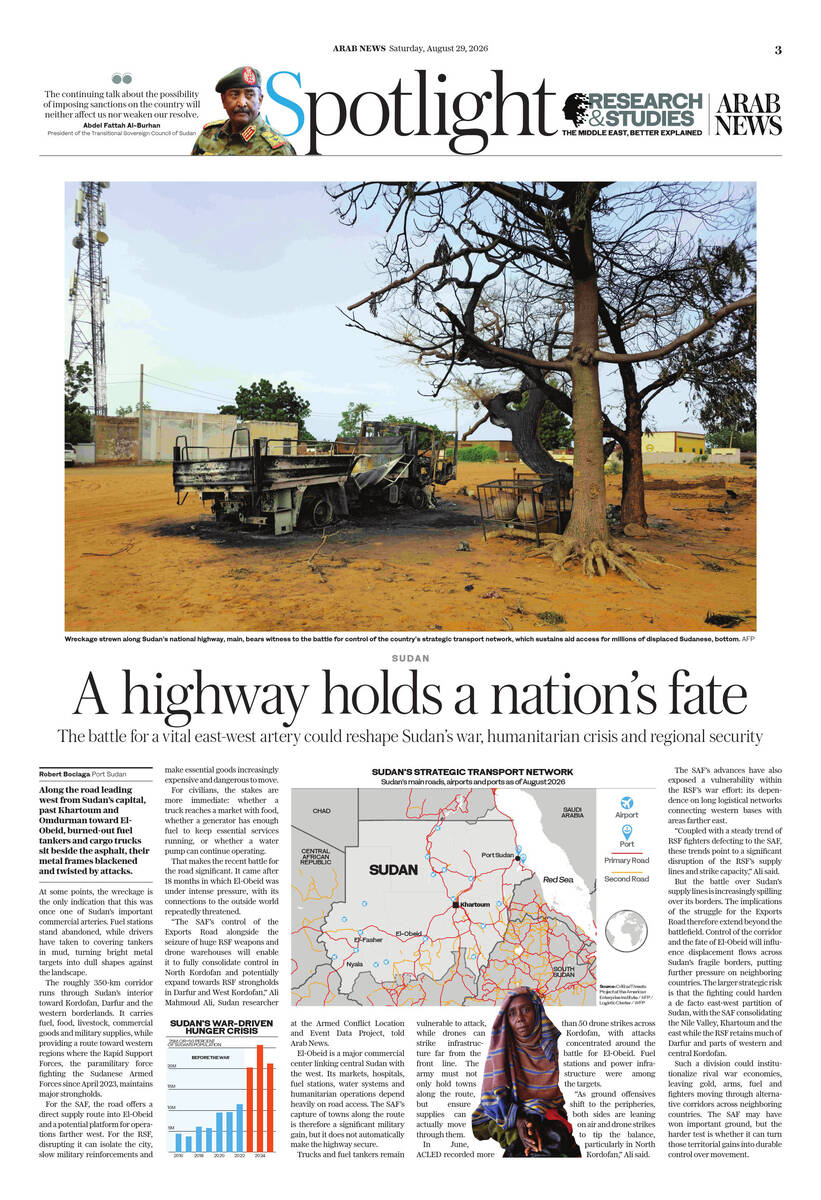
PORT SUDAN: Along the road leading west from Sudan’s capital, past the sprawling urban area of Khartoum and its twin city Omdurman toward the regional center of El-Obeid, the burned-out remains of fuel tankers and cargo trucks sit beside the asphalt, their metal frames blackened and twisted by attacks.
At some points, the wreckage is the only indication that this was once one of Sudan’s important commercial arteries. Fuel stations stand abandoned, their pumps and canopies damaged. Drivers who continue to make the journey have taken to covering tankers in mud, turning their vehicles from bright metal targets into dull shapes against the landscape.
The roughly 350-km corridor runs through Sudan’s interior toward Kordofan, Darfur and the western borderlands. It carries fuel, food, livestock, commercial goods and military supplies, while providing a route toward western regions where the Rapid Support Forces, the paramilitary force fighting the Sudanese Armed Forces since April 2023, maintains major strongholds.
For the SAF, the road offers a direct supply route into El-Obeid and a potential platform for operations farther west. For the RSF, disrupting it can isolate the city, slow military reinforcements and make the movement of essential goods increasingly expensive and dangerous.
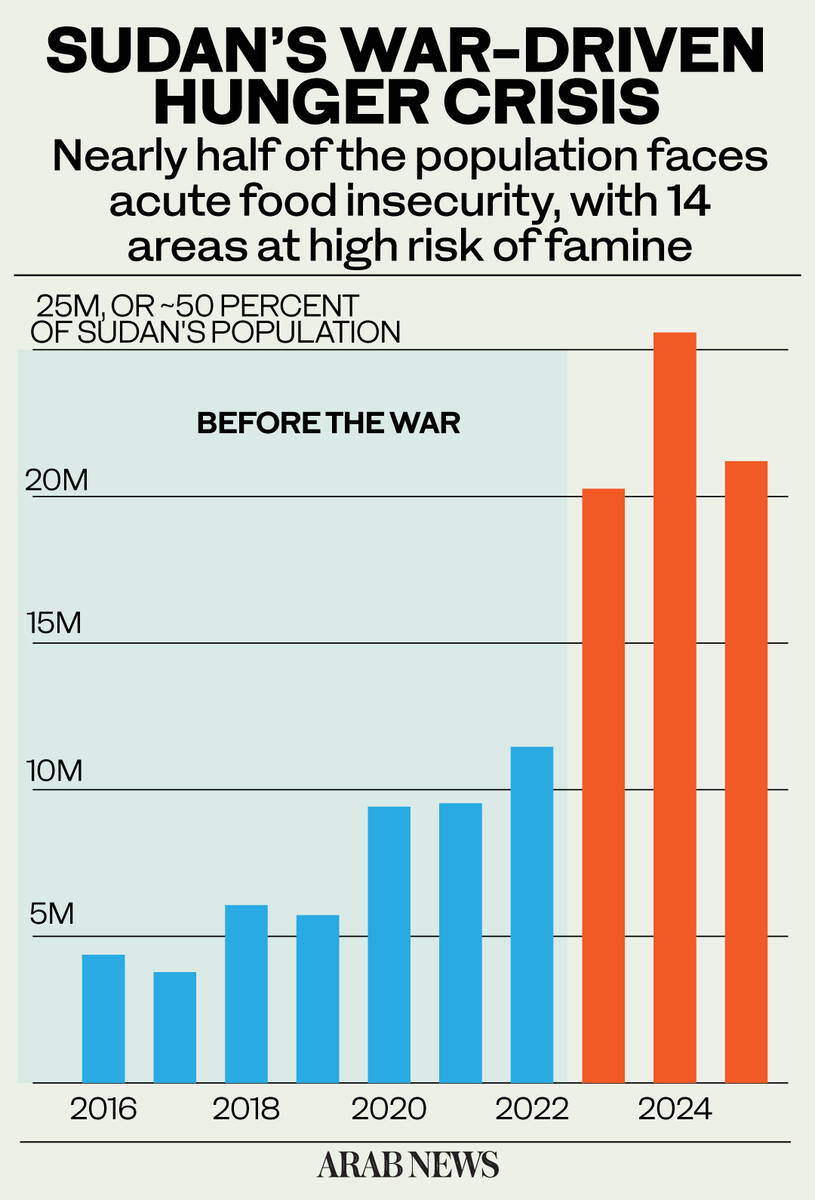
For civilians, however, the stakes are more immediate: whether a truck reaches a market with food, whether a generator has enough fuel to keep essential services running, or whether a water pump can continue operating.
That makes the recent battle for the road significant. It came after 18 months in which El-Obeid was under intense pressure, with its connections to the outside world repeatedly threatened.
“The SAF’s control of the Exports Road alongside the seizure of huge RSF weapons and drone warehouses will enable it to fully consolidate control in North Kordofan and potentially expand towards RSF strongholds in Darfur and West Kordofan,” Ali Mahmoud Ali, Sudan researcher at the Armed Conflict Location and Event Data Project, told Arab News, describing the development as the beginning of a “third phase” of Sudan’s war.
El-Obeid is a major commercial center linking central Sudan with the west. Its markets, hospitals, fuel stations, water systems and humanitarian operations all depend heavily on road access. The SAF’s capture of towns along the route is therefore a significant military gain, but it does not automatically make the highway secure.
Trucks and fuel tankers remain vulnerable to attack, while drones can strike infrastructure far from the conventional front line. For the army, securing the corridor means not only holding the towns along it, but ensuring that supplies can actually move through them.
That distinction is crucial. The SAF has changed the geography of the ground war, but the RSF can still contest the geography of movement. The army may control the highway, while the RSF retains the ability to threaten what travels along it. During the rainy season, when ground movement becomes slower and more difficult, that aerial reach becomes even more valuable.
In Sudan’s fragmented war, control is therefore no longer binary. A road can belong to one side on a military map yet remain effectively closed to civilians. While it can be open to an army convoy, it can be too dangerous for a trader, or carry supplies in the morning and be abandoned by evening after a drone strike.
The scale of the attacks around El-Obeid illustrates the problem. In June, ACLED recorded more than 50 drone strikes across Kordofan, with attacks concentrated around the battle for El-Obeid. Fuel stations and power infrastructure were among the targets.
“As ground offensives shift to the peripheries, both sides are leaning on air and drone strikes to tip the balance, particularly in North Kordofan,” Ali said.
For residents, the result is a new kind of insecurity. Streets can appear relatively normal during the day while people remain alert to drones overhead. Water shortages have forced women to travel farther to collect water, while attacks on water points have made those journeys more dangerous.
The SAF’s advances have also exposed another vulnerability within the RSF’s war effort: its dependence on long logistical networks connecting western bases with areas further east.
“Coupled with a steady trend of RSF fighters defecting to the SAF, these trends point to a significant disruption of the RSF’s supply lines and strike capacity,” Ali said. That disruption could become important if the SAF attempts to build on its gains and move toward Darfur and West Kordofan.
But the battle over Sudan’s supply lines is increasingly spilling beyond its borders.
On Aug. 20, the SAF carried out deep aerial and drone strikes inside northeastern Chad, targeting what it said was a major RSF resupply convoy in the Ennedi-Est region. SAF officials said the convoy, consisting of roughly 200 combat vehicles, was transporting UAE-linked weapons shipments from the Al-Kufra region of southeastern Libya through Chad into Sudan.
The escalation drew concern from Washington and the African Union. US Special Envoy for Sudan Tom Perriello spoke with Chadian President Mahamat Idriss Deby and reiterated that there is “no military solution” to the conflict, while African Union Commission Chairperson Mahmoud Ali Youssouf warned that the incident risked widening the war into a broader regional conflict.
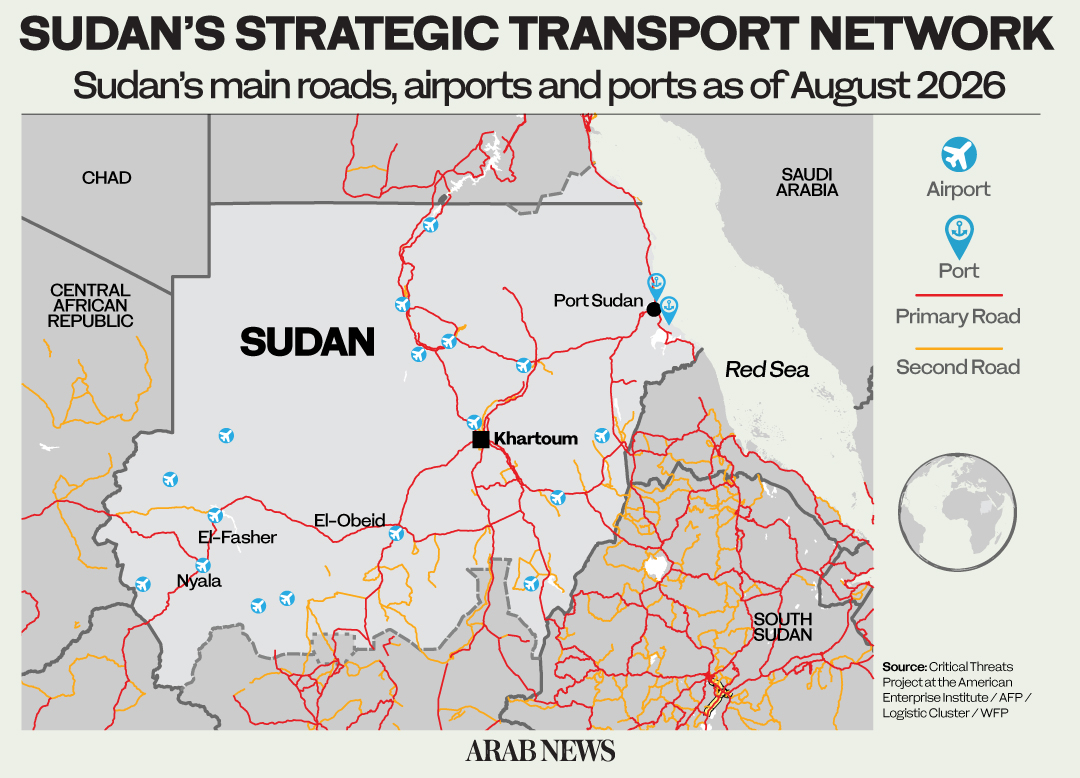
Indeed, the implications of the struggle for control over the Exports Road extend beyond the battlefield. Control of the corridor and the fate of El-Obeid will influence displacement flows across Sudan’s already fragile borders, putting further pressure on neighboring countries, particularly Chad and South Sudan, while creating additional risks for Ethiopia and Egypt.
Prolonged fighting can push more civilians toward borders already struggling to absorb refugees and displaced populations. At the same time, the increasingly contested supply routes linking Libya, Chad, Darfur and Kordofan show how Sudan’s war is becoming entangled with the logistics networks of its neighbors.
The larger strategic risk is that the fighting could help harden a de facto east-west partition of Sudan, with the SAF consolidating the Nile Valley, Khartoum and the east while the RSF retains much of Darfur and parts of western and central Kordofan.
Such a division would not simply freeze the war but could institutionalize rival war economies, leaving gold, arms, fuel and fighters moving through alternative corridors across neighboring countries.
The road’s importance, then, lies in what moves along it and what its control enables. Whoever controls Sudan’s east-west arteries gains greater influence over the movement of resources, people and military supplies — and over the country’s ability to reconnect its fragmented regions.
The SAF may have won important ground, but the harder test is whether it can turn those territorial gains into durable control over movement. If it cannot, Sudan risks emerging not as a country reunified by military advances, but as the center of a wider belt of instability stretching from the Sahel to the Red Sea.