
RIYADH: Saudi Arabia and France have built a cultural relationship that now spans contemporary art, heritage, language, higher education, research, and a growing network of young professionals. What was once largely driven by state-level diplomacy is increasingly being shaped by institutions, creative communities, universities, and informal people-to-people exchanges.
Cultural exchange remains a key pillar of that relationship, extending across heritage, film, museums, fashion, libraries, performing arts, and visual arts.
In January, Saudi Assistant Minister of Culture Rakan Al-Touq and French Ambassador to Saudi Arabia Patrick Maisonnave reviewed ongoing cooperation in Diriyah, covering projects in heritage, film, culinary arts, libraries, joint exhibitions, and professional training. That same month, Al-Touq met Centre Pompidou President Laurent Le Bon in Diriyah to discuss art loans and exhibition exchanges with the Museums Commission.
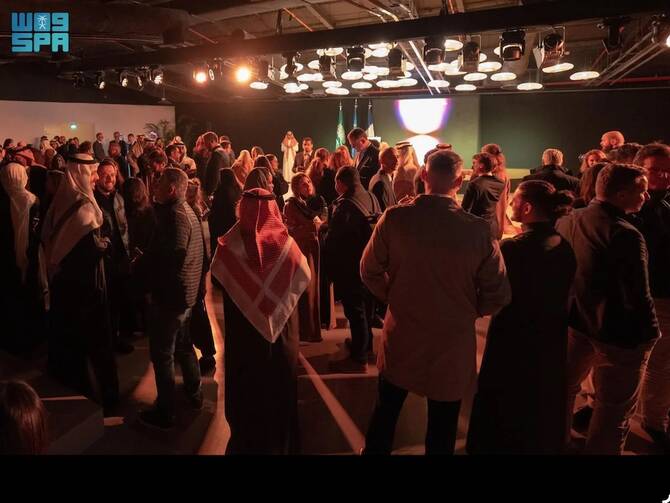
A recent example of this evolving relationship is La Fabrique, a Saudi-French cultural platform launched in January by Riyadh Art and the Institut français in Saudi Arabia at the JAX District.
Bringing practitioners together across performance, digital art, photography, music, and cinema, La Fabrique was designed as a co-creative laboratory. Maisonnave described it as a new phase in bilateral cooperation: “By bringing our artists together, we are not only sharing techniques and traditions, we are opening a space where imaginations meet, new forms emerge, and creativity becomes a bridge between our two societies.”

As part of this intercultural exchange, language remains a key channel of communication. On July 14, 2020, coinciding with France’s National Day, Arab News launched its French edition to strengthen links between Arab and Francophone audiences. Francophonie has remained one of the most visible people-to-people connections between the two nations.
The Organisation Internationale de la Francophonie estimates there are 396 million French speakers worldwide, with around 170 million people learning or studying in the language.
In Saudi Arabia, interest in French is visible in formal education as well as informal community spaces. In Riyadh, Cafe en Francais has become a regular meeting point for cultural exchange. Founded in January 2019, the initiative brings together Saudis and French speakers for weekly conversations, extending engagement beyond classrooms into social interactions.
This exchange is reciprocal. The King Salman Global Academy for Arabic Language ran a month-long Arabic program in Paris, Lyon, and Tourcoing from Oct. 7 to Nov. 1, 2024, working with educational institutions to support teachers and strengthen Arabic’s presence in France.
Educational links provide another route into academic and professional exchange. French Consul General in Jeddah Mohammed Nehad said in January that between 1,000 and 1,200 Saudi students travel to France to study annually, excluding language learners. His remarks came during an exhibition at the University of Business and Technology in Jeddah, where 15 French universities presented academic opportunities.
In January, Princess Nourah bint Abdulrahman University in Riyadh hosted a Saudi-French universities roundtable involving representatives from approximately 55 Saudi and French universities, alongside Campus France, focusing on research cooperation, innovation, and knowledge exchange.
Intercultural exchange is also expanding through professional networks like the French Saudi Youth Business Club, founded in Paris in 2022 and later launched in Riyadh to connect young entrepreneurs across innovation, technology, tourism, sustainability, and culture.
The club publishes the bilingual Odyssee Arabia magazine, emphasizing youth creativity and connection. This year, the club held its third networking gathering at the Institut du Monde Arabe in Paris under the theme “France 2030 & Vision 2030,” linking the two countries’ transformation agendas.
These networks sit alongside established institutional cooperation. A major milestone came in April 2018, when Saudi Arabia and France signed an intergovernmental agreement for the sustainable development of AlUla, leading to the creation of the French Agency for AlUla Development alongside the Royal Commission for AlUla.
Over time, cooperation expanded from archaeology into academic research and postgraduate training. That evolution is reflected in the career of Abdulrahman Alsuhaibani, vice president of culture at RCU, who was recently named a Chevalier de l’Ordre des Arts et des Lettres by the French government.
Alsuhaibani, who earned his PhD in archaeology at Sorbonne University, viewed the distinction as a reflection of the “enduring friendship and growing cultural partnership between France and Saudi Arabia.” Through RCU, he highlighted ongoing cooperation with partners including AFALULA, Centre Pompidou, CNRS, and Sorbonne University.
Further academic partnership is visible in the Jaussen & Savignac Programme, jointly run by Paris 1 Pantheon-Sorbonne University and RCU. Earlier this year, the program opened five three-year doctoral positions beginning in September 2026, focusing on environmental heritage, oasis landscapes, archaeology, and conservation.
Creative industries are also becoming increasingly prominent. The Institut Francais and Business France launched the second edition of ICC Immersion Saudi Arabia this year to connect French cultural companies with the Kingdom’s creative ecosystem through remote preparation and an intensive local immersion.
These initiatives show how culture is no longer confined to heritage preservation but is intersecting with entrepreneurship, design, technology, and the creative economy.
It can be seen in major institutional partnerships, an artist working alongside an international counterpart, an archaeologist building a research career between Riyadh and Paris, a student choosing a French university, or French and Arabic speakers learning each other’s languages. Together, these connections give the Saudi-French relationship a presence beyond formal diplomacy — rooted in cultural production and knowledge exchange.