



PARIS: Long perceived as a secondary field, or even as something separate from major economic and geopolitical issues, culture has now become one of the driving forces behind Saudi Arabia’s transformation.
At the heart of Vision 2030, it is accompanying a profound transformation of the Kingdom and contributing to the construction of a new national identity, one that is increasingly open to the world.
Within this dynamic, France occupies a distinctive position. From cooperation around AlUla and artist residencies at Villa Hegra to the establishment of the Esports World Cup in Paris, initiatives are multiplying and shaping the contours of a cultural partnership that is set to grow.
For Louis Blin, a diplomat and specialist in the Arab world, this evolution should not be reduced to the spectacular rise of the entertainment sector alone.
Video games, cinema, music, heritage, contemporary arts and artistic creation are all part of the same movement: that of a Saudi Arabia seeking to combine international openness with an affirmation of its roots.

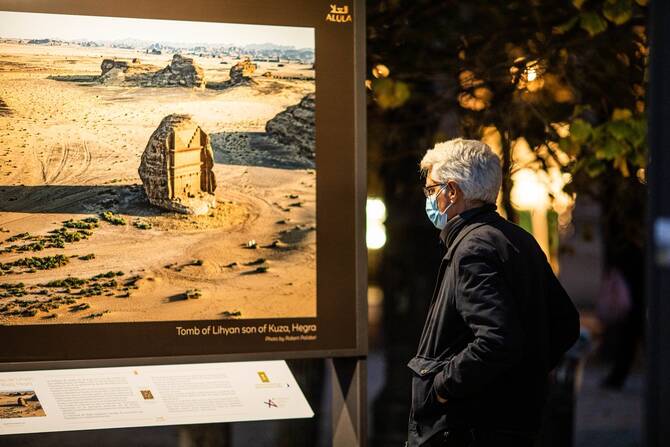
Franco-Saudi cooperation there brings together heritage restoration, archaeology, cultural tourism, contemporary creation and the development of an international artistic ecosystem. (Supplied)
“We tend to separate the economy from culture,” observes Blin, author of several books on Islam and Arabia, where he has served. Yet, he points out, France itself demonstrates the extent to which cultural industries can constitute a major economic sector.
Video games are one of the most emblematic examples. It is precisely around this industry that the two countries are now coming together, notably through the EWC, whose presence in Paris represents a new symbol of this convergence.
But this Franco-Saudi cultural encounter did not begin with the EWC. It has been built progressively around a number of major projects, among which the cultural and heritage development of AlUla occupies a central place.
Franco-Saudi cooperation there brings together heritage restoration, archaeology, cultural tourism, contemporary creation and the development of an international artistic ecosystem.
Nearby, Villa Hegra has become another laboratory for this relationship, hosting artist residencies and providing creators with a space for dialogue with the heritage and landscapes of AlUla.

From the heritage of AlUla to the artists of Villa Hegra, the emerging dynamic is that of a Saudi Arabia that now intends to make culture a universal language. (Supplied)
The EWC now brings a new dimension to this cooperation, and the choice of Paris reflects the ambition to make the event far more than an international video game competition.
It illustrates the growing place of entertainment in Saudi Arabia’s strategy of influence and its desire to bring the two societies closer together through shared cultural practices.
This strategy also responds to an identity challenge, as Saudi Arabia’s transformation is, according to Blin, taking place within the broader context of globalization.
After decades during which “the affirmation of authenticity was sometimes associated with the rejection of certain forms of cultural diversity,” the Kingdom is seeking, in Blin’s view, to build “a national identity capable of opening itself to the world without renouncing its heritage.”
But for him, the difficulty lies precisely in maintaining this balance, since the objective would not be to import a foreign culture, but rather to “build something new from the old.”
This, he continues, “means rediscovering and valuing a heritage that is far broader than purely religious references, such as pre-Islamic heritage, the history of the Hijaz, or the traditions of Asir.
“We have to restore our brains, because otherwise we will never be able to restore the stones,” he says, explaining that cultural transformation cannot be solely material, but also requires a shift in mindsets, “a reclaiming of heritage and the emergence of a new generation of artists.”

Franco-Saudi cooperation there brings together heritage restoration, archaeology, cultural tourism, contemporary creation and the development of an international artistic ecosystem. (Supplied)
It is here, in Blin’s view, that cooperation with France takes on its full meaning, as the country has extensive experience in heritage, artistic expression and cultural industries.
Saudi Arabia, for its part, has an exceptional heritage and considerable political and financial will to promote it. “Their rapprochement can thus produce an original model, based on encounter rather than imitation.”
Culture is therefore becoming a powerful tool for transforming the Kingdom’s image, as video games, for example, provide a particularly effective platform for engagement with French society. When two countries share the same passions, the same artists and the same cultural experiences, perceptions naturally evolve.

Louis Blin
For Blin, the challenge extends well beyond the deadline set by Vision 2030. The year “2030 is a mobilizing date,” he said, but “cultural transformation is set to continue well beyond it.”
And contrary to a commonly held view, Blin considers that “this transformation would not be solely the work of the crown prince; he would above all have accompanied an aspiration that was already present in society.
“He did not create the wave, society did,” Blin said, emphasizing in particular the role of young people and women.
From the heritage of AlUla to the artists of Villa Hegra, and through to the globalized world of the EWC, the emerging dynamic is that of a Saudi Arabia that now intends to make culture a universal language, capable of telling the world a new story about the Kingdom.


