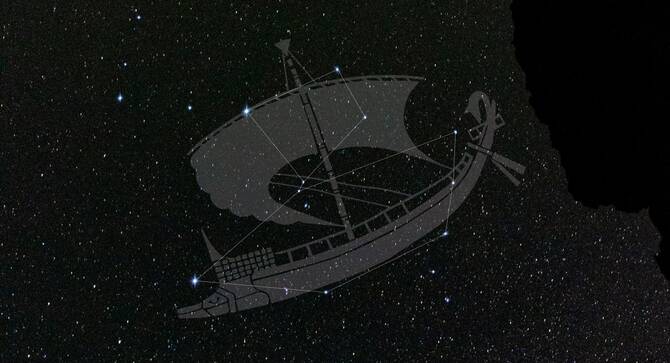

RIYADH: With Christopher Nolan's highly anticipated “The Odyssey” in cinemas this summer, visitors to AlUla can enjoy an interpretive asterism depicting the Greek hero’s legendary ship and experience one of mythology’s greatest adventures beneath some of the world’s clearest night skies.
The Odysseus figure is an interpretive asterism, a recognizable pattern formed by selected stars.
Unlike the 88 official constellations defined by the International Astronomical Union, asterisms are informal star patterns created by cultures around the world throughout history for navigation, storytelling and cultural expression.
Continuing this tradition, the Odysseus asterism uses 10 stars to depict Odysseus aboard his ship, symbolizing his 10-year journey home following the Trojan War.
The location of the Odysseus asterism was carefully chosen to reflect Homer’s original tale. The selected sky region includes Bootes, one of the celestial figures explicitly observed and referenced during Odysseus’ voyage home.
The neighboring constellations of Hercules and Corona Borealis reinforce the broader Greek mythological setting and provide a visually compelling framework for the contemporary asterism.
For millennia, the night sky has guided travelers, inspired storytellers and connected civilizations. Today, visitors to AlUla can experience that tradition through stargazing experiences where astronomy, heritage and storytelling come together beneath some of the world’s most pristine dark skies.

The Odysseus asterism uses 10 stars to depict Odysseus aboard his ship, symbolising his 10-year journey home following the Trojan War. (Supplied/Saeed Baghdadi)
Inspired by renewed global interest in “The Odyssey,” the interpretive asterism offers visitors a fresh way to engage with one of mythology’s most enduring tales, transforming the night sky into a shared experience of exploration, discovery and imagination.
Astrophotographer Saeed Baghdadi said: “One of the most fascinating aspects of astrophotography is its ability to connect people with stories that transcend generations. In AlUla, the combination of pristine dark skies and rich cultural heritage creates the perfect setting for that. Capturing the Odysseus asterism was a reminder that the night sky remains one of humanity’s greatest canvases for imagination, discovery and wonder.”
As access to naturally dark skies becomes increasingly limited around the world, AlUla provides a rare setting where visitors can observe the stars with exceptional clarity and reconnect with one of humanity’s oldest relationships with the night sky.
Visible throughout the Northern Hemisphere during summer and until September, the Odysseus asterism is best observed shortly after sunset. Visitors can join guided experiences offered by local operators and resorts to discover the formation alongside constellations, navigation techniques and stories that have shaped cultures for thousands of years.
AlUla’s commitment to astrotourism will continue with the opening of AlUla Manara, a landmark astronomy destination designed by Heatherwick Studio. Located within one of the world’s largest Dark Sky Parks, it will combine immersive visitor experiences, scientific research and education.
AlUla encompasses more than 6,000 sq. km of internationally recognized Dark Sky Parks, making it the world’s third-largest protected dark-sky area. Spanning AlUla Manara, Al-Gharameel Nature Reserve, Sharaan National Park and Wadi Nakhlah Nature Reserve, these landscapes are safeguarded under AlUla’s Dark Sky Policy. With skies ranked among the darkest 5 percent globally, AlUla is one of the world’s leading destinations for astronomy and stargazing.