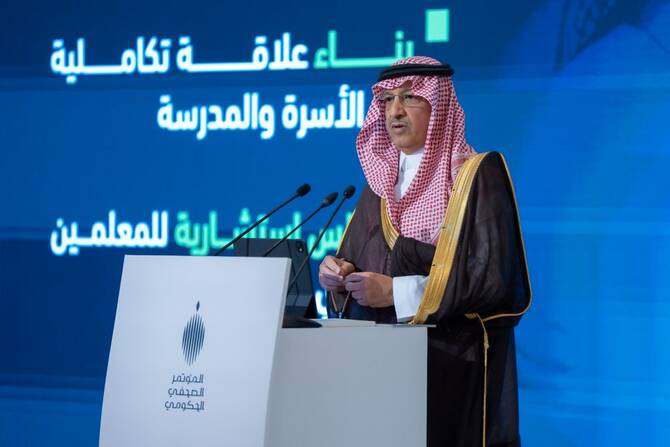
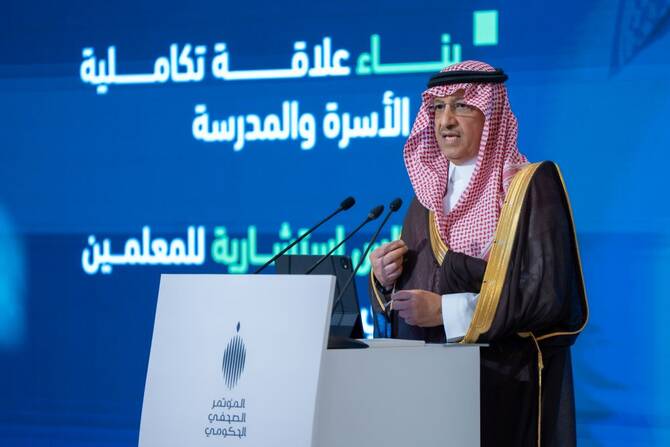

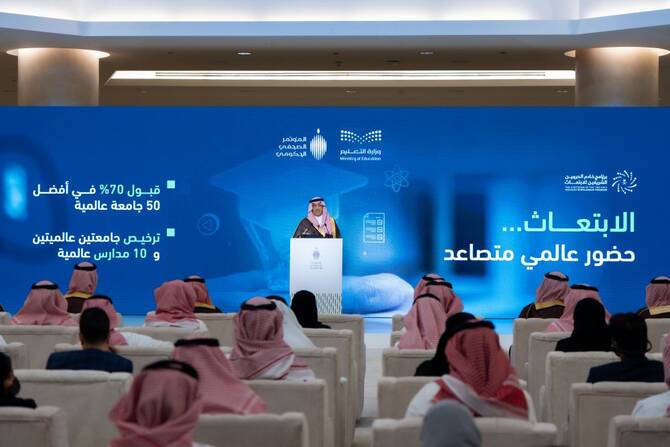
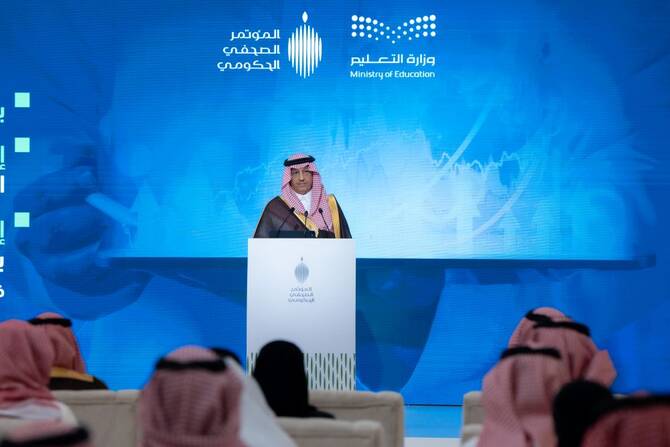

RIYADH: Key education reforms for the coming school year in Saudi Arabia include a strict ban on educators teaching outside their specializations; the introduction of AI tools to ease administrative workloads; the promotion of more than 37,000 educational and administrative staff; and working hours for teachers based on the individual needs of each school, rather than a single, standard workday.
Unveiling the plans at Princess Nourah University on Monday, the Saudi minister of education, Yousef Al-Benyan, said: “The teacher is a fundamental pillar in education.
“The approval of the General Education System is a continuation of the government's approach in supporting the education ecosystem and ensuring the ongoing development of education.”
The core principles of the education system, he added, include “preserving and committing to our religious values and national identity, as well as taking pride in and highlighting the Kingdom’s history and symbols, and preserving and mastering the Arabic language and taking pride in it.
“Through this system, we also enable quality service for the most important element, which is the student, empowering them and looking after them through their rights and responsibilities.”
Al-Benyan highlighted the Ministry of Education’s continual efforts to raise the quality of education, and the global competitiveness of students, in line with the goals and benchmarks of Saudi Vision 2030, the national plan for development and diversification.
In early childhood education, he said the ministry aimed to increase the enrollment rate from 35 percent to 90 percent by the end of 2030, as part of wider efforts to enhance the quality of early-stage education. He also described ways in which educators will be supported through training and development programs, in partnership with government agencies.
“There is a training, development and professional plan for teachers, which is considered one of the largest training and professional plans for the education ecosystem,” Al-Benyan said.
“Through the Human Capability Development Program initiative, more than 240,000 male and female teachers will be trained. During the past year, 60,000 from this batch were trained, and the goal is the professional development of all education staff across different stages.”
One of the biggest announcements about the day-to-day work of teachers was a revision of the “Hudoori” mechanism, a smart attendance-monitoring system that tracks and manages check-in and check-out times for teachers and other school staff.
Under the new system, working hours will be based on the needs of each individual school’s daily schedule and operational plan, rather than a single, standard start and end to the school day. In other words, once teachers complete all their scheduled duties, including lessons, grading and campus supervision, according to the school’s timetable, they will be free to go home.
The ministry also said that “a teacher shall not teach a subject in which they are not specialized, ensuring the student’s right” to quality education.
Regarding professional advancement, Al-Benyan said: “The Ministry of Education is also looking to carry out promotions in the next month; promotions will be issued for more than 28,000 educational staff, and 9,500 promotions for administrative staff will be issued as well,”
With 2026 designated the “Year of Artificial Intelligence” in Saudi Arabia, the ministry said it had made significant efforts to implement AI technology across the educational landscape. This included a technical experiment that aims to reduce the operational and administrative burdens on teachers and students through strategic partnerships with the Saudi Authority for Data and Artificial Intelligence, and the Saudi AI company Humain.
“Artificial intelligence (will) assist teachers, allowing them to focus on their role and follow up on students’ needs,” Al-Benyan said.
In addition, 36 million textbooks were delivered to schools before the summer break in an effort to enhance the quality of the curriculum, he added.
“Over the past three years, the curricula or textbooks used to reach schools two weeks before the start of the academic year,” Al-Benyan said.
“This year, through working with the Tatweer company and improving supply chains, more than 36 million books reached schools before the start of this year’s school summer. Among them, 60,000 books reached the homes of” students, in cooperation with the Saudi postal service, SPL.
He added: “This is an initiative through which we aim to improve the quality of service for students and their parents.”
In terms of educational achievements in the Kingdom, the ministry said 4,000 teachers had been trained to identify gifted students, and more than 45,000 students had enrolled in specialized schools for the gifted.
In addition, 72 teachers in Saudi Arabia received local and international awards last year, students won more than 400 local and international awards, and about 70 percent of Saudi scholarship students had been accepted to study in the top 50 international universities, Al-Benyan said.
“I bet on teachers in the Kingdom,” he added.