

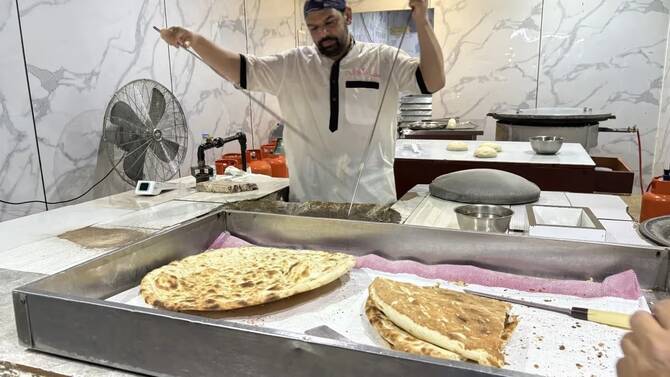

RIYADH: For years, the price of a loaf of tamees bread in Saudi Arabia remained fixed at SR1 ($0.27), becoming part of the Kingdom’s cultural memory and immortalized in a line of poetry: “If your only concern in life is your daily bread, beans are SR2 and bread is SR1.”
But this equation has recently changed. The bread, which withstood waves of inflation for decades, has begun to leave the “one riyal club” after most bakeries across Saudi Arabia raised prices by 50 percent to 100 percent, driven by higher operating costs.
A field survey conducted by reporters from Al-Eqtisadiah newspaper revealed that the price of tamees bread has risen in most bakeries, from SR1 to SR1.5 or even SR2 in some shops. In contrast, a few bakeries have kept the price unchanged so far.
Gas price hike increased operating costs
Bakery owners who spoke to Al-Eqtisadiah newspaper said they tried to keep prices as stable as possible, especially for traditional tamees bread. However, the increase in gas cylinder prices at the beginning of July to SR37, compared to SR26 previously, increased operating costs, prompting some to raise prices.
Bakery owners in Riyadh, Taif, Jeddah, and Najran who increased the price of bread told Al-Eqtisadiah that keeping the price of tamees unchanged remained a priority because it is their best-selling product and the main reason customers visit their bakeries.
Over the past few years, bakeries have introduced higher-value products with stronger profit margins to offset rising operating costs. They sought to adapt to the fixed price of tamees bread at SR1 by diversifying their offerings. They introduced varieties with additions such as cheese, sesame, and za’atar, in addition to what is known as “biscuit” bread. These products are sold at prices ranging from SR2 to SR10. At the same time, they maintained the price of the basic product at SR1 to retain their customer base.
Tamees, a popular bread commonly found at breakfast and dinner tables, is made from either white or whole wheat flour. It originated in the Makkah region and then spread throughout the Kingdom.
It is believed that tamees originated in Central Asia and is related to Afghan bread. It was brought to Saudi Arabia by pilgrims performing Hajj and Umrah and has since become a staple of Saudi cuisine, particularly in cities like Riyadh, Makkah, Madinah, and Jeddah.
Bakeries consume 5 gas cylinders daily
Bakery workers, most of whom are Afghan and Pakistani, explained that bakeries consume an average of four to five gas cylinders daily, resulting in additional costs of up to SR2,000 per month. Bakeries also consume a similar number of flour sacks, as ovens operate for around 12 hours a day, even during periods of low demand and when there are no customers, to maintain a high oven temperature.
Iqbal, a bakery worker, said that any shop with less than SR1,000 in daily revenue is considered to be operating at a loss. He pointed out that the cost of raw materials alone reaches about SR500 per day, including flour, oil, and gas.
Tamees is a traditional flatbread popular across Saudi Arabia, known for its high carbohydrate content and relatively high calorie count. It is baked in a clay oven known as a tanour, where flattened dough is pressed against the hot inner walls until it puffs up and develops a crisp, golden crust. The bread is typically made from wheat flour, water, yeast, salt, and a small amount of sugar.
Iqbal added that a 40-kilogram bag of flour costs about SR31 and produces between 80 and 120 pieces of dough. He noted that the bakery where he works consumes between four and five pallets daily, equivalent to around 1,200 loaves of dough, which is the average for most bakeries. Daily production ranges between 1,000 and 2,000 pieces of dough.
Rashid Khan, who works at a bakery in Taif, confirmed his colleagues’ statements, explaining that peak demand for tamees bread occurs during the early morning hours. The dough is prepared in advance and placed in trays for fermentation.
For his part, Luqman, who works at a tamees bakery east of Riyadh, confirmed that the rise in gas prices was not the only reason behind the increase in the price of tamees bread. He pointed out that the costs of several operating supplies also increased, contributing to higher production costs and consequently, a higher price per loaf.
He explained that the bakery tries to compensate for the lower profit margin on regular tamees bread by selling other varieties, such as cheese tamees and ghee tamees, which generate higher margins than traditional tamees.


