

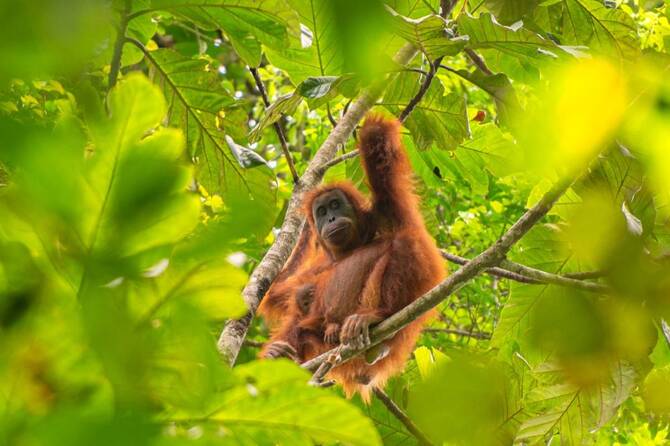

JAKARTA: Landslides driven by climate change in Sumatra, Indonesia last year alone wiped out 7 percent of the Tapanuli orangutan population, new research shows, as scientists warn of an increased risk of extinction for one of the world’s rarest great apes.
Cyclone Senyar ravaged northern Sumatra in November, causing catastrophic floods and landslides that killed more than 1,200 people and damaged more than 180,000 houses in three provinces, with environmental groups blaming the extent of the damage on rapid deforestation.
At least 58 Tapanuli orangutans, out of a total population of fewer than 800, were killed in the widespread landslides, according to findings published in the scientific journal Current Biology on Wednesday.
“Our findings provide quantitative evidence that extreme rainfall events can directly threaten great ape survival,” the study authors said.
“Given the species’ slow reproduction and sensitivity to additional mortality, this single event constitutes a severe demographic shock with long-term implications for its viability.”
Scientists analyzed satellite evidence of landslide scars in the Batang Toru region of North Sumatra — home to the critically endangered Tapanuli orangutans — and found that about 8,300 hectares were affected by the extreme weather in November.
The orangutans are likely to have died from tree falls, landslide burial or drowning that occurred during the multi-day deluge.
Yet the study provided only “conservative” estimates, the authors said, as they analyzed only landslides that took place in the western area of Batang Toru and did not include other possible causes of death, such as reduced food availability or rainfall-induced canopy breakage.
Studies have indicated that the species, which was only discovered in 2017, will go extinct if it continues to lose more than 1 percent of its population annually.
“This study is a stark demonstration of how intertwined the crises of climate change and biodiversity loss are,” Friederike Otto, an author on the study and a professor of climate science at Imperial College London, said in a statement.
“Human-induced climate change turned a severe tropical storm into a catastrophic trigger for these tragic landslides.”
Researchers had previously found that human-induced climate change caused an increase of 10 to 50 percent in Cyclone Senyar’s rainfall intensity.
The study published this week also shows an urgent need for conservation action, said Jatna Supriatna, an author of the study and a professor of biology at Universitas Indonesia.
“To prevent the first modern extinction of a great ape species, Indonesia must permanently protect the Batang Toru ecosystem,” he said.
“But our international partners must also meet their global commitments by providing immediate biodiversity-recovery financing.”


