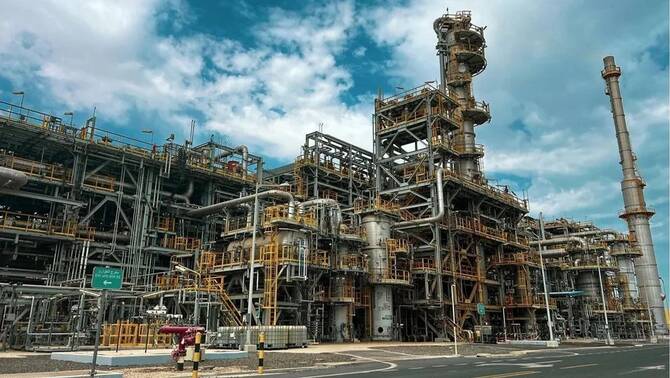

RIYADH: The Vice Chairman and CEO of the Kuwait Petroleum Corp., Nawaf Al-Sabah, stated that Kuwait has the capacity to restore 80 percent of its oil production, which was halted due to the Iran war, in less than a month. The remaining 20 percent will require three to four months to be brought back online.
The conflict in the region has severely impacted Kuwait’s oil sector, resulting in the second-largest production decline in the region after Iran. Bloomberg reported that the Gulf state’s production fell by 310,000 barrels per day to 490,000 bpd, less than one-fifth of pre-war levels.
During a panel discussion on the sidelines of the Atlantic Council’s Global Energy Forum in Washington, D.C., Al-Sabah noted that Kuwait had deliberately and systematically reduced its production levels at the beginning of the war to the minimum necessary to meet domestic consumption. Some refined products were then directed to Gulf markets, and he pointed out that buying and selling within the region continued, creating what could be termed a “mini-economy.”
He said: “We are now building on this experience, recognizing the new reality, and addressing the challenges through a collective vision across the Gulf Cooperation Council,” adding that “discussions are underway with officials in Saudi Arabia and the UAE to explore how to expand their pipeline systems to accommodate Kuwaiti oil exports.”
The Saudi oil pipeline, which crosses the country to the Red Sea coast, is the main artery for crude oil, providing capacity for up to 70 percent of the Kingdom’s regular exports.
Amin Nasser, CEO of Saudi Aramco, stated last month that the Kingdom is exploring ways to expand export capacity at its ports on the west coast. He did not mention expanding the pipeline’s capacity.
The UAE has a pipeline running from the desert oil fields of Abu Dhabi to the port of Fujairah, outside the Strait of Hormuz. The UAE’s ADNOC is constructing another crude oil pipeline to double its export capacity and is considering connecting it to another pipeline for transporting refined products.
Not the highest in history
In a related context, Al-Sabah pointed out that current oil prices are not among the highest in history when adjusted for inflation. He noted that the market has witnessed prices significantly higher in real terms in the past, even if the current level appears high in nominal terms.
The Iran-Iraq War and the subsequent near-complete halt to shipping in the Strait of Hormuz, through which 20 percent of the world’s oil shipments pass, caused prices to surge to over $140 per barrel, up from around $60 before the war.
Over the past three months, prices have fluctuated sharply in response to news of the conflict, currently stabilizing around $91 per barrel amid hopes for an agreement to end the war and restore normal traffic flow in the strait.
Al-Sabah added that the current market stability is largely due to temporary factors, including the release of strategic reserves by several major countries, as well as a slowdown in global demand. These factors have helped to moderate prices but do not represent permanent or sustainable long-term solutions.