- Meeting highlights deep divide within the council over legitimacy of sanctions reimposed last year as a result of noncompliance by Iran with its nuclear commitments
- 8 nations urge UN members to implement sanctions, citing International Atomic Energy Agency report that Iran has 10 times amount of partially enriched uranium needed for a weapon
NEW YORK CITY: Arab and Western powers issued a joint warning on Tuesday over Iran’s nuclear program, in which they called on all UN member states to fully implement recently reinstated Security Council sanctions against Iran.
France’s ambassador to the UN, Jerome Bonnafont, read the statement on behalf of delegations from his country, the UK, the US, Bahrain, Denmark, Greece, Latvia and the UAE.
It came ahead of a meeting of the Security Council, convened under the “Non-Proliferation” agenda, to discuss the status of the 1737 Sanctions Committee, the body tasked with overseeing the UN’s sanctions architecture against Tehran, and the broader question of whether sanctions on Iran remain in force following the expiration of Resolution 2231 in October 2025.
Resolution 2231 endorsed the 2015 Iran nuclear deal, more formally known as the Joint Comprehensive Plan of Action, under which Iran agreed to limit its nuclear research and enrichment activity in return for sanctions relief.
Tuesday’s session highlighted a deep divide within the council, with the US, UK, France and some other members maintaining that sanctions had been legally reimposed last year through a “snapback” mechanism built into the nuclear deal, which was triggered as a result of noncompliance by Iran with its nuclear commitments.
Iran, China and Russia argued that Resolution 2231 and all related sanctions provisions had expired, leaving no legal basis for the work of the 1737 Sanctions Committee or continuing consideration by the council of Iran’s nuclear program.
Against the backdrop of ongoing regional tensions and stalled diplomatic efforts over Iran’s nuclear program, council members used the meeting to restate their competing interpretations of international law, sanctions enforcement, and nonproliferation obligations.
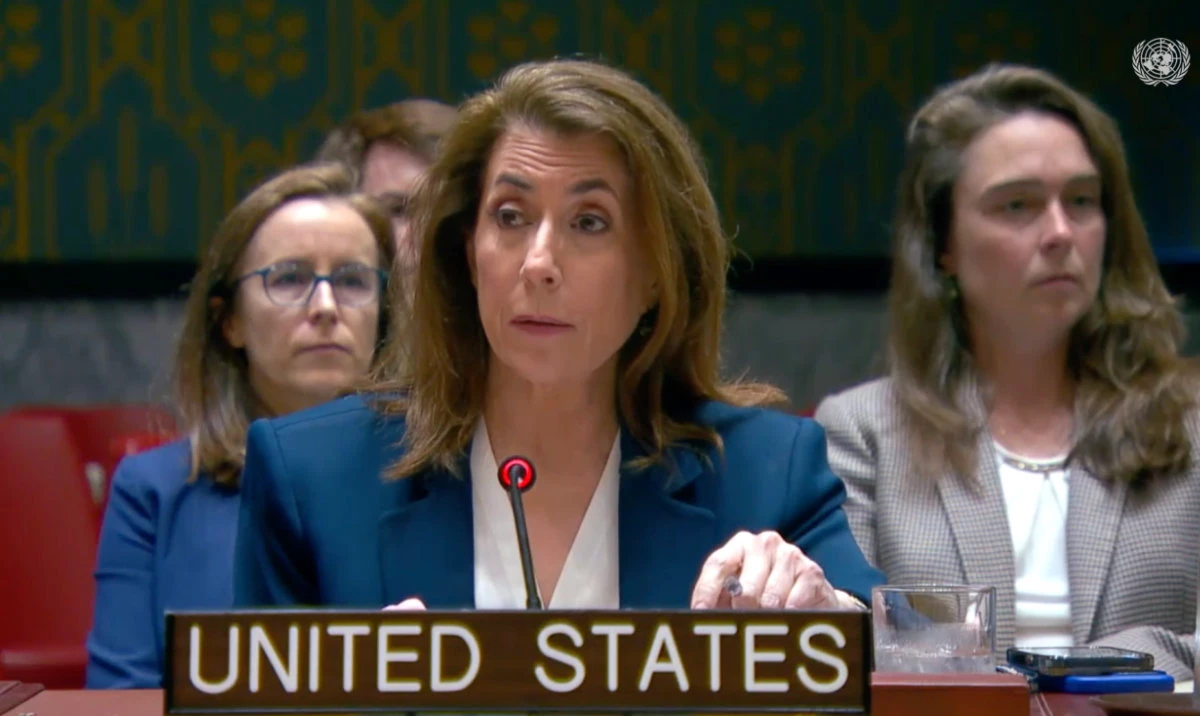
The deputy US representative, Tammy Bruce, accused Iran of continued noncompliance with its nuclear and non-proliferation obligations. She argued that international inspectors have been unable to verify key aspects of Iran’s nuclear activities, and alleged that Tehran had violated its nuclear safeguards commitments as well as several Security Council resolutions.
She also linked Iran’s ballistic missile program to instability in the region on the grounds that it had enabled attacks by Tehran and affiliated groups against civilian targets across the Middle East in recent months.
Bruce further accused Iran of breaching UN restrictions on arms exports and of supplying conventional weapons to groups beyond its borders.
“Iran has not only continued to violate its safeguards agreement, and sustained its ballistic missile programs in defiance of council resolutions, but it has violated a UN prohibition on the exports of Iranian weapons,” she told the council.
Tehran had “proliferated conventional capabilities around the world, including in many cases to nonstate actors,” she added.
Diplomatic sources told Arab News that Iran did not attend the Tuesday’s Security Council meeting because Tehran does not recognize the 1737 Sanctions Committee, and therefore the legitimacy of a meeting to discuss its work.
In a message posted on social media platform X, Iran’s mission to the UN rejected the discussions during the council meeting as politically motivated and driven by what it described as US-led efforts to revive allegations about its nuclear activities.
Representatives of Iran argued that the expiration of UN Security Council Resolution 2231 ended all related mandates and mechanisms, leaving no legal basis for further council meetings about Iran under the nonproliferation agenda.
Tehran characterized Tuesday’s session as a misuse of Security Council authority and part of a broader campaign to misrepresent the nature of its nuclear program. It maintained that it has remained a committed party to the Nuclear Non-Proliferation Treaty for more than five decades and has never pursued possession of nuclear weapons.
According to Tehran, the current tensions stem from the withdrawal of the US from the Joint Comprehensive Plan of Action in 2018, the failure of European signatories to meet their commitments under the nuclear deal, and the recent US and Israeli military strikes against Iranian nuclear facilities that were subject to international safeguards.
Iran argued that it is actions such as these, rather than its own conduct, that pose the greatest challenge to the global non-proliferation regime.
The 1737 Committee was established by Security Council Resolution 1737 on Dec. 23, 2006, after Iran failed to halt its uranium-enrichment program. Its mandate covered sanctions, including asset freezes and technology transfer bans, that target individuals and organizations in Iran involved in proliferation-sensitive nuclear activities or the development of delivery systems for nuclear weapons. The scope was expanded under subsequent resolutions.
The committee had effectively gone dormant following the 2015 Iran nuclear deal with the US, UK, France, Russia, China and Germany, more formally known as the Joint Comprehensive Plan of Action, under which prior sanctions resolutions were suspended.
However, the committee reentered the diplomatic arena in August 2025 when France, Germany and the UK triggered a “snapback” mechanism within the nuclear deal, over noncompliance by Iran with its nuclear commitments, that reimposed the sanctions. The US, under President Donald Trump, had withdrawn from the nuclear deal in May 2018.
In their statement on Tuesday, the eight member state delegations cited the latest quarterly report from the International Atomic Energy Agency as cause for serious alarm. It noted that Iran remains the only state without nuclear weapons that has enriched uranium to 60 percent purity, and has stockpiled over 400 kilograms at that level, which is more than ten times the IAEA’s “significant quantity,” the agency’s benchmark beyond which it cannot exclude the possibility that nuclear material could be used to manufacture a weapon.
The statement also highlighted the fact that IAEA inspectors have not set foot in Iran’s most proliferation-sensitive nuclear facilities in over a year, and the agency was therefore unable to confirm that the program is exclusively peaceful in nature.
Regarding the sanctions architecture, the delegations recalled the triggering of the snapback mechanism on Aug. 28, last year, followed by a Security Council vote on Sept. 19 that rejected a resolution calling for the continuation of sanctions relief for Iran, and then the completion of the process on Sept. 27 when the council reinstated six previously lifted resolutions targeting Iran’s nuclear program with sanctions. Those resolutions, they said, are legally binding on all member states under the UN Charter.
Russia and China continue to contest the validity of the snapback mechanism, blocking the work of the committee, a position that Washington and its European allies argue only confirms that the committee exists and is functional.
The joint statement called for the prompt appointment of a chairperson to the 1737 Committee, and the immediate appointment of a panel of experts to monitor the implementation of sanctions, investigate any violations and identify evasion trends. These roles are critical to the effectiveness of the sanctions regime, the signatories said.
The delegations reaffirmed their commitment to achieving a diplomatic resolution, and said only a credible, robust and verifiable agreement can guarantee that Iran would never seek, acquire or develop a nuclear weapon.