

Trump tells UN Security Council Iran must never gain a nuclear weapon

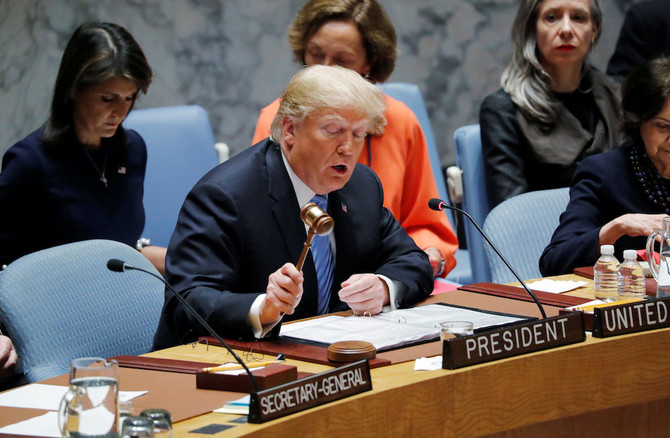
Donald Trump opened the UN Security Council meeting by outlining the threat posed by Iran. (Reuters)
Updated 27 September 2018
Follow

Trump tells UN Security Council Iran must never gain a nuclear weapon

  • US president chairs UN Security Council meeting on non-proliferation of weapons of mass destruction
  • Iran, along with Russia, enable President Bashar Al-Assad to carry out "butchery" in Syria

NEW YORK: Donald Trump on Wednesday warned against Iran's pursuit of a nuclear weapon. as he chaired a United Nations Security Council meeting for the first time.

A government with Iran's track record "must never be allowed to obtain" a nuclear weapon, the US president said as he addressed the meeting in New York.

Trump said Iran had stepped up its "aggression" after signing a nuclear accord in 2015, saying Tehran took advantage of a lifting of sanctions to fund a missile program.

"In the years since the deal was signed, Iran's aggression only increased," Trump said. "The regime used new funds from the deal to support terrorism, build nuclear capable missiles and foment chaos."

The meeting piled more pressure on Tehran, a day after the US president used his UN General Assembly speech to accuse Iran of sowing "chaos, death and destruction.”

Washington has moved to isolate Iran after pulling out of the 2015 deal to curb Tehran’s nuclear program in exchange for a reduction in crippling international sanctions against the country.

Trump also accused Iran, along with Russia, of enabling President Bashar Al-Assad to carry out his "butchery" in Syria.

The meeting was attended by many heads of state in New York for the UN General Assembly, including European leaders trying to keep the Iran nuclear deal alive after Trump announced America's withdrawal earlier this year.

Both Theresa May and Emmanuel Macron said they were committed to the deal but said there were deep concerns about Iran's ballistic missile program and exporting of that technology to its proxies in Lebanon and Yemen. 

"In the Middle East, the ballistic assistance provided to (Lebanon's) Hezbollah and (Yemen's) Houthis is a new and alarming development and has to stop before it further destabilises a tense region," Macron said.

He said a policy of sanctions and containment on Iran was not enough and that a long-term plan to manage the crisis should be put together.

The United States had initially said the Security Council meeting chaired by Trump would focus on Iran, but later broadened the agenda under the theme of nuclear non-proliferation and weapons of mass destruction.

The US this month holds the presidency of the 15-nation council that deals with the world's most pressing security threats.

During his opening statement Trump accused China of working against his Republican Party in upcoming elections, saying Beijing did "not want me or us to win" because of his hard line on trade.


EU, India successfully conclude major trade deal: New Delhi

Updated 3 sec ago
Follow

EU, India successfully conclude major trade deal: New Delhi

  • Indian government officials say the pact, which was two decades in the making, will be unveiled Tuesday
  • European Commission President Ursula von der Leyen and European Council president Antonio Costa appear as guests of honor at India’s Republic Day parade
NEW DELHI: India and the European Union have finalized a massive free trade deal, Indian government officials said on Monday, about two decades after negotiations were first launched.
Facing challenges from China and the United States, Brussels and New Delhi have sought closer ties, producing a pact that is to be unveiled in the Indian capital on Tuesday.
Feted Monday as guests of honor at India’s Republic Day parade, European Commission President Ursula von der Leyen and European Council president Antonio Costa are to meet Indian Prime Minister Narendra Modi for a summit.
“Official level negotiations are being concluded and both sides are all set to announce the successful conclusion” of talks at the Tuesday summit, Indian commerce secretary Rajesh Agrawal told AFP.
The EU has eyed India — the world’s most populous nation — as an important market for the future, while New Delhi sees the European bloc as an important source of much-needed technology and investment to rapidly upscale its infrastructure and create millions of new jobs.

’Mother of all deals’

Bilateral trade in goods reached 120 billion euros ($139 billion) in 2024, an increase of nearly 90 percent over the past decade, according to EU figures, with a further 60 billion euros ($69 billion) in trade in services.
India’s Commerce Minister Piyush Goyal has described the new pact as “the mother of all deals.”
“Final negotiations have been focused and fruitful, and we are now very optimistic that we will land this historic trade deal,” an EU official said Monday speaking on condition of anonymity.
Under the agreement, India is expected to ease market access for key European products, including cars and wine, in return for easier exports of textiles and pharmaceuticals, among other things.
“The EU stands to gain the highest level of access ever granted to a trade partner in the traditionally protected Indian market,” von der Leyen said on Sunday, adding that she expected exports to India to double.
“We will gain a significant competitive advantage in key industrial and agri-good sectors.”
Talks went down to the wire on Monday, focusing on a few sticking points, including the impact of the EU’s carbon border tax on steel, according to sources familiar with the discussions.
The accord comes as both Brussels and New Delhi have sought to open up new markets in the face of US tariffs and Chinese export controls.
India and the EU were also expected to conclude an accord to facilitate movement for seasonal workers, students, researchers and highly skilled professionals, and a security and defense pact.
“India and Europe have made a clear choice. The choice of strategic partnership, dialogue and openness,” von der Leyen wrote on social media. “We are showing a fractured world that another way is possible.”
New Delhi, which has relied on Moscow for key military hardware for decades, has tried to cut its dependence on Russia in recent years by diversifying imports and pushing its own domestic manufacturing base.
Europe is doing the same with regard to the United States.