
BEIRUT: Lebanese and Israeli officials are set to hold a rare face-to-face meeting in Washington on Tuesday, with efforts to secure a ceasefire in the six-week war expected to dominate the agenda, Lebanese sources told Arab News.
The talks, scheduled at the US State Department, will bring together Lebanon’s Ambassador to Washington Nada Moawad and her Israeli counterpart Yechiel Leiter, in what would mark an unprecedented diplomatic encounter between the two sides.
The US Ambassador to Lebanon Michel Issa will attend the meeting, along with a representative of the US State Department, an official source said.
A Lebanese official familiar with the preparations told Arab News the meeting will focus primarily on halting the hostilities or reaching a truce, amid mounting international pressure to contain the conflict.
The source said the Lebanese side intends to present the ceasefire proposal, leaving Israel to respond. If accepted, the discussions could pave the way for direct negotiations between the two countries.
According to the source, any subsequent talks would involve a separate Lebanese delegation led by former Lebanese Ambassador to the US Simon Karam, who previously took part as a civilian member in indirect negotiations with Israel in Ras Naqoura under the committee overseeing the implementation of the November 2024 ceasefire agreement.
Israel said Ron Dermer, a former strategic affairs minister, will lead any eventual negotiations with Lebanon.
Further rounds of negotiations are expected to take place in a third country at a later stage if initial progress is made in Washington.
The meeting comes after Lebanon’s leaders, President Joseph Aoun and Prime Minister Nawaf Salam, rejected any negotiations by another party on behalf of the state before the launch of US-Iran talks last week, underscoring Beirut’s position on handling the file through official state channels.
“If negotiations begin, Lebanon is open to discussing all issues. However, negotiations could only happen with a ceasefire in place,” the source told Arab News, adding that an immediate ceasefire will be Lebanon’s conditions for further talks to reach a broader deal with Israel.
The Lebanese government has sought to strategically separate the Lebanese state from the Iranian file, to prevent the two from becoming intertwined and to ensure Tehran does not use Lebanon as leverage in its own negotiations.
Attacks continue
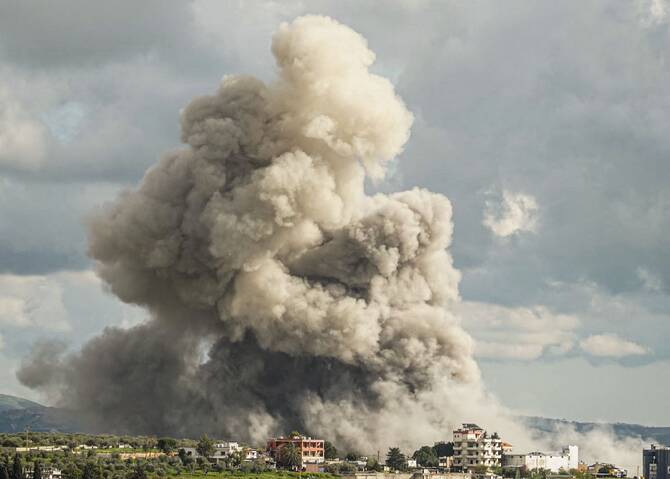
Israeli strikes continued in the south ahead of the Washington meeting.
On Monday, the Israeli army intensified its operations to seize the strategic border town of Bint Jbeil, viewing its fall as “key to linking the border areas it had already seized and establishing operational control over them,” according to a Lebanese military source.
Fierce battles are continuing in the town between the Israeli army and Hezbollah fighters. The Israeli army claimed it had “eliminated more than 100 Hezbollah members” in close-range clashes and airstrikes.
In response, Hezbollah announced in a series of statements that “it had launched drone strikes targeting Israeli troop concentrations and artillery positions in settlements near the Lebanese border.”
On the previous day, Israeli Prime Minister Benjamin Netanyahu vowed that the “war will continue” as he visited southern Lebanon.
He said Israeli forces had eliminated the threat of an invasion by Hezbollah militants.
Israel has been bombing Lebanese villages as it seeks to create a “buffer zone” against Hezbollah past its northern border.
Earlier, Netanyahu said the talks with Lebanon would aim to achieve two goals: disarming Hezbollah and securing a peace agreement between Israel and Lebanon.
According to the Ministry of Health, the war has claimed 2,055 lives and left 6,588 people wounded, while displacing more than 1.2 million people and inflicting widespread devastation.
Hezbollah opposes talks
Hezbollah and the Amal Movement remain firmly opposed to negotiations with Israel, while the Lebanese government is relying on US guarantees to ease tensions and to spare the capital Beirut, in spite of stalled Iran-US negotiations.
Qassem Hashem, a deputy from the Amal Movement allied with Hezbollah, told Arab News that while the party supports a ceasefire, it is wary of the timing and context of the planned meeting in Washington, which he said Israel could exploit.
He cautioned against entering negotiations under military pressure, warning that “we must not be drawn into negotiations under fire,” as this aligns with Israel’s objectives.
Hashem said that a ceasefire may not be Israel’s immediate priority, suggesting that its broader aim is to push for Hezbollah’s disarmament and a potential peace agreement with Lebanon, even as its military campaign intensifies, particularly in the south.
“Lebanon was included in the US-Iran agreement, but Israel reneged on it to carry out what it did last Wednesday in Beirut and across all regions,” he told Arab News.
While acknowledging that international pressure helped halt attacks on Beirut and its southern suburbs, Hashem said southern Lebanon continues to bear the brunt of the conflict.
He pointed to fighting in the border town of Bint Jbeil, describing it as an attempt by Israel to “restore the prestige” of its army after failing to occupy the area during the 2006 war.
MP Pierre Bou Assi, a member of the Strong Republic bloc, said Hezbollah had effectively pushed Lebanon into negotiations with Israel by dragging the country into the war.
He told Arab News that the timing of the talks was “a direct consequence” of the conflict, adding that the conditions surrounding the negotiations are far from ideal, particularly in light of Israel’s continued presence in several Lebanese towns.
Bou Assi warned that the war offers no viable future for Lebanon, and criticized Hezbollah’s threats to bring down the government and exert pressure in the streets.
“The state must be the strongest authority in Lebanon,” he said, adding that it is fully capable of asserting that role.
In recent days, Hezbollah has waged a smear campaign against Salam, staging demonstrations near the prime minister’s office and accusing him of being a “Zionist.”
In response, Salam delivered a speech on Sunday night marking the 51st anniversary of the outbreak of the Lebanese civil war, in which he indirectly addressed his critics, saying: “Some burdened Lebanon with more than it could bear. Those who relied on external backers, believing they would support them, found themselves trapped in a game greater than themselves.”
Salam stressed the need to strengthen national unity and avoid any slide into internal strife, warning that the current moment requires consolidating the home front.
“The south has borne a heavy cost from wars and attacks. Its protection, like that of all Lebanon, can only come through a single, strong, and just state.”
He pledged to continue working to end this war, ensure the withdrawal of the Israeli enemy from all Lebanese territory, secure the release of all prisoners, rebuild the destroyed areas, and ensure the dignified and safe return of displaced people to their homes.
International pressure
Italian Foreign Minister Antonio Tajani said during a visit to Beirut on Monday that Italy is ready to host future negotiations, following talks with Aoun.
He added that he held “a lengthy call” with Israeli Foreign Minister Gideon Sa’ar to encourage dialogue between Israel and Lebanon, urging Israel to halt attacks on civilians and UNIFIL, while also condemning Hezbollah’s operations as destabilizing the south.
Tajani expressed confidence in the Lebanese Armed Forces, saying they play a key role in preserving the country’s unity and stability.
As diplomatic efforts intensify, Lebanon’s Foreign Minister Youssef Rajji told his German counterpart Johann Wadephul that Beirut is seeking a ceasefire through direct negotiations with Israel, stressing that this approach separates the Lebanese track from the Iranian one.
According to Rajji’s office, Wadephul reaffirmed Germany’s support for Lebanon’s efforts to assert sovereignty and achieve stability, adding that Berlin is working toward a ceasefire.