

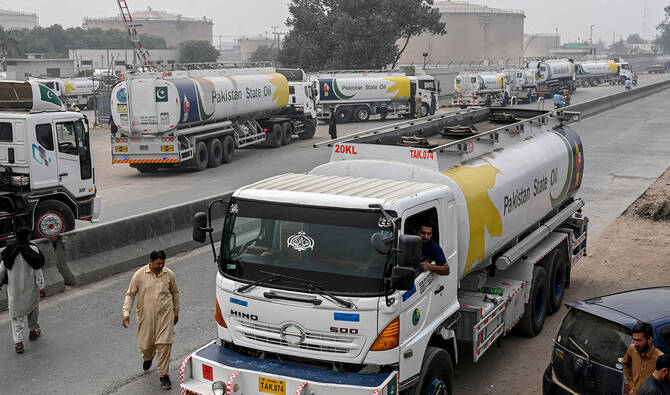

KARACHI: Pakistan’s oil retailers have urged the government to urgently intervene and prevent a potential disruption in the country’s fuel supply chain due to pending subsidy payments, warning that mounting financial pressures on oil marketing companies (OMCs) could lead to shutdowns.
The warning comes as tensions stemming from the ongoing war in the Middle East and disruptions in the Strait of Hormuz, a strategic transit route for global oil, have driven up energy prices and heightened risks for import-dependent economies like Pakistan.
Pakistan on Thursday sharply raised petrol and diesel prices to Rs458.40 ($1.65) and Rs520.35 ($1.87) per liter, respectively, reflecting continued volatility in international energy markets. The new prices marked an increase of Rs137.23 ($0.49) for petrol and Rs184.49 ($0.66) for diesel.
To mitigate the impact of international market volatility on domestic consumers, Islamabad has relied on a price differential claim (PDC) system, under which oil marketing companies (OMCs) sell fuel at regulated prices below international rates and later seek reimbursement for the difference.
“The survival of the emerging companies is at stake because the PDC amount the government is giving to the masses is being paid through us,” Tariq Ali Wazir, chairman of the Oil Marketing Association of Pakistan (OMAP), told Arab News.
“The OMCs are paying Rs203 ($0.7) per liter upfront subsidy on diesel and Rs96 ($0.3) per liter on petrol,” he said, adding that oil companies were supposed to receive the PDC on a weekly basis, but their payments for three past weeks were still pending.
The weekly PDC dues could go as high as Rs40 billion ($143.3 million), according to Wazir. This could disturb OMCs’ cash flows.
Arab News reached out to Pakistan’s petroleum division spokesperson Zafar Abbas and energy ministry spokesperson Rabbiya Khalid, but they did not respond to requests for comment.
In a letter written to Prime Minister Shehbaz Sharif on March 30, Wazir cautioned that the current structure was placing an unsustainable burden on the industry.
“OMCs are presently required to procure fuel at high international prices while selling at regulated lower prices, funding the entire price differential upfront,” he said, describing the situation as an “urgent SOS.”
These companies are also required to maintain a mandatory 20-day stock cover, which many say is further straining liquidity.
Wazir said the situation is particularly “critical” for small and mid-sized OMCs, which lack the financial resilience of larger firms, and the sector could face supply disruptions, market imbalances and shutdowns of emerging companies without immediate corrective measures.
He called for a series of measures, including time-bound reimbursements with at least 70 percent of the claims released upfront, and alignment of payments with the fuel procurement stage to reduce financing pressures.
The OMAP chief also sought emergency liquidity or bridge financing support, facilitation of refinery credit against price differentials, and simplification of claim procedures to ensure faster processing.
“A swift and decisive intervention… can prevent a looming supply crisis,” he stated in his letter to PM Sharif.
Myesha Sohail, an analyst at Karachi-based Topline Securities brokerage firm, noted that OMCs’ sales rose 19 percent year-on-year to 1.44 million tons in March, but they may not sustain the global price hikes.
“We expect oil sales to decline in Apr. 26 as elevated petroleum prices are likely to dampen demand,” she said in a note to clients.


