
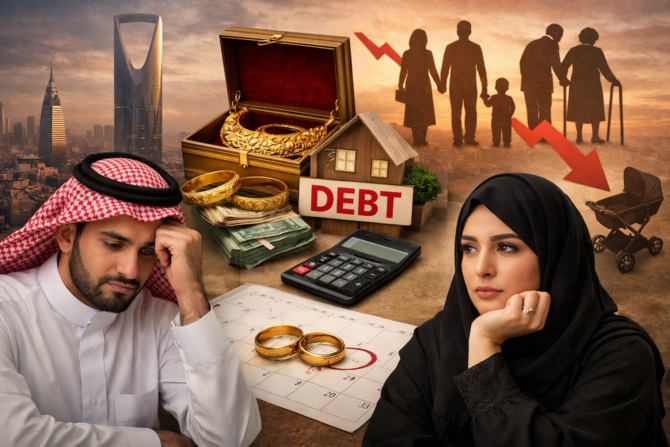

RIYADH: On her engagement night, Sara Khalaf smiled for the photos while quietly calculating the costs in her head: the venue, the gold, the dress, the mahr.
“Fifty thousand riyals ($13,330) used to mean something different,” she said later. “Now, it disappears so fast. Sometimes, it feels like the wedding is for everyone else — not for the couple. That money could build a life, not just a night.”
Across Saudi Arabia, mahr, the dowry given by the groom to the bride, is changing. Once a simple symbol of respect, security, and responsibility, it has become part of a complex mix of social expectations, competition, and rising costs.
Islamic scholars remind families that mahr is a gesture, not a price. But in reality, weddings today often include expensive gold, gifts, and elaborate celebrations. For many young Saudis, the excitement of marriage now comes with a heavy dose of financial stress.
Twenty-five-year-old Kendah Nabeel put it simply:
“Mahr was meant to honor the woman. Today, most of it goes to dresses, events, makeup, and gold. For me, something like 70,000 riyals feels reasonable — only because everything else has become so expensive.”
Families frequently step in to help with costs, yet the pressure remains. Some couples delay marriage, waiting until they feel financially secure. Others quietly walk away, feeling that the financial demands outweigh their readiness to commit.
Over the past few decades, the average age of first marriage in Saudi Arabia has steadily increased, according to the Saudi General Authority for Statistics. Education and careers are important, but money often dominates the conversation. For young people, the decision to marry is rarely just about love or readiness; it is also about financial security and the ability to provide a stable home.
These delays can affect fertility. Saudi Arabia’s total fertility rate fell from 2.8 in 2011 to 2 in 2024, while fertility among Saudi women specifically declined from 3.8 to 2.7 in 2024, according to the General Authority for Statistics. Urban living, rising costs, and women’s increasing participation in education and work all play a role in shaping these trends. Private decisions about marriage and family size gradually shape broader national demographics.
Not every wedding is marked by financial strain. Fatima Al-Ahmed, from Dammam, shared a different experience:
“My brother married with a modest dowry and no big party. Everyone supported them. It felt closer to the real spirit of marriage. It was about the couple, not the spectacle.”
Religious and community leaders are increasingly promoting smaller weddings and realistic expectations. Campaigns encourage families to focus on the meaning of marriage rather than extravagant displays. Yet experts warn that lowering mahr alone cannot solve the larger financial challenges couples face. Housing, job stability, and childcare continue to weigh heavily long after the wedding ends.
Family lawyer Mohammad bin Talal Al-Akbari, of Value Law Co., sees the shift firsthand.
“Marriage hasn’t lost its importance,” he said, “but it has become a carefully calculated decision. Young people are not hesitant — they are realistic. Marriage carries financial, legal, and social responsibilities that cannot be handled by emotion alone.”
He highlighted government initiatives, such as interest-free marriage loans of up to 60,000 riyals, as evidence that family stability is a national priority. These programs aim to ease financial pressure and make marriage accessible without forcing couples into debt.
Al-Akbari believes success should be measured by stability, cooperation, and shared responsibility, not by lavish displays or ostentation. At the same time, he cautions against reducing mahr too drastically, which could undermine the bride’s financial security at the very beginning of married life.
Today, mahr sits at the crossroads of tradition, economy, and identity. For some, high costs signal social status; for others, they feel like walls separating young couples from marriage. Many young Saudis are learning to balance respect for cultural heritage with the practical need to protect their financial future.
For Khalaf and many young Saudis, the hope is for weddings that celebrate love and commitment, without leaving couples overwhelmed by debt or societal expectations. The ideal, experts say, is a marriage built on cooperation, mutual respect, and shared responsibility — a foundation that will outlast the party, the photos, and even the gifts.
Because at the end of the day, it is not the dowry that sustains a family, but the life built after the guests go home.