

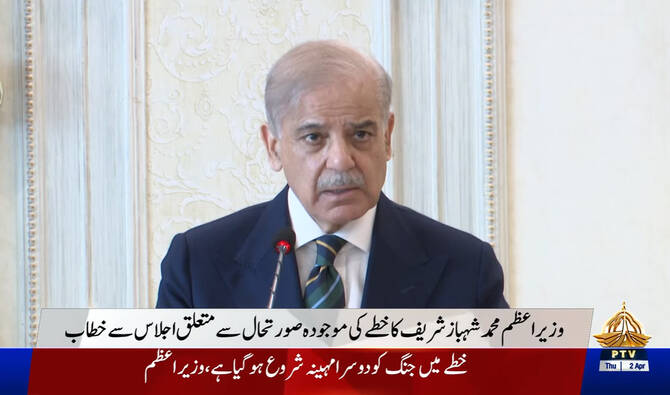

ISLAMABAD: Prime Minister Shehbaz Sharif said on Thursday that there will be further progress on the 20 Pakistani-flagged ships allowed by Iran to cross the Strait of Hormuz “in the coming days,” stressing that the war in the Middle East has had adverse effects on the country’s economy.
Deputy Prime Minister Ishaq Dar said on Mar. 28 that Iran had permitted 20 ships under Pakistan’s flag to cross the Strait of Hormuz waterway, through which roughly 20 percent of the world’s oil and gas supplies are shipped.
Chairing a high-level meeting to discuss the regional situation with federal ministers, chief ministers of all four provinces and Pakistan’s chief of defense forces, Sharif noted that two Pakistan-flagged ships had already passed through the strait in recent days.
“In recent days, arrangements have been made for 20 ships [to cross the strait] under the Pakistani flag,” the Pakistani prime minister told participants of the meeting.
“There will be further progress on this as well in the coming days.”
Iran has effectively blocked the Strait of Hormuz, one of the world’s busiest oil shipping channels, since the US and Israel attacked the country on Feb. 28. Tehran has allowed only a few vessels to cross through, with several stranded on either side of the narrow waterway, causing global oil prices to shoot up and shipping costs to increase as ships alter their course.
Sharif said his government had worked hard to ensure macroeconomic stability over the past two years, acknowledging that the war in Iran has had adverse effects on Pakistan’s economy.
“Pakistan has put in consistent efforts to stop this war and ensure a ceasefire,” Sharif said. “The rest is in the hands of Allah. And while I speak to you, these efforts are going on.”
Pakistan has acted as a go-between during the current war, carrying messages between Iran and the US as the conflict intensifies. Islamabad also hosted talks with the foreign ministers of Saudi Arabia, Türkiye and Egypt in Islamabad on Sunday to de-escalate tensions in the Middle East.
Dar also traveled to China earlier this week where he met Foreign Minister Wang Yi. Both sides put forth a five-point initiative to restore peace in the Middle East, calling for a ceasefire and the start of peace talks ” as soon as possible.”


