

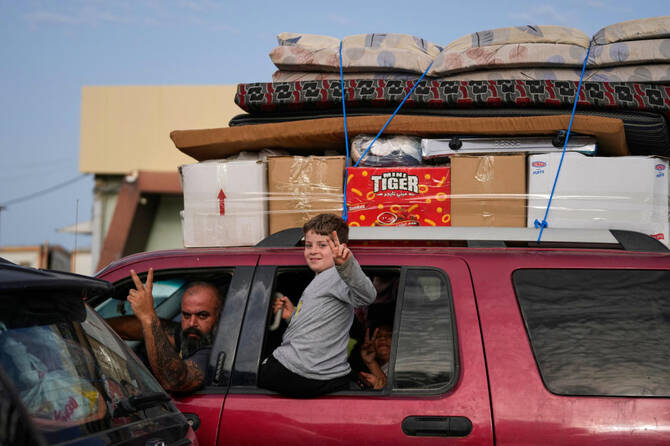

BEIRUT: A 10-day ceasefire deal struck between Lebanon and Israel took effect on Friday, sending displaced residents streaming south toward their homes, even as the Lebanese army warned of “a number of violations” in the area.
Shortly after the truce went into effect at midnight local time (2100 GMT), the army told residents of the south — many of whom had to flee their homes following sweeping Israeli evacuation warnings — not to return, citing “several Israeli acts of aggression.”
Nonetheless, AFP images showed packed cars heading southwards along Lebanon’s coastal highway before dawn, and crossing at sunrise what was left of a bridge bombed by Israel during the war.
Displaced resident Alaa Damash acknowledged the warnings “to wait a bit” before rushing back home.
But the people’s “love for their lands and houses, and their attachment to them, pushed them to go back there despite the fire threats,” she said.
The ceasefire represents a key step in Washington’s efforts to reach a deal to end its war with Iran, with Tehran insisting a Lebanon truce must be part of any agreement.
Kremlin welcomes US-backed Israel-Lebanon ceasefire
The Kremlin said on Friday it welcomed a US-backed ceasefire between Israel and Lebanon and hoped it would help prevent a recurrence of military clashes, Reuters reported.
“We welcome this decision and hope that, within the timeframe set out, it will be possible to reach agreements that will prevent a recurrence of armed clashes,” Kremlin spokesman Dmitry Peskov told reporters.
French president praises ceasefire in Lebanon
French President Emmanuel Macron said he supports the 10-day-ceasefire between Hezbollah and Israel and called for its continuation.
“Hezbollah must renounce its weapons. Israel must respect Lebanese sovereignty and stop the war,” he said Friday in a post on X.
“I also express my concern that it may already be undermined by the continuation of military operations,” Macron said without elaborating on any specific operations.
Pakistan’s PM welcomes ceasefire
Pakistan’s Prime Minister Shehbaz Sharif welcomed the ceasefire and expressed hope the cessation of hostilities would “pave the way for sustainable peace.”
“I welcome the announcement of a ceasefire in Lebanon, facilitated through bold and sagacious diplomatic efforts led by President Donald Trump, and express the hope that it will pave the way for sustainable peace,” Sharif posted on X.
“Pakistan reaffirms its unwavering support for the sovereignty and territorial integrity of Lebanon, and will continue to support all efforts aimed at lasting peace in the region.”
Mediator Islamabad has been leading the international push to restart face-to-face talks between Tehran and Washington with Trump signaling he might fly to Pakistan to sign any agreement — adding they were “very close” to striking one.
Iranian FM ‘welcomes’ Israel-Lebanon ceasefire
Iran’s foreign ministry welcomed the Israel-Lebanon truce, calling it part of the earlier two-week ceasefire deal struck between the Islamic republic and the United States to pause the Middle East war, state media reported.
Ministry spokesman Esmaeil Baghaei “welcomed the announcement of the ceasefire in Lebanon and noted that the cessation of the war in Lebanon was part of the ceasefire understanding between Iran and the United States, mediated by Pakistan”, state news agency IRNA posted on Telegram.
The fighting in Lebanon broke out on March 2 when Tehran-backed Hezbollah fired rockets at Israel just a few days after the start of the Middle East war in retribution for the death of Iran’s supreme leader Ali Khamenei in the opening waves of US-Israeli strikes.
Gunfire rang out overnight in Beirut’s southern suburbs, where Hezbollah holds sway, as the ceasefire came into effect — an apparent bout of spontaneous celebration, although that could not be confirmed.
Traffic accumulated kilometers away from the only bridge connecting the coastal region south of Lebanon’s Litani River to the rest of the country, as people lined up for hours waiting for a chance to return home, AFP journalists said.
As the ceasefire came into effect, Israel’s military said it had struck over 380 “Hezbollah terror organization targets in southern Lebanon” and was on “high alert” to resume strikes.
Trump said he had spoken to both Israeli Prime Minister Benjamin Netanyahu and Lebanese President Joseph Aoun ahead of the truce, adding the pair had agreed to the truce “in order to achieve PEACE between their Countries.”
He later said he expected Netanyahu and Aoun to visit the White House “over the next four or five days.”
‘Very happy’
A top-level face-to-face meeting between the Lebanese and Israeli leadership would be a watershed moment for the region.
But it remained to be seen whether it would take place.
Netanyahu said the ceasefire with Lebanon offered an opportunity for a “historic peace agreement” with Beirut — but insisted that the disarmament of militant group Hezbollah remained a precondition.
Trump said Hezbollah was included in the ceasefire, but according to the US State Department, the truce committed Lebanon itself to dismantle the Iran-backed militant group.
Lebanese Prime Minister Nawaf Salam welcomed Trump’s announcement of the ceasefire, saying a truce was a “key Lebanese demand that we have pursued since the very first day of the war” between Hezbollah and Israel.
But the Lebanese president had rejected Trump’s request for a direct call with Netanyahu, an official source told AFP.
In Beirut, housewife Jamal Shehab, 61, applauded the truce.
“We are very happy that a ceasefire has been reached in Lebanon because we are tired of war and we want safety and peace,” she said.
Trump called the development “very exciting,” in response to a question from an AFP reporter as he left the White House. “Today they’re going to be having a ceasefire, and that’ll include Hezbollah.”
A Hezbollah lawmaker told AFP it would “cautiously adhere” to the truce if Israel stopped attacks.
Ibrahim Al-Moussawi thanked Iran for having applied pressure in Lebanon’s favor — adding that “the ceasefire would not have happened without Iran considering the ceasefire as equal to closing the Strait of Hormuz.”
Netanyahu said Israel agreed to the truce but would maintain a 10-kilometer (six-mile) “security zone” along the border in southern Lebanon.
Lethal violence continued right up until shortly before the truce began, with Lebanon’s health ministry saying at least seven people were killed and more than 30 wounded in an Israeli strike on the town of Ghazieh on Thursday.
An Israeli hospital spokesman also said three people had been injured on Thursday.
– with Reuters


