
LONDON: For much of the Global South, the US-Israel-Iran war is no longer a distant geopolitical crisis. It is showing up in farm budgets, fuel queues and food markets, as disruption in the Strait of Hormuz drives up costs and strains already fragile economies.
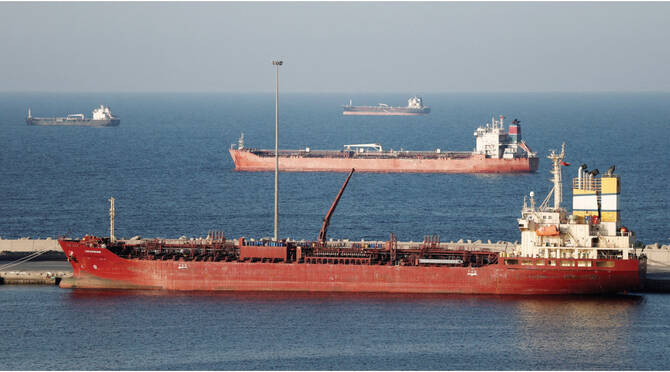
Iran’s blockade of Hormuz has rattled one of the world’s most important shipping lanes, while the US naval blockade ordered by President Donald Trump targets ships headed to or from Iranian ports rather than all traffic using the strait.
In Sudan, the consequences are already visible before sunrise.
At a fuel station in Khartoum, the queue begins before dawn. Petrol prices climbed to 30,000 Sudanese pounds ($50) per gallon in early April, up from SDG 19,000 ($31.61) in February, and some analysts say they could hit SDF 35,000 ($58.24) by midyear as shortages deepen.
For farmers in Al-Qadarif and Al-Jazirah, who rely on diesel to power irrigation pumps and move seeds to market, the math is already becoming impossible. Sudan’s planting window opens in June, and time is running short.

Farmers sort out peanuts harvested at the New Halfa irrigated agricultural project in Kassala state in eastern Sudan on October 20, 2024. (AFP file photo)
That pressure is no longer abstract for ordinary households.
Alfatih Mohamed, a Sudanese journalist and human rights researcher based in Uganda, said conditions are worsening so sharply that some people have “resorted to using cooking oil instead of diesel in their vehicles.”
“The situation in Sudan is not good at all and continues to deteriorate,” Mohamed told Arab News, adding that the crisis has already forced some to reduce the number of daily meals and fall back on community support networks to survive.
The fuel shock is tied directly to a wider military escalation. After the Feb. 28 joint US-Israeli strikes on Iran that killed Supreme Leader Ali Khamenei and several other senior Iranian leaders, the Strait of Hormuz was effectively shut down.
The narrow passage carries roughly one-third of globally traded fertilizer, along with an estimated 20 percent of liquefied natural gas and 27 percent of globally traded oil.
Tanker traffic collapsed within days. Although a two-week truce was later declared, traffic has not returned to normal.

On April 12, Trump said that the US Navy would begin enforcing a blockade, which went into effect the following morning. He vowed to stop ships from entering or leaving the strait to pressure Tehran into reopening the waterway and accepting US terms.
And Hormuz is only part of the risk. Iran has also signaled it could widen the confrontation to the Red Sea, threatening the Bab Al-Mandeb chokepoint that goods must pass through before reaching Port Sudan.
Saeed Laylaz, an Iranian analyst, warned that if Iran’s oil exports were halted, pressure could extend southward, raising the prospect of a second disruption hitting the same supply chains at once.
“Iran’s capacity for retaliation is very high,” Laylaz told Financial Times on Wednesday. “If Iran’s oil exports are halted, the Bab Al-Mandab Strait (at the southern end of the Red Sea) will be closed.”
That is why economists are increasingly focused on timing, not just prices.
The Food and Agriculture Organization’s chief economist Maximo Torero warned in early April that once a supply disruption stretches beyond 40 days, farmers begin making planting decisions that diplomacy cannot easily reverse.

FAO Chief Economist Maximo Torero, right, and David Laborde, head of FAO's Agrifood Economics Division, discuss the Strait of Hormuz crisis in FAO's Situation Room. (UN FAO photo)
By the time the ceasefire was announced on April 7, that threshold had already been crossed. With both major maritime arteries for food and fuel under threat at the same time, the danger had moved well beyond energy and into the food system itself.
“This is not only an energy shock,” he said. “It is a systematic shock affecting food systems globally.”
For Sudan, the latest shock is landing on a country that was already on its knees.
Nearly four years of civil war between the Sudanese Armed Forces and the Rapid Support Forces have hollowed out what was once one of Africa’s most significant agricultural economies.
Fertilizer imports have fallen from roughly 450,000 tons a year before the war to around 50,000 tons. The country is heading toward a third straight below-average harvest, famine has been confirmed in El-Fasher and Kadugli, and about 21.2 million people — nearly half the analyzed population — are facing acute food insecurity.

A Sudanese farmer harvests sorghum sudangrass crops in the Riba area of Kassala State, eastern Sudan, on November 18, 2025. (AFP)
The cost of key inputs is rising just as farmers need them most. Urea prices jumped from about $400 to more than $700 per ton in the week after the strikes. Sudan’s fuel import bill had already exceeded $1.2 billion in 2025, and an estimated 60 percent of those shipments moved through corridors now under threat.
Daniel Herszberg, a geopolitical analyst and doctoral researcher in law at the University of Oxford, said the Iran war “will likely have a compounding effect on this already vulnerable sector — in particular as an indirect shock.
“For a country like Sudan, there is a real risk that Gulf fertilizer cannot make it in time for June’s planting season,” Herszberg told Arab News. “This means both reduced planting due to input constraints, and potentially higher produce prices.”
That raises the stakes far beyond this year’s harvest.
Mohamed, who fled Sudan’s civil war two years ago, warned that a failed season would mean “even greater food shortages, and a heavier reliance on international aid, which is arriving in very limited quantities.”

Sudanese refugees to receive free meals at the Al-Afad camp for displaced people in the town of Al-Dabba, northern Sudan, on November 20, 2025. Since its outbreak in April 2023, the war between Sudan's army and the paramilitaries has killed tens of thousands of people and displaced nearly 12 million. (AFP)
He said the fallout would not be uniform across the country, but wherever it hits, it is likely to drive more displacement, further weaken the economy and make eventual recovery even harder.
Sudan, however, is not an outlier. Across East Africa, about 38 million people are already facing crisis-level hunger or worse — classified as IPC Phase 3 or above, the standard scale used to measure acute food insecurity.
In Somalia, the FAO has warned that crop production in some areas is running 80 percent below the long-term average, the lowest on record. In northern Kenya, repeated failed rainy seasons have killed tens of thousands of livestock. In Ethiopia, persistent drought has reduced yields by 34 percent to 54 percent in some areas.
That is why aid groups say the damage is already being locked in.
“The food security consequences of this war are already written into harvests that have not yet been planted,” said Melaku Yirga, Mercy Corps’ vice president for Africa.
“Even if prices were to stabilize tomorrow, the most important agricultural decisions have already been made,” he added. “Farmers are already planting less, or not at all, because they can’t afford the inputs.”
Nitrogen-based fertilizers such as urea and ammonia depend on natural gas, and Gulf producers account for a disproportionate share of global supply. Qatar, one of the world’s largest urea producers, was forced to halt production at one of its main plants after a strike, tightening a market that was already under stress.
Africa has expanded fertilizer production capacity in recent years, but much of that output is still geared toward export markets. That leaves many countries heavily dependent on imported nitrogen-based fertilizers, with little domestic cushion when Gulf supply chains seize up.
In effect, the current shock is hitting a system with almost no redundancy.
The pressure extends well beyond Africa. India, the world’s second-largest fertilizer consumer, uses roughly 40 million tonnes of urea each year and relies heavily on Gulf imports.
Prices at major Indian hubs have risen by more than 35 percent since the conflict began, crossing $700 per tonne for the first time since Russia’s invasion of Ukraine.
Bangladesh is already seeking alternative supply from China and Morocco, while prices in parts of Southeast Asia have jumped by more than 40 percent.
Still, the pattern is remarkably consistent. Countries with deeper financial buffers, diversified suppliers and stronger state support can absorb some of the shock. Those without — especially smallholder farmers growing food for low-income households — cannot.
The financial room to respond is also narrowing. Fertilizer subsidy programs are common across Africa and Asia, but many low-income governments are already constrained by debt, weak revenues and falling overseas development assistance.
The World Food Program has warned that funding shortfalls are already forcing ration cuts in Sudan, Yemen and Somalia, and estimates that another 45 million people could be pushed into acute hunger.
There are a few buffers left, but they are limited. Some nutrients remain in the soil for more than one season, and some farmers can shift into less fertilizer-intensive crops such as legumes.
But the International Food Policy Research Institute has warned that a prolonged rise in nitrogen fertilizer prices would cut yields for staple crops in many countries and eventually feed through to higher prices for the foods poor households depend on most.
That leaves a very narrow window for action, however.
“A narrow window remains before June,” said Herszberg. “Priority should be given to measures which safeguard access to the inputs required for food production.”
He pointed to several immediate steps, including “getting emergency seed and crop-support packages out before planting begins, restoring damaged irrigation networks, supporting low-input or input-substitution farming where supply cannot be stabilized, improving security conditions for market access, and, of course, protecting humanitarian access.”
Even those options are shrinking, however, because planting seasons in parts of South Asia and the Horn of Africa are already underway.
For now, existing inventories are absorbing some of the blow, and food prices have not yet surged everywhere.
Nonetheless, David Laborde, director of the FAO’s agrifood economics division, has warned that this is already an “input crisis.
“We don’t want to make it a catastrophe,” he said. “The difference depends on the actions we take.”
He added that delays in getting fertilizer and fuel where they are needed could quickly turn into lower output, higher inflation and slower growth.
For farmers in Al-Qadarif and Al-Jazirah, that global calculus means very little. June is approaching, the fertilizer has not arrived, fuel costs more than they can afford, and the harvest that could pull millions back from the brink now depends on decisions being made in real time, at a pump, in a line, before dawn.