

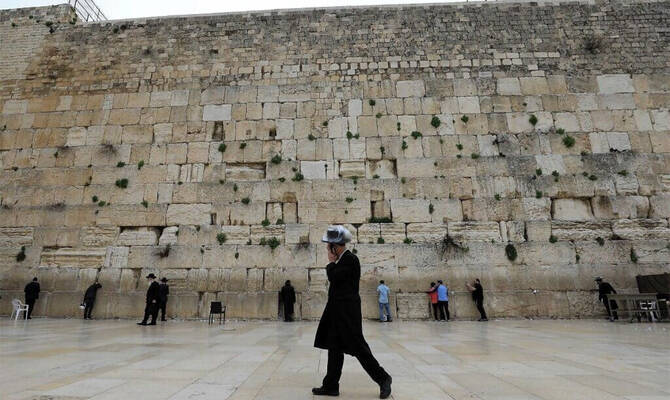

JERUSALEM: Israeli lawmakers on Wednesday advanced a bill that would place the Western Wall under the exclusive authority of the Chief Rabbinate, effectively restricting non-Orthodox worship at the site’s mixed-gender prayer section.
Located in the Old City of Jerusalem, occupied by Israel in 1967, the Western Wall is the last remnant of the Second Temple destroyed by the Romans in 70 AD.
It is the holiest site at which Jews are permitted to pray by the rabbinate.
The plaza includes three prayer areas — the largest for men, another for women, and a smaller mixed area which is disapproved of by the official Israeli rabbinate, dominated by the ultra-Orthodox.
A bill introduced by far-right lawmaker Avi Maoz that would give the Chief Rabbinate full authority over all sections passed a preliminary parliamentary reading on Wednesday, with 56 lawmakers voting in favor and 47 against.
The legislation would define any activity contrary to the rabbinate’s directives — including non-Orthodox forms of worship — as a “desecration.”
Prime Minister Benjamin Netanyahu was not present for the vote.
At the heart of the dispute lies the prayer area known as Ezrat Yisrael, established to accommodate mixed-gender worship.
Several non-Orthodox Jewish movements — predominant among Jewish communities in the US but a small minority in Israel — worship at the site but complain that it is hard to access and poorly laid out.
Seeking to make a gesture to the American Jewish community, a previous Netanyahu government had voted in 2016 for establishing the mixed-gender area, but backtracked the following year under pressure from its ultra-Orthodox allies.
As such, the mixed space was established but not developed.
The bill advanced on Wednesday is the latest twist in the clash between Netanyahu’s coalition government, one of the most right-wing in Israel’s history, and the Supreme Court, whose powers the government has sought to curtail since it took office in 2022.
Last week the court ordered the government and Jerusalem municipality to act on long-delayed plans to develop and improve the mixed-gender section, including issuing building permits that had been stalled for nearly a decade.
The court did not directly rule on theological matters but emphasized that prior government commitments could no longer remain indefinitely suspended.
In response, Justice Minister Yariv Levin urged lawmakers to support Maoz’s bill in order to block what he described as unacceptable interference by the top court in religious affairs.


