UAE denies striking desalination facility in Iran

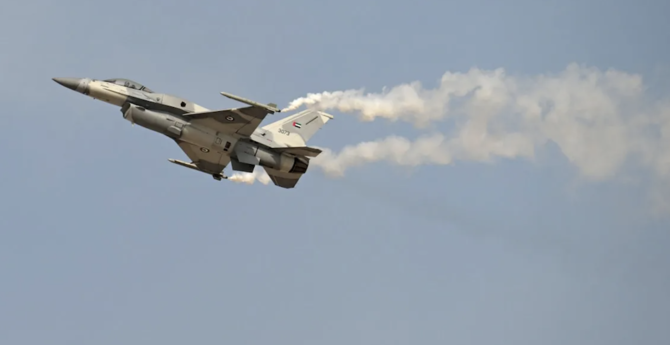
An Emirati Air Force F-16 in 2025. (AFP/File Photo)
Short Url
Updated 08 March 2026
Follow

UAE denies striking desalination facility in Iran

  • Earlier reports have claimed that the UAE struck the desalination facility in what would have been its first retaliatory actions

DUBAI: A senior UAE official has denied that the country was involved in a strike on a desalination plant in Iran, Jerusalem Post has reported.

“The UAE will never place the Iranian people in the same basket as the Iranian regime. The Iranian people are the real victims of that regime and the ones who suffer the most from its policies,” Ali Al-Nuaimi, chairman of the UAE’s National Defense Committee, stated.

“As neighbors, we recognize this reality, and we care about their well-being.”

On Sunday, Emirati presidential adviser Anwar Gargash said any announcements regarding UAE maneuvers would be communicated through official channels.

“The UAE is in a state of self-defense in the face of the Iranian aggression that targeted its territories, its people, and its civilian infrastructure,” he posted on X.

“Any defensive measures that the state will take will be public and clear, and will not rely on press leaks or narratives from unknown sources and intentions.

“Our goal is to stop this ongoing aggression against the UAE and the Arab Gulf states, not to be dragged into escalation,” he added.

Earlier reports claimed that the UAE struck the desalination facility in what would have been its first retaliatory actions against the barrage of missiles and drones from Iran.

A source close to the UAE noted that officials in Abu Dhabi were having difficulty understanding Israel’s conduct and the nature of the briefings, Jerusalem Post reported, as the UAE is a sovereign state that makes its decisions independently and that publications of this kind do not assist the regional effort and could harm relations.

It was inappropriate for what was described as a “senior Israeli official” to speak on the UAE’s behalf or to spread rumors about the actions of another sovereign state, Jerusalem Post reported, quoting the unnamed source.

Iranian Foreign Minister Abbas Araghchi said on Saturday that an American attack hit a freshwater desalination plant on Iran’s Qeshm Island, disrupting water supplies in 30 villages, posting on X that “the US set this precedent, not Iran.”


Strikes kill nine Iran-backed fighters near Iraq-Syria border: security officials

Updated 12 sec ago
Follow

Strikes kill nine Iran-backed fighters near Iraq-Syria border: security officials

  • Iraqi authorities denounced the “blatant attacks” on bases that belong to the Hashed Al-Shaabi
  • Nine fighters were killed and another 10 wounded in the strikes

BAGHDAD: Air strikes killed at least nine Iran-backed fighters in Iraq on Thursday near the Iraqi-Syrian border, two senior security officials told AFP.
Iraqi authorities denounced the “blatant attacks” on bases that belong to the Hashed Al-Shaabi, a former paramilitary group now integrated into the regular army, which also encompasses brigades from Iran-backed armed groups.
Nine fighters were killed and another 10 wounded in the strikes that targeted a base housing the US-blacklisted Harakat Ansar Allah Al-Awfiya, two security officials said.
“The base was destroyed, and the rescue teams who arrived at the site were also targeted,” one of the officials said on condition of anonymity.
The base belongs to the Hashed Al-Shaabi or the Popular Mobilization Forces (PMF) whose positions have been repeatedly targeted in attacks blamed on the United States and Israel since the start of the war.
The PMF said nine of its members were killed in Thursday’s attack.
It accused the US of striking its sites, and said that these bases “had no role in targeting US bases in Iraq or elsewhere.”
The PMF added that “all fighters killed were carrying out their official duties, and some were stationed near the borders.”
And it called the Hashed Al-Shaabi an “essential part of Iraq’s security apparatus.”
Iraq has long been a proxy battleground between the United States and Iran, with the country’s successive governments struggling to balance relations between the two rivals.
It was immediately dragged into the Middle East war triggered when the United States and Israel attacked Iran on February 28.
The Islamic Resistance in Iraq, a loose alliance of several Iran-backed groups, have been claiming daily attacks against US bases in Iraq.
Iraq’s Prime Minister Mohammed Shia Al-Sudani denounced what he called “blatant attacks” on the PMF, whose members were “performing their sacred duty within the missions of our security forces.”
“This systematic and repeated aggression, and the targeting of sites and headquarters without distinction, is not merely a military violation. It represents a desperate attempt to create confusion” and weaken Iraq’s security.