JERUSALEM: A new draft law on conscripting ultra-Orthodox Jews, whose support is crucial for Prime Minister Benjamin Netanyahu’s government, has sparked uproar in Israel, with the opposition denouncing it as a special privilege for “draft-dodgers.”
Under a ruling established at the time of Israel’s creation in 1948, men who devote themselves full-time to studying sacred Jewish texts are given a de facto pass from mandatory military service.
But this exemption has come under mounting scrutiny from the rest of Israeli society — particularly when tens of thousands of conscripts and reservists are mobilized on several fronts, despite the fragile truce halting the war in Gaza.
The ultra-Orthodox make up 14 percent of Israel’s Jewish population.
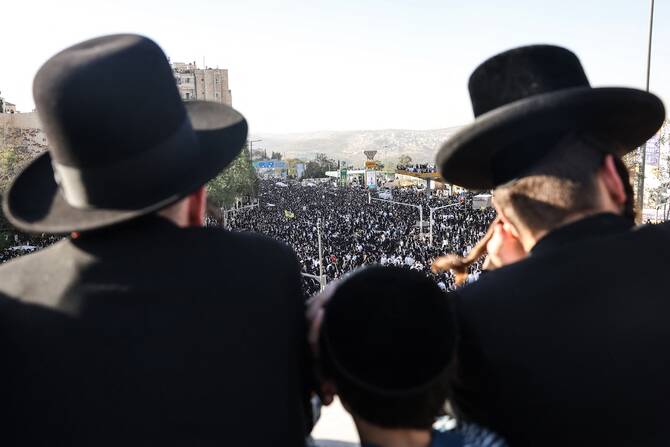
Keeping ultra-Orthodox parties on board is key to the survival of Netanyahu’s right-wing coalition, and their opposition to mandatory military service proposals sparked a mass rally in Jerusalem in October.
Two ultra-Orthodox parties rejected a draft bill in July that would have seen an increasing number of ultra-Orthodox men enlisted each year, and financial penalties for those who refuse to comply.
On Thursday, a new draft was put forward by Boaz Bismuth, the chairman of parliament’s cross-party foreign affairs and defense committee, which rolls back significantly from the previous text.
The new proposal includes only minimal penalties for ultra-Orthodox draft dodgers, notably a ban on traveling abroad or obtaining a driving license.
It also lowers enlistment quotas and facilitates exemptions for ultra-Orthodox men who study in religious seminaries known as yeshivas.
Lawmakers will debate the text on Monday.
The center-right Yedioth Ahronoth newspaper ran a front-page headline on Friday reading “Conscription on paper only,” denouncing “an obvious fraud.”
“The new ‘conscription’ law will not recruit anyone,” it read.
Bismuth has called the bill “balanced” and “responsible.”
‘Contemptible politics’
The ultra-Orthodox United Torah Judaism party quit the government in July over the previous draft conscription bill, and now Netanyahu’s coalition only holds 60 out of 120 seats in parliament.
Ministers from the other main ultra-Orthodox party, Shas, resigned from the cabinet over the issue, though the party has not formally left the coalition.
Shas is now threatening to bring down the government if Netanyahu fails to grant the exemptions he had promised the ultra-Orthodox parties in 2022 when forming the coalition.
The decades-old de facto exemption was challenged at the Supreme Court level in the early 2000s, since when successive Israeli governments have been forced to cobble together temporary legislative arrangements to appease the ultra-Orthodox, who are the makers and breakers of governments.
The opposition has slammed the latest draft bill, believing it is too soft, and is vowing to bring it down.
Opposition leader Yair Lapid called the text an “anti-Zionist disgrace” on X, denouncing the “contemptible politics of the corrupt and the draft-dodgers.”
“This law is a declaration of war by the government on the reservists,” said former prime minister Naftali Bennett, who is expected to run against Netanyahu in elections due by November 2026.
In June 2024, Israel’s Supreme Court ruled that the state must draft ultra-Orthodox men, declaring their exemption had expired.
The government has also been forced to cut certain subsidies to yeshivas, much to the chagrin of the ultra-Orthodox parties.
‘Flagrant inequality’
Only two percent of ultra-Orthodox Jews respond to conscription orders according to the military, which has created units specifically for them.
There are around 1.3 million ultra-Orthodox Jews in Israel, and roughly 66,000 men of military age currently benefit from the exemption, a record number according to local media reports.
On November 19, Israel’s Supreme Court ruled that the government was required to present an effective proposal for conscripting the ultra-Orthodox.
The ruling notes that the “flagrant inequality” created by their exemption has “worsened significantly” with the war in Gaza, triggered by Hamas’s October 7, 2023 attack on Israel.
It also says ultra-Orthodox conscription fills a “real security need” as the army requires about 12,000 soldiers to fill its ranks.
The court did not set a deadline for the adoption of a conscription law, but only for a debate on the issue in parliament.


![]()

Ultra-Orthodox military conscription row reignites in Israel
Short Url
https://arab.news/4kgt5
Ultra-Orthodox military conscription row reignites in Israel
- Only two percent of ultra-Orthodox Jews respond to conscription orders according to the military
- There are around 1.3 million ultra-Orthodox Jews in Israel, and roughly 66,000 men of military age currently benefit from the exemption


Latest updates


© 2026 SAUDI RESEARCH & PUBLISHING COMPANY, All Rights Reserved And subject to Terms of Use Agreement.