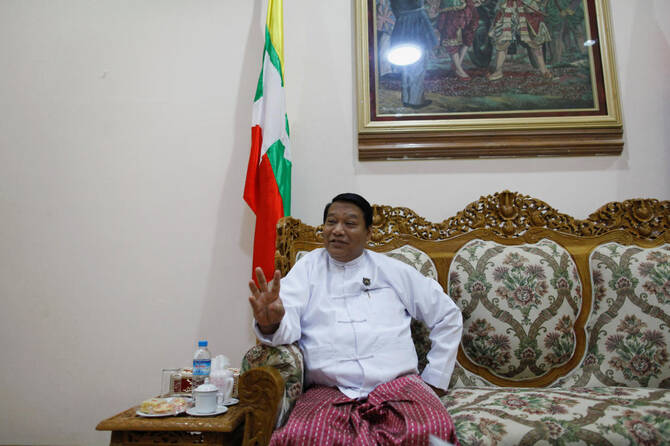
A retired general from an army-backed party that swept Myanmar’s election is set to take the powerful role of speaker of parliament, party sources said, which could help the military cement control of government after a return to democratic rule.
A junta that has run Myanmar since a 2021 coup will formally cede power after a new parliament meets next month, with the top generals expected to loom large in politics after a resounding election win by the Union Solidarity and Development Party, which the military formed in 2010.
Three USDP sources told Reuters the party’s chairman, Khin Yi, a retired brigadier general and former police chief, is tipped to take the pivotal post of lower house speaker.
In that role, he would oversee the election of a new president, the passage of laws and the approval of budgets and key state appointments.
The USDP did not respond to requests for comment on Khin Yi’s future role.
Military to dominate civilian politics
One of the sources, who all spoke on condition of anonymity as the issue is a sensitive one, said retired generals with close ties to junta chief Min Aung Hlaing were likely to become first and second vice presidents.
“Since there are high-ranking former military officers within the party, understanding their roles, the highest possible position for him would likely be the speaker of the lower house,” the source said, speaking of Khin Yi.
Myanmar’s unique power-sharing system gives control of 25 percent of legislative seats to the military that has ruled the country for five of the past six decades, and also of the ministries of defense, border affairs and interior.
With low voter turnout, a raging civil war and no viable opposition, the USDP won 81 percent of available seats in the upper and lower houses during the recent election, effectively putting the legislature under the military’s control.
In addition, a new five-member panel, the Union Consultative Council, will be set up to oversee both military and civilian administration.
Experts say such a move will allow Min Aung Hlaing to become president without loosening his grip on the armed forces.
Power and influence
The post of speaker, held previously by political heavyweights, offers greater clout than the prestigious but largely ceremonial role of vice president, said independent political analyst Htin Kyaw Aye.
“This is a position with a high capacity for influence and action,” he said. “If one cannot be president, the position of speaker of the Hluttaw (parliament) is the one that allows for the greatest exercise of power.”
Another incoming USDP lawmaker said information about who would take the key posts in Myanmar was closely guarded and known among only the core leadership.
Two other members present at a recent USDP meeting said Khin Yi, a former immigration minister, had been asked informally if he would be vice president and responded by saying he would take a key parliamentary role.
“He said, ‘What is certain is that I think I will be leading in the legislative sectors of one of the houses of parliament’,” one of the sources quoted Khin Yi as saying at the meeting.


Retired Myanmar general set for powerful role in new parliament, sources say
https://arab.news/mc59s
Retired Myanmar general set for powerful role in new parliament, sources say

- Khin Yi, a retired brigadier general and former police chief, is tipped to take the pivotal post of lower house speaker
- Myanmar’s unique power-sharing system gives control of 25 percent of legislative seats to the military


26 Doctors without Borders workers remain unaccounted for in South Sudan a month after attacks
- A hospital in the town of Lankien was bombed by government forces, MSF said
- “We have lost contact with them amid ongoing insecurity”
NAIROBI: More than two dozen Doctors Without Borders workers remain unaccounted for a month after attacks in South Sudan, the medical charity said.
Two facilities belonging to the group, known by French acronym MSF, were attacked on Feb. 3 in Jonglei State, northeast of the capital, Juba, where violence has displaced an estimated 280,000 people since December.
A hospital in the town of Lankien was bombed by government forces, MSF said, while another medical facility in the town of Pieri was raided by “unknown assailants.” Both were located in opposition-held areas.
Staff working at the two facilities fled alongside much of the local population into deeply rural areas where armed clashes and aerial bombardments were ongoing.
MSF said in a statement on Monday that “26 of 291 of our colleagues working in Lankien and Pieri remain unaccounted for.
“We have lost contact with them amid ongoing insecurity,” it said.
The lack of communication with its staff could be linked to the limited network connectivity in much of the state. Staff members who had been contacted described “destruction, violence and extreme hardships.”
Fighting escalated sharply in December, when opposition forces captured a string of government outposts in north central Jonglei. In January, the government responded with a counteroffensive that recaptured most of the area it had lost.
Displaced people in Akobo, an opposition-held town near the Ethiopian border, described horrific violence by government fighters. Many described not being able to find food or water as they walked for days to reach safety.
The attacks on MSF facilities in Lankien and Pieri are part of an uptick in violence on humanitarian staff, supplies and infrastructure, aid groups say. MSF facilities have been attacked 10 times in the last 12 months.
“This violence has taken an unbearable toll not only on health care services, but on the very people who kept them running,” said Yashovardhan, MSF head of mission in South Sudan, who only uses one name.
“Medical workers must never be targets,” he said. “We are deeply concerned about what has happened to our colleagues and the communities we serve.”