AKOBO: Kool Gatyen Pajock was in a South Sudan hospital while a physiotherapist wrapped bandages around the 18-month-old’s legs under the watchful eye of his grandmother, Nyayual Chuol.
Government forces put a bullet in the baby’s leg and killed his parents, according to Chuol, who carried him to the hospital in Akobo, South Sudan’s northeastern region near Ethiopia, from their village 130 kilometers (80 miles) to the west.
They were among the 280,000 people who have been displaced in the past two months by a renewed conflict in Jonglei state between the government army, known as the South Sudan People’s Defense Forces, and the Sudan People’s Liberation Movement In Opposition.
“I have nothing in my hand now to take care of this baby,” Chuol said. “I’m worried about my four children who ran in different directions when the attack took place. I don’t know where they are now.”
The fighting further threatens a fragile peace reached in 2018 after a five-year civil war.
Opposition leader Riek Machar was named first vice president alongside President Salva Kiir under a 2020 power-sharing agreement. But Kiir placed Machar under house arrest following new outbreaks of violence in March. Machar was charged in September with treason along with seven opposition members linked to an attack on government forces.
The conflict escalated in December when opposition forces seized government outposts in Jonglei. The government has conducted a counteroffensive since January with aerial bombardments and ground assaults, despite an official commitment to the peace agreement.
In addition to being forced from their homes, civilians have suffered significant casualties.
“People are still fearing that the government army may come and attack here,” Chuol said. “This is what is worrying me right now.”
Civilians suffer the consequences
Nyankhiay Gatluak Jock, 28, escaped from her village of Walgak after a government attack in early February.
“They bombed us from the gunship helicopter, and after that the soldiers came with their cars and started shooting,” said Jock, who was among 42,000 displaced people sheltering in Akobo under the protection of the United Nations Mission in South Sudan.
“We want to ask the president to tell his army to differentiate between the combatants and the civilians,” Jock said while breastfeeding two children in a church alongside other displaced women and youth.
After government forces bombed a hospital operated by humanitarian group Doctors Without Borders on Feb. 3, Nyaphan Nyang Lual headed for Akobo with her husband, daughter and 1-month-old granddaughter. On the road, her husband was shot and her daughter was abducted by armed youths.
Lual reached Akobo with her granddaughter, Bhan Tut Mut, but could not find food assistance and worried for the infant who has developed diarrhea.
“We took her to the clinic but there is no medicine there, and I cannot afford to buy from the pharmacy,” Lual said.
Fighting disrupts humanitarian services
Humanitarian services have not been spared. The UN Office for the Coordination of Humanitarian Affairs said 13 health facilities in Jonglei were “looted or partially destroyed.” Reports of widespread sexual violence also have emerged.
Funding cuts and government-imposed restrictions on humanitarian organizations have resulted in a lack of resources and supplies, according to humanitarian workers who said they were frustrated by an inability to offer the necessary level of assistance.
“We have nothing … no feeding, no medication,” said Susan Tab, a reproductive health officer in Akobo with Nile Hope, a South Sudanese organization. “The only thing we can provide to help these displaced people is psychosocial support.”
UN humanitarian chief Tom Fletcher visited Akobo on Feb. 21 during a tour of South Sudan’s areas impacted by the fighting.
During nearly three years of civil war in Sudan to the north and conflicts in nearby countries in the Horn of Africa, Fletcher said South Sudan has become “one of the most neglected crises in the world right now.”
“I want to make this crisis more visible to the public. And I want them to demand change. To demand funding. To demand political engagement to end this war,” Fletcher said.
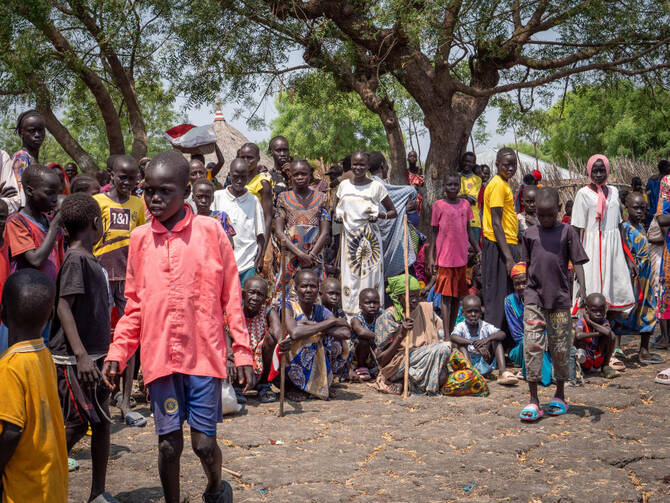
He was greeted in Akobo by thousands of displaced women and children who remained unsure of their safety and future. Some held posters with handwritten messages, including one with the blunt report, “They killed everyone.”
“Help is coming,” Fletcher told the survivors.


As fighting spirals in South Sudan, a humanitarian crisis looms for displaced survivors
https://arab.news/4weuk
As fighting spirals in South Sudan, a humanitarian crisis looms for displaced survivors

- The conflict has caused the displacement of 280,000 people and widespread civilian casualties in the past two months in Jonglei state


Trump says Australia will grant asylum to Iran women footballers
- Presenter on Iranian state TV had branded the players “wartime traitors” after they stood motionless during the anthem
MIAMI: US President Donald Trump said Monday that Australia had agreed to grant asylum to some of Iran’s visiting women’s football team, amid fears they could face retaliation back home for not singing the national anthem before a match.
The gesture ahead of the team’s Asian Cup match against South Korea last week was seen by many as an act of defiance against the Islamic republic just two days after the United States and Israel attacked it.
“I just spoke to Prime Minister Anthony Albanese, of Australia, concerning the Iranian National Women’s Soccer Team. He’s on it! Five have already been taken care of,” Trump said Monday on his Truth Social network, less than two hours after an initial post urging Australia to take them in.
Trump added that “some, however, feel they must go back because they are worried about the safety of their families, including threats to those family members if they don’t return.”
There was no immediate comment from the Australian government, which has so far declined to say whether it could offer the players asylum.
Asked about their case on Sunday, Foreign Minister Penny Wong said Australia “stands in solidarity” with the people of Iran.
The son of Iran’s late shah, US-based Reza Pahlavi, warned on Monday that the refusal to sing the anthem could have “dire consequences,” and urged Australia to offer the team protection.
Trump then weighed in, pressing Albanese to “give ASYLUM” to the team and adding: “The US will take them if you won’t.”
“Australia is making a terrible humanitarian mistake by allowing the Iran National Woman’s Soccer team to be forced back to Iran, where they will most likely be killed,” the US leader said on Truth Social.
Pahlavi, who has not returned to Iran since before the 1979 Islamic revolution that ousted the monarchy, has billed himself as the man to lead a democratic transition to a secular Iran as the theocratic regime fights to survive.
Politicians, human rights activists and even “Harry Potter” author J.K. Rowling have also called for the team to be offered official protection.
“Please, protect these young women,” Rowling said in a post on social media.
‘Save our girls’
A presenter on Iranian state TV had branded the players “wartime traitors” after they stood motionless during the anthem before their match against South Korea.
In subsequent games, the players saluted and sang.
Crowds gathered outside the Gold Coast stadium where the side played their last match over the weekend, banging drums and shouting “regime change for Iran.”
They then surrounded the Iranian team bus, chanting “let them go” and “save our girls.”
On Monday, an AFP journalist saw members of the team speaking on phones from their balcony of their hotel.
Asked about the possibility of granted asylum, a spokesperson for Australia’s Home Affairs department told AFP earlier it “cannot comment on the circumstances of individuals.”
Amnesty International campaigner Zaki Haidari said they faced persecution, or worse, if they were sent home.
“Some of these team members probably have had their families already threatened,” Haidari told AFP.
“Them going back... who knows what sort of punishment they will receive?“
Despite being heavily monitored, the side would have a “small window of opportunity” to seek asylum at the airport, he said.
Iran’s embassy in Australia did not respond to a request for comment.