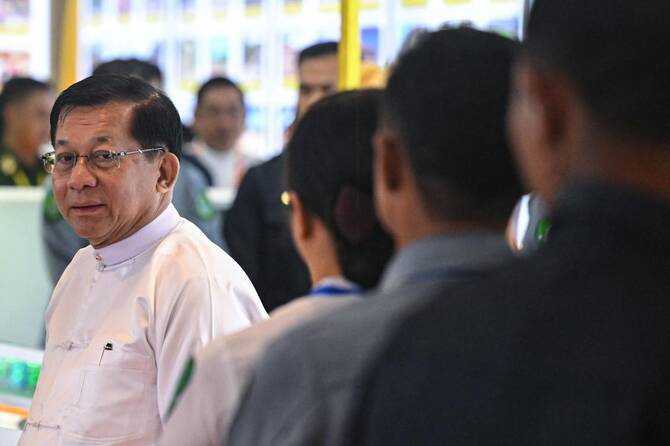
YANGON: Myanmar’s top general Min Aung Hlaing was months from retirement five years ago when he made an about-face, deposed the democratic government and promoted himself to leader.
The bespectacled officer became military chief in 2011, just as Myanmar broke with its history of iron-fisted martial rule and began its latest experiment with democracy.
Now 69, he spent a decade jostling with civilian leaders before mounting his coup, jailing Nobel Peace Prize laureate Aung San Suu Kyi and triggering a vicious civil war that is still being fought.
He is presiding over a month-long poll due to wrap up on Sunday that he promises will return peace and democracy to tropical Myanmar, despite skepticism at home and abroad.
The main pro-military party is on course for a landslide win, and Min Aung Hlaing has declined to rule out swapping his khaki uniform for the presidency when parliament convenes.
Even if he remains armed forces chief, many in Myanmar will still regard him as the country’s real but unlawful ruler.
Misdeeds and medals
Min Aung Hlaing was born in Dawei city in Myanmar’s south, and studied law at university before enrolling in officer training school on his third attempt.
He rose through the ranks, burnishing his credentials by leading a campaign against an ethnic rebel insurrection around crucial trade crossings with China.
His predecessor, Than Shwe, ruled Myanmar for nearly two decades, but it was Min Aung Hlaing’s rare fate to be a top general under civilian command.
A military-drafted constitution still gave him a central role in politics, with a quarter of parliamentary seats and essential cabinet positions reserved for his officers.
Even before the coup, Min Aung Hlaing was persona non grata in many countries for commanding a 2017 military crackdown on the Rohingya ethnic minority that drove about 750,000 people into Bangladesh.
He was banned from Facebook for stoking hate speech, heavily sanctioned, and the International Criminal Court’s chief prosecutor is seeking his arrest for crimes against humanity.
Min Aung Hlaing has said military operations were justified to root out insurgents and steadfastly denies allegations of human rights abuses.
He also embarked on an ambitious and expensive program to outfit the army with modern equipment, sourcing weapons and hardware from China, Russia and Israel.
Every March 27, he oversees a parade of troops and materiel in the capital Naypyidaw for Armed Forces Day, standing on an open-top jeep and festooned with his many military and civilian awards.
His official title in state media is “State Security and Peace Commission Chairman Commander-in-Chief of Defense Services Senior General Thadoe Maha Thray Sithu Thadoe Thiri Thudhamma Min Aung Hlaing.”
However, even as his nomenclature has grown, the number of soldiers assembled for inspection has shrunk each year, with embattled forces deployed to frontlines elsewhere.
Reinforced rule
Min Aung Hlaing was about to turn 65 — the mandatory military retirement age at the time — in 2021 when he toppled Suu Kyi’s democratically elected government and jailed her.
He claimed her National League for Democracy party had won a landslide over pro-military parties through voter fraud.
Analysts said at the time he was probably anxious about the military’s waning power.
Security forces crushed pro-democracy protests, but activists quit the cities to fight as guerrillas alongside ethnic rebels, including those Min Aung Hlaing battled earlier in his career.
There is no official death toll for Myanmar’s civil war and estimates vary widely.
According to non-profit organization Armed Conflict Location & Event Data (ACLED), which tallies media reports of violence, as many as 90,000 have been killed on all sides since the coup.
That number almost certainly includes conscripts the military has begun forcibly recruiting to bolster its ranks.
Min Aung Hlaing ruled by fiat as military chief over four years of emergency rule after the coup.
He ended the state of emergency last summer and handed back power to the president’s office — which he also occupies.
That is another reason why analysts, democracy monitors and many Myanmar citizens see the election as a hollow exercise.


![]()

Myanmar general looms over poll seen as cementing junta’s power
Short Url
https://arab.news/8ak4v
Myanmar general looms over poll seen as cementing junta’s power
- Min Aung Hlaing became military chief in 2011, just as Myanmar broke with its history of iron-fisted martial rule
- He spent a decade jostling with civilian leaders before mounting his coup, jailing Nobel Peace Prize laureate Aung San Suu Kyi


Latest updates


© 2026 SAUDI RESEARCH & PUBLISHING COMPANY, All Rights Reserved And subject to Terms of Use Agreement.