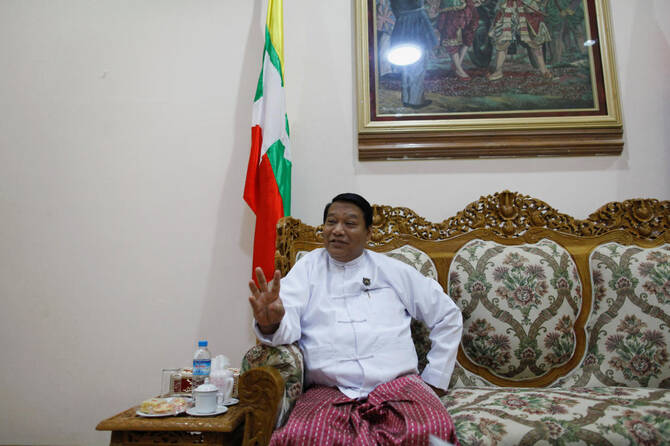
Retired Myanmar general set for powerful role in new parliament, sources say

Khin Yi, a retired brigadier general and former police chief, is tipped to take powerful role of speaker of Myanmar’s parliament. (Reuters)
Short Url
Updated 25 February 2026
Follow

Retired Myanmar general set for powerful role in new parliament, sources say

  • Khin Yi, a retired brigadier general and former police chief, is tipped to take the pivotal post of ‌lower house speaker
  • Myanmar’s unique power-sharing system gives ‌control of 25 percent of legislative seats to the military

A retired general from an army-backed party that swept Myanmar’s election is set to take the powerful role of speaker of parliament, party sources said, which could help the military cement control of government after a return to democratic rule.
A junta that has run Myanmar since a 2021 coup will formally cede power after a new parliament meets next month, with the top generals expected to loom large in politics after a resounding election win by the Union Solidarity and Development Party, which the military formed in 2010.
Three USDP sources told Reuters the party’s chairman, Khin Yi, a retired brigadier general and former police chief, is tipped to take the pivotal post of ‌lower house speaker.
In ‌that role, he would oversee the election of a new president, ‌the ⁠passage of laws ⁠and the approval of budgets and key state appointments.
The USDP did not respond to requests for comment on Khin Yi’s future role.
Military to dominate civilian politics
One of the sources, who all spoke on condition of anonymity as the issue is a sensitive one, said retired generals with close ties to junta chief Min Aung Hlaing were likely to become first and second vice presidents.
“Since there are high-ranking former military officers within the party, understanding their roles, the highest possible position for him ⁠would likely be the speaker of the lower house,” the source ‌said, speaking of Khin Yi.
Myanmar’s unique power-sharing system gives ‌control of 25 percent of legislative seats to the military that has ruled the country for five of ‌the past six decades, and also of the ministries of defense, border affairs and interior.
With ‌low voter turnout, a raging civil war and no viable opposition, the USDP won 81 percent of available seats in the upper and lower houses during the recent election, effectively putting the legislature under the military’s control.
In addition, a new five-member panel, the Union Consultative Council, will be set up to oversee both ‌military and civilian administration.
Experts say such a move will allow Min Aung Hlaing to become president without loosening his grip on the ⁠armed forces.
Power and influence
The ⁠post of speaker, held previously by political heavyweights, offers greater clout than the prestigious but largely ceremonial role of vice president, said independent political analyst Htin Kyaw Aye.
“This is a position with a high capacity for influence and action,” he said. “If one cannot be president, the position of speaker of the Hluttaw (parliament) is the one that allows for the greatest exercise of power.”
Another incoming USDP lawmaker said information about who would take the key posts in Myanmar was closely guarded and known among only the core leadership.
Two other members present at a recent USDP meeting said Khin Yi, a former immigration minister, had been asked informally if he would be vice president and responded by saying he would take a key parliamentary role.
“He said, ‘What is certain is that I think I will be leading in the legislative sectors of one of the houses of parliament’,” one of the sources quoted Khin Yi as saying at the meeting.


Tug of war: how US presidents battle Congress for military powers

Updated 01 March 2026
Follow

Tug of war: how US presidents battle Congress for military powers

  • The last official declaration of war by Congress was as far back as World War II

WASHINGTON, United States: Donald Trump’s unleashing of operation “Epic Fury” against Iran has once more underscored the long and bitter struggle between US presidents and Congress over who has the power to decide on foreign military action.
In his video address announcing “major combat” with the Islamic republic, Trump didn’t once mention any authorization or consultation with the US House of Representatives or Senate.
In doing so he sidelined not only Democrats, who called for an urgent war powers vote, but also his own Republican party as he asserts his dominance over a largely cowed legislature.
A US official said Secretary of State Marco Rubio had called top congressional leaders known as the “Gang of Eight” to give them a heads up on the Iran attack — adding that one was unreachable.
Rubio also “laid out the situation” and consulted with the same leaders on Tuesday in an hour-long briefing, the US official said.
According to the US Constitution, only Congress can declare war.
But at the same time the founding document of the United States first signed in 1787 says that the president is the “commander in chief” of the military, a definition that US leaders have in recent years taken very broadly.
The last official declaration of war by Congress was as far back as World War II.
There was no such proclamation during the unpopular Vietnam War, and it was then that Congress sought to reassert its powers.
In 1973 it adopted the War Powers Resolution, passed over Richard Nixon’s veto, to become the only lasting limit on unilateral presidential military action abroad.
The act allows the president to carry out a limited military intervention to respond to an urgent situation created by an attack against the United States.
In his video address on Saturday, Trump evoked an “imminent” threat to justify strikes against Iran.

- Sixty days -

Yet under this law, the president must still inform Congress within 48 hours.
It also says that if the president deploys US troops for a military action for more than 60 days, the head of state must then obtain the authorization of Congress for continued action.
That falls short of an official declaration of war.
The US Congress notably authorized the use of force in such a way after the September 11, 2011 attacks on the United States by Al-Qaeda. Presidents have used it over the past two decades for not only the 2001 invasion of Afghanistan but a series of operations in several countries linked to the “War on Terror.”
Trump is far from the first US president to launch military operations without going through Congress.
Democrat Bill Clinton launched US air strikes against Kosovo in 1999 as part of a NATO campaign, despite the lack of a green light from skeptical lawmakers.
Barack Obama did the same for airstrikes in Libya in 2011.
Trump followed their example in his first term in 2018 when he launched airstrikes in Syria along with Britain and France.
But since his return to power the 79-year-old has sought to push presidential power to its limits, and that includes in the military sphere.
Trump has ordered strikes on alleged drug trafficking boats in Latin America without consulting Congress, and in June 2025 struck Iran’s nuclear facilities.
Perhaps the most controversial act was when he ordered the capture of Venezuelan president Nicolas Maduro in a lightning military raid on January 3.
Republicans however managed to knock down moves by Democrats for a rare war powers resolution that would have curbed his authority over Venezuela operations.
Trump has meanwhile sought to extend his powers over the home front. Democrats have slammed the Republican for deploying the National Guard in several US cities in what he calls a crackdown on crime and immigration.