Two killed in suicide attack targeting security forces in Pakistan’s northwest

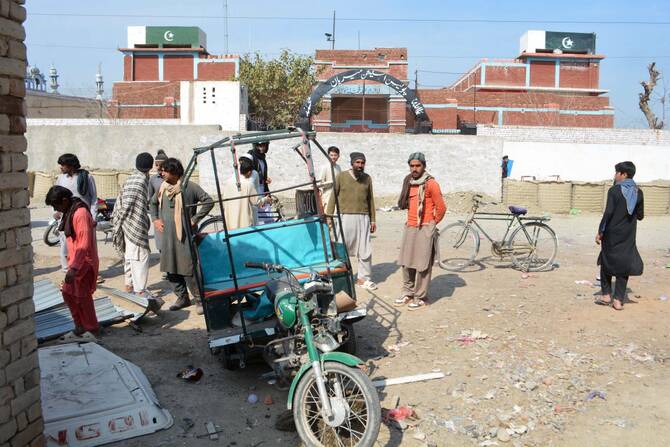
People gather at the site of an earlier bomb explosion in Bannu city of Pakistan’s Khyber Pakhtunkhwa province on Feb. 16, 2026. (AFP file photo)
Short Url
Updated 21 February 2026
Follow

Two killed in suicide attack targeting security forces in Pakistan’s northwest

ISLAMABAD: Two security personnel, including an officer, were killed, while multiple others sustained injuries when a suicide blast targeted their vehicle in Pakistan’s northwestern Khyber Pakhtunkhwa (KP) province, a police official said.

The suicide bomber hit his explosive-laden motorbike into an armored vehicle of security forces in Sara Darga area of KP’s Bannu district, according to a local police official who requested anonymity.

No group immediately claimed responsibility for the attack, but the Pakistani Taliban, or the Tehreek-e-Taliban Pakistan (TTP), have carried out similar assaults in the region in past.

“The attack had damaged the armored vehicle, causing deaths and injuries,” he told Arab News, adding that they suspected the Pakistani Taliban to be behind the attack.

Pakistan has struggled to contain a surge in militancy in KP, which borders Afghanistan, in recent years, with militant groups, particularly the TTP, frequently targeting security forces, law enforcers and government officials in the region.

Earlier this week, Pakistani Taliban militants rammed an explosive-laden vehicle into a checkpoint jointly manned by security forces and law enforcement agencies in KP’s Bajaur district, killing 11 security personnel among 12 people, the Pakistani military’s media wing said.

Islamabad accuses Afghanistan of allowing the use of its soil and India of backing militant groups for cross-border attacks against Pakistan. Kabul and New Delhi deny this.

* This article also appears on Arab News Pakistan


26 Doctors without Borders workers remain unaccounted for in South Sudan a month after attacks

Updated 4 sec ago
Follow

26 Doctors without Borders workers remain unaccounted for in South Sudan a month after attacks

  • A hospital in the town of Lankien was bombed by government forces, MSF said
  • “We have lost contact with them amid ongoing insecurity”

NAIROBI: More than two dozen Doctors Without Borders workers remain unaccounted for a month after attacks in South Sudan, the medical charity said.
Two facilities belonging to the group, known by French acronym MSF, were attacked on Feb. 3 in Jonglei State, northeast of the capital, Juba, where violence has displaced an estimated 280,000 people since December.
A hospital in the town of Lankien was bombed by government forces, MSF said, while another medical facility in the town of Pieri was raided by “unknown assailants.” Both were located in opposition-held areas.
Staff working at the two facilities fled alongside much of the local population into deeply rural areas where armed clashes and aerial bombardments were ongoing.
MSF said in a statement on Monday that “26 of 291 of our colleagues working in Lankien and Pieri remain unaccounted for.
“We have lost contact with them amid ongoing insecurity,” it said.
The lack of communication with its staff could be linked to the limited network connectivity in much of the state. Staff members who had been contacted described “destruction, violence and extreme hardships.”
Fighting escalated sharply in December, when opposition forces captured a string of government outposts in north central Jonglei. In January, the government responded with a counteroffensive that recaptured most of the area it had lost.
Displaced people in Akobo, an opposition-held town near the Ethiopian border, described horrific violence by government fighters. Many described not being able to find food or water as they walked for days to reach safety.
The attacks on MSF facilities in Lankien and Pieri are part of an uptick in violence on humanitarian staff, supplies and infrastructure, aid groups say. MSF facilities have been attacked 10 times in the last 12 months.
“This violence has taken an unbearable toll not only on health care services, but on the very people who kept them running,” said Yashovardhan, MSF head of mission in South Sudan, who only uses one name.
“Medical workers must never be targets,” he said. “We are deeply concerned about what has happened to our colleagues and the communities we serve.”