

Afghan national behind Bajaur suicide bombing that killed 11 security personnel in Pakistan — official

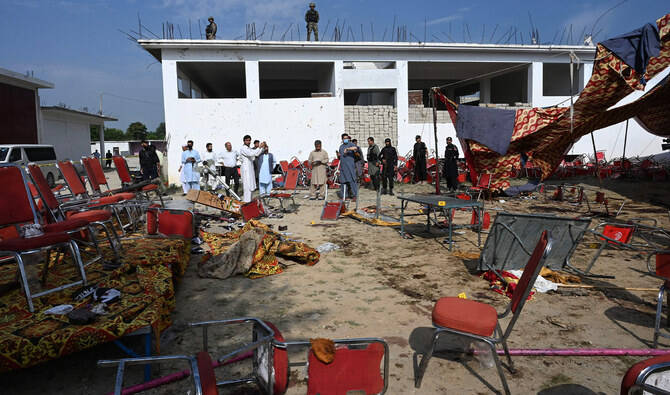
Security personnel examine the site of a bomb blast in Bajaur district of Khyber-Pakhtunkhwa province on July 31, 2023. (AFP/File)
Short Url
Updated 20 February 2026
Follow

Afghan national behind Bajaur suicide bombing that killed 11 security personnel in Pakistan — official

  • Pakistan’s foreign ministry delivered ‘strong demarche’ this week to Kabul over the attack
  • Security official links multiple attacks in Pakistan to militants operating from Afghan soil

ISLAMABAD: Pakistan has identified the suicide bomber behind a deadly attack in the northwestern district of Bajaur earlier this week as an Afghan national, a security official said amid accusations against the Taliban administration in Kabul of facilitating cross-border militancy.

The Feb. 16 suicide bombing at the Malangi post in Bajaur killed two civilians and 11 security personnel, prompting Pakistan’s foreign office to summon the Afghan deputy head of mission in Islamabad on Wednesday and deliver a “strong demarche” to Kabul over the attack.

“The suicide bomber was identified as Khariji Ahmad alias Qari Abdullah Abuzar, who was a resident of Balkh province, Afghanistan,” the official who spoke on condition of anonymity said, adding the attacker was also “part of the Taliban’s special forces.”

“The involvement of Afghan citizens in terrorism in Pakistan is clear evidence of the Taliban regime’s complete patronage and facilitation of terrorists,” he added.

Pakistan, which refers to militants as “Khwarij,” has repeatedly accused Afghanistan of sheltering proscribed armed groups such as the Tehreek-e-Taliban Pakistan (TTP) and the Balochistan Liberation Army (BLA), and of allowing them to launch attacks against Pakistani civilians and security forces. Kabul denies providing safe havens to militants targeting Pakistan.

The official said investigations had established links between the attacker and networks operating from Afghan territory.

According to the security official, several recent attacks in Pakistan had also been traced to Afghanistan, including a suicide bombing in Islamabad on Feb. 6 and assaults last year on a Judicial Complex in Islamabad and the Frontier Corps headquarters in Peshawar.

Authorities have previously said Afghan nationals were involved in attacks on the Dera Ismail Khan Police Training Center and the Wana Cadet College.

The official also cited the March 4, 2025 attack on Bannu Cantonment and the March 11, 2025 Jafar Express attack, saying their planners or facilitators had operated from across the border.
In another case, a suicide bomber arrested in September 2024 had confessed to receiving training in Afghanistan, he added.

Tensions between the two countries have flared repeatedly over security concerns. Last year, Pakistan shut several major border crossings with Afghanistan in October following one of the deadliest military escalations between the neighbors in recent years, which claimed dozens of lives on both sides.

Pakistan’s foreign office has said border crossings will remain closed until Kabul provides credible written assurances that it will prevent cross-border militant attacks and act against groups such as the Pakistani Taliban that Islamabad says operate from safe havens in Afghanistan.

Afghanistan’s Taliban-led government has consistently rejected Pakistan’s accusations, saying it does not allow its territory to be used against other countries.


Pakistan rice exports slump 40% as India’s return hits pricing power

Updated 24 February 2026
Follow

Pakistan rice exports slump 40% as India’s return hits pricing power

  • Statistics show non-Basmati shipments have fallen over 50 percent in July-January period
  • Government offers 9 percent tax drawback on premium Basmati exports to support sector

ISLAMABAD: Pakistan’s rice exports fell 40.5 percent to $1.31 billion in the first seven months of the fiscal year, official data showed on Tuesday, as India’s return to the global market squeezed Islamabad’s market share and pricing power.

According to the Pakistan Bureau of Statistics (PBS), non-Basmati exports dropped 50.8 percent to $827.8 million, with volumes falling to 2.0 million tons from 3.15 million tons a year ago. Basmati exports declined 6.62 percent to $477.7 million, with volumes easing to 436,484 tons from 487,278 tons.

The Ministry of National Food Security told a parliamentary committee in two separate meetings in December and January that India’s re-entry into the global rice market was a key factor behind the decline, saying increased Indian supplies had made Pakistani rice less competitive.

Officials told lawmakers that India benefits from free trade agreements and provides substantial support to its rice sector, putting additional pressure on Pakistani exporters.

In response, the Ministry of Commerce last month issued a notification under the “Drawback of Local Taxes and Levies for Rice Order, 2026,” allowing a rebate of 9 percent of the free-on-board (FOB) value for Basmati exports priced above $750 per metric ton.

The government said the measure, announced on January 23, aims to ease liquidity pressures on exporters and improve competitiveness.

While PBS data for July-January shows a 40.5 percent decline, figures from the Federal Board of Revenue (FBR) for July-December show an even steeper 47 percent drop to $973 million from $1.82 billion in the same period last year, reflecting a deficit of over $800 million.

Industry representatives say they are now focusing on market diversification to counter the slowdown.

“Currently Basmati is mainly exported to Middle East and EU. Non-Basmati is exported to Philippines, Indonesia, Malaysia and African countries,” Malik Faisal Jahangir, chairman of the Pakistan Rice Exporters Association, told Arab News last week.

“For the new markets for our non-basmati rice exports, we are looking to increase our volumes to China, Philippines, Indonesia and Bangladesh,” he added.