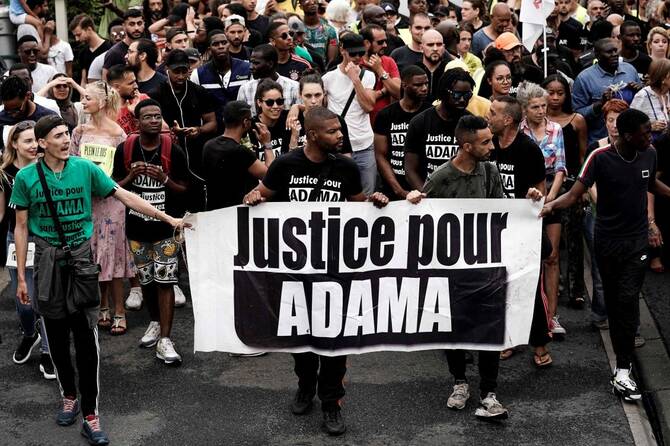
PARIS: France’s top court on Wednesday ruled against reopening an investigation into the 2016 death of a young black man in police custody, confirming a previous decision to dismiss the case against three arresting officers.
The Court of Cassation’s decision definitively closes the case nearly a decade after the death of 24-year-old Adama Traore following his arrest in the Paris suburb of Beaumont-sur-Oise, a fatality that triggered national outcry over police brutality and racism.
Traore’s family was contesting a 2024 appeal court ruling confirming a prior decision to drop the case, after an investigation led to no charges against the military policemen — or gendarmes — involved and therefore no case in court.
A lawyer representing his family announced after Wednesday’s ruling they would take the case to the European Court of Human Rights to “have France convicted.”
Three gendarmes pursued the young man on July 19, 2016, when temperatures reached nearly 37C, pinning him down in an apartment, after which he told officers he was “having trouble breathing.”
He then fainted during the journey to a gendarmerie station, where he died.
Probably not fatal
In 2023, French investigating magistrates dropped the case against the three gendarmes, in a ruling that was upheld on appeal in 2024.
They had been tasked with probing whether the three arresting officers used disproportionate force against Traore during a police operation targeting his brother, Bagui.
According to the magistrates, Traore’s death was caused by heatstroke that “probably” would not have been fatal without the officers’ intervention — though it concluded their actions were within legal bounds.
His family however has accused the gendarmes of failing to help the young man, who was found by rescue services unconscious and handcuffed behind his back.
In their appeal, Traore’s family criticized the justice system for not carrying out a reconstitution of events as part of the investigation.
But prosecutors requested that the appeal be dismissed.
Internal investigations
Activists have repeatedly accused French police of violence and racism, but few cases make it to criminal court in France as most are dealt with internally.
In January, several thousand people protested in Paris over the death in custody of a Mauritanian immigrant worker, El Hacen Diarra, 35, who died after passing out at a police station following his violent arrest.
Paris police launched an internal investigation after video filmed by neighbors, shared on social media, showed a policeman punching what appears to be a man on the ground as another officer stands by and watches.
In 2024, a judge gave suspended jail sentences to three officers who inflicted irreversible rectal injuries to a black man, Theo Luhaka, during a stop-and-search in 2017.
Prosecutors have also called for a police officer to be tried over the 2023 killing of a teenager at a traffic stop, in a case that sparked nationwide protests.
A court is to rule in March whether he will face a criminal trial over the killing of 17-year-old Nahel M.
Europe’s top rights court in June condemned France over its police discriminating against a young man during identity checks, in the first such ruling against the country over alleged racial profiling.


![]()

French court rejects bid to reopen probe into black man’s death in custody
Short Url
https://arab.news/87j6t
French court rejects bid to reopen probe into black man’s death in custody
- Europe’s top rights court in June condemned France over its police discriminating against a young man during identity checks, in the first such ruling against the country over alleged racial profiling


Latest updates


Recommended


© 2026 SAUDI RESEARCH & PUBLISHING COMPANY, All Rights Reserved And subject to Terms of Use Agreement.