

France calls for witnesses after ex-teacher charged with sexual abuse of 89 minors

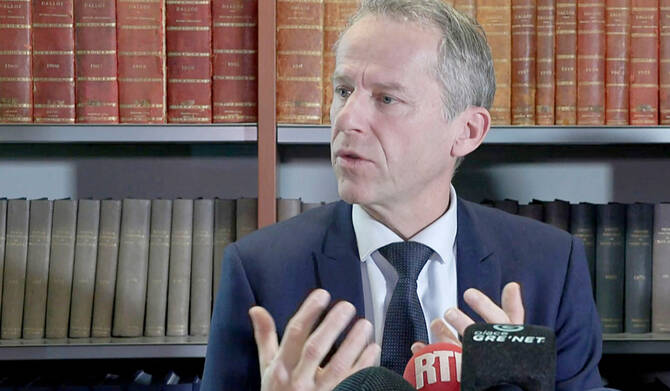
In this video grab from AFP TV, Grenoble public prosecutor Etienne Manteaux speaks during a press conference in Grenoble on February 10, 2026. (AFP)
Short Url
Updated 10 February 2026
Follow

France calls for witnesses after ex-teacher charged with sexual abuse of 89 minors

  • In May last year, a French court sentenced retired doctor Joel Le Scouarnec to 20 years in prison after he confessed to sexually abusing or raping 298 patients between 1989 and 2014

GRENOBLE, France: A French prosecutor on Tuesday appealed for further testimony in a mass abuse case across nine countries, after charging a 79-year-old former educator with rape and sexual assault of 89 minors since the 1960s.
Prosecutor Etienne Manteaux spoke to reporters in the southeastern city of Grenoble to publicize the case of the former teacher, who had also confessed to killing his terminally ill mother and his elderly aunt.
In an unusual move, French authorities named the suspect, Jacques Leveugle, who was born in 1946 in Annecy, an Alpine town an hour’s drive away from Grenoble. 


This handout image released by France's Gendarmerie Nationale on February 10, 2026, shows a public appeal notice bearing portraits, taken in different years and locations, of Jacques Leveugle, a 79-year-old man who have charged in 2024 for aggravated rape and sexual assault committed against 89 minors. (AFP)

“This name must be known because the aim is to enable potential victims to come forward,” the prosecutor said.
When asked why prosecutors did not reveal the information when Leveugle was placed under investigation, Manteaux said that it was a “somewhat unusual case, and we wanted to first ensure the veracity of the facts.”
Then “it became essential to allow victims who could not be identified and who were not going to be heard to come forward,” he added.
Leveugle, who is accused of committing sexual crimes against minors between 1967 and 2022, has been in custody since his indictment in 2024, the prosecutor said.
In May last year, a French court sentenced retired doctor Joel Le Scouarnec to 20 years in prison after he confessed to sexually abusing or raping 298 patients between 1989 and 2014.
Of those, more than 250 victims were under 15 years old.
Victims and child rights advocates say that case highlighted systemic flaws that allowed Le Scouarnec to repeatedly commit sexual crimes.
Leveugle allegedly committed the crimes against minors in Germany, Switzerland, Morocco, Niger, Algeria, the Philippines, India, Colombia, and the French overseas territory of New Caledonia, where he worked as a freelance teacher and instructor, said the prosecutor.
His varied roles included instructor of speleology, or the study of caves, and French teacher.
“He traveled to these different countries and in each of these places where he settled to provide tutoring and teach, he would meet young people and have sexual relations with them,” according to the prosecutor.
The number of victims was established from writings compiled on a USB drive by the man, which refer to “sexual relations” with minors aged 13 to 17.
The USB stick on which the documents were stored by the man was discovered by his nephew, who was “questioning his uncle’s emotional and sexual life,” Manteaux added.
It “contains 15 tomes of very dense material, and investigators will review and read all of these writings and identify 89 minors,” he said.
During the investigation, the man also confessed to suffocating his mother — a terminally ill cancer patient — with a pillow in the 1970s, according to the prosecutor.
He also suffocated his 92-year-old aunt, also with a pillow, in the 1990s, the prosecutor said.
Leveugle had to travel and the aunt “begged him not to go.”
“He decided to kill her too, so while she was asleep, he took a pillow and suffocated her,” the prosecutor said.
In his “memoirs,” the man had written that he had “killed two people,” Manteaux said.
A separate murder investigation has been launched.
The suspect “justifies his actions by saying that he would like someone to do the same for him if he found himself in this end-of-life situation,” the prosecutor said.


‘No to the war’: Spain digs in as rift with US deepens

Updated 10 sec ago
Follow

‘No to the war’: Spain digs in as rift with US deepens

  • Pedro Sanchez: ‘We will not be complicit in something that is harmful to the world and contrary to our values and interests’
  • US forces use the Rota naval base and Moron air base in southern Spain under an agreement signed in 1953 under the dictatorship of General Francisco Franco

MADRID: Spain’s prime minister defiantly posted “No to the war” on Wednesday, deepening a rift with the United States after Madrid refused the use of its bases to attack Iran and Washington threatened trade reprisals.
Spain’s Socialist Prime Minister Pedro Sanchez had already angered US President Donald Trump with a series of other policies.
Sanchez has refused to join NATO allies in a pledge to boost defense spending to five percent of GDP as demanded by Trump, and has fiercely criticized Israel’s war in Gaza.
Trump lashed out at Sanchez’s government on Tuesday, calling Spain a “terrible” ally and threatening to sever all trade with Spain.
Sanchez defended his position on Wednesday, saying his government’s position “can be summed up in four words: no to the war.”
“We will not be complicit in something that is harmful to the world and contrary to our values and interests, simply out of fear of retaliation,” he added in a televised address.
Spain is part of the European Union, which allows goods to move freely between its 27 countries. This would complicate any bid to impose trade restrictions on a single member state.
“Trump’s words don’t always become policy. We will have to see if he follows through, and how,” said Angel Saz Carranza, director of the Esade Center for Global Economy and Geopolitics, a Spanish think tank.
European Council chief Antonio Costa wrote on X that he had called Sanchez to “express the EU’s full solidarity with Spain.”
“The EU will always ensure that the interests of its member states are fully protected,” Costa said.
French President Emmanuel Macron also called to “express France’s European solidarity in response to the recent threats of economic coercion targeting Spain,” his office said.

‘Oppose this disaster’

US forces use the Rota naval base and Moron air base in southern Spain under an agreement signed in 1953 under the dictatorship of General Francisco Franco.
During the 2003 invasion of Iraq, Spain, then led by conservative prime minister Jose Maria Aznar, staunchly backed the United States by sending troops.
Spain’s participation in the Iraq war sparked huge street demonstrations and many Spaniards blame it for the March 11, 2004 Madrid train bombings that killed nearly 200 people.
A branch of Al-Qaeda claimed responsibility for the attacks and called for the withdrawal of Spanish forces from Iraq.
Sanchez on Wednesday compared the Iran attacks to the Iraq war, which he said increased terrorism, increased energy prices and led to a less secure world.
“We oppose this disaster,” he said in reference to the Iran war.
In contrast, neighboring Portugal authorized the United States to “conditionally” use an air base on the Azores archipelago in the Atlantic Ocean for the Iran strikes, Prime Minister Luis Montenegro told parliament on Wednesday.
The authorization was granted as long as “these operations are defensive or retaliatory, are necessary and proportionate, and exclusively target military objectives,” Montenegro said.
The conservative leader said those conditions were “aligned with international law,” but he declined to openly support Sanchez or take a stance on the US-Israeli strikes on Iran.

Rally his base

The Spanish prime minister has emerged as a prominent figure for Europe’s disillusioned progressives, who see him as one of the few remaining openly leftist voices in a continent increasingly dominated by right-wing politics.
His opposition to the use of the bases is seen by some analysts as an attempt to rally his supporters around an issue that unites the Spanish left.
Sanchez, in power since 2018, heads a minority coalition government that struggles to pass legislation.
The popularity of his Socialist party has taken a hit from a string of sexual harassment and graft scandals ahead of the next general election due in 2027.
Many on Spain’s right consider Sanchez’s opposition to Trump as motivated more by domestic politics than by a moral compass.
The head of the main opposition conservative Popular Party which tops opinion polls, Alberto Nunez Feijoo, accused Sanchez on X of using foreign policy for “partisan” purposes.
Left-leaning daily newspaper El Pais urged Sanchez in an editorial on Wednesday to “resist the temptation” to “exploit widespread hostility toward Trump in Spanish society to boost his popularity.”