

Filipinos worry about future as Manila posts worst economic growth in 15 years

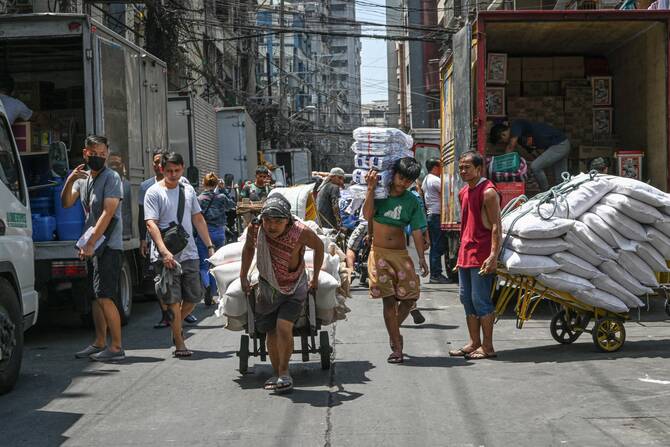
Men pull a trolley of agricultural products along a street in Manila on May 9, 2024. (AFP)
Short Url
Updated 31 January 2026
Follow

Filipinos worry about future as Manila posts worst economic growth in 15 years

  • Philippine economy slowed to weakest pace last quarter, with only 3.0 percent growth
  • Filipinos struggle with high prices, increased business cost, reduced savings 

MANILA: Over ten years ago, when Fatima Macud brought home roughly 30,000 pesos ($509) a month, the money was enough to cover her expenses and still leave room for savings.

Though she now earns 45,000 pesos, Macud finds herself unable to save any money as she struggles with rising prices to cover daily spending. 

“Yes, I got a salary increase, but the thing is, the cost of living here in the city also increased,” the 52-year-old resident of Metro Manila told Arab News on Saturday.

“Now for me, it barely covers my basic needs because the price of commodities just keeps rising — goods, services, everything … Everything feels way too expensive … Now, I can’t save money at all. It’s not enough.” 

The Philippine economy has slowed to the weakest pace in nearly 15 years outside of the pandemic, with data from the Philippines Statistics Authority showing just 3.0 percent growth in October to December, compared with 5.3 percent from the same period a year earlier. 

The full-year growth in 2025 settled at 4.4 percent, below the 5.7 percent posted in 2024 and lower than the government’s revised target of at least 4.8 percent. 

It was the result of “several converging factors,” Economic Planning Secretary Arsenio Balisacan told reporters earlier this week. 

“These include the adverse economic effects of weather and climate-related disruptions. Admittedly, the flood control corruption scandal also weighed on business and consumer confidence,” he said. 

But on the ground, Filipinos were more concerned about their day-to-day lives, and the state of the economy has begun to spark new worries about the future. 

“I am worried about my future,  especially my retirement. If the government is in a bankruptcy state or ends up in financial trouble, will they be able to pay my pension? Can I still avail the free health services with full benefits?” Macud said. 

“I’m also worried about my family’s future; the rising cost of living and the lack of employment opportunities.”

Olga Resureccion, a 52-year-old worker in Manila, is among those who believes the government has been “trying its best,” and is keeping her hopes alive. 

“You can’t lose hope,” she said. “Most people are still able to provide for themselves and their family. Like (me), I’m able to provide. You just really need to work hard.” 

Yet for entrepreneurs such as John Paul Maunes, the economic slowdown was taking a toll on his small restaurant in Cebu City, as he struggled with increasing prices of supplies, taxes and cost of government permits. 

“I think people from the ground, especially business owners, are really struggling right now. Particularly those who are SMEs (small and medium enterprises),” Maunes said. 

“We cannot increase our prices the way we want it because we’ll lose our customers. And at the same time, we are also struggling on how we can cope with the rising prices of commodities. Plus, the government permits and taxes are increasing every year.” 

Over the years, the 41-year-old has had to lay off employees to survive, while hoping for more government support and opportunities through economic growth. 

“We have this fear of impending doom as small business owners … With the increasing prices and economic impact on us on the ground, it’s a huge challenge,” he said.

 “We’re just hoping that better things will come for our government, for our economy.”


Regional health organization issues alert as measles cases surge across the Americas

Updated 5 sec ago
Follow

Regional health organization issues alert as measles cases surge across the Americas

  • In the first three weeks of 2026, PAHO confirmed 1,031 new measles cases across seven countries — a staggering 43-fold increase compared to the same period last year

MEXICO CITY: The Pan American Health Organization, PAHO, on Wednesday issued a new epidemiological alert following a surge of measles cases across the Americas, with Mexico reporting the highest numbers. It also called for urgent vaccination campaigns, highlighting that 78 percent of recent cases involved unvaccinated people.
The alert follows Canada’s loss of measles-free status in November — a setback the United States and Mexico could soon mirror. While both governments have requested a two-month extension to contain their respective outbreaks, the situation is complicated by the Trump administration’s January withdrawal from the World Health Organization, the parent agency of PAHO.
Current data is discouraging; the upward trend persists with only months remaining before the 2026 FIFA World Cup kicks off across the three North American host nations.
In the first three weeks of 2026, PAHO confirmed 1,031 new measles cases across seven countries — a staggering 43-fold increase compared to the same period last year.
While no deaths have been reported thus far, the concentration remains high: Mexico leads with 740 cases, followed by the United States with 171 and Canada with 67.
The state of Jalisco, in western Mexico, has recorded the country’s highest incidence rate this year, following last year’s major outbreaks in Chihuahua and neighboring Texas.
In the United States, public health attention has shifted toward South Carolina, where cases are rising. In response, the Mexican government has spent weeks urging the public to receive the two-dose vaccine.
Authorities have even established mobile vaccination clinics in high-traffic hubs like airports and bus terminals, while in the capital, Mayor Clara Brugada launched 2,000 new vaccination modules this week.
“Everyone under 49 years of age, please get vaccinated,” Brugada urged on Tuesday, emphasizing that the vaccine is now accessible throughout the city. To maximize reach, the new modules are being stationed outside health centers and within major subway stations, bringing the campaign directly to the city’s busiest transit corridors.
PAHO’s alert follows a year of sustained growth in measles cases — the highest in five years — driven by a global resurgence and what the agency describes as “persistent immunization gaps.”
While adolescents and young adults account for the largest volume of cases, the highest incidence rates are striking children under the age of one. The disparity underscores a critical need to reinforce second-dose coverage.
Regional data is grim: only 33 percent of countries have reached the 95 percent threshold for the first vaccine dose, and a mere 20 percent have achieved it for the second.