How developing countries can make the most of AI

https://arab.news/8cpxu
Since the 2008 global financial crisis, industrial policy has crept back into respectable economic discourse after decades of being derided as misguided interventionism, particularly for developing countries. But its renaissance is being led by the advanced economies that once rejected it, with the push into artificial intelligence and renewable energy hastening the shift.
For developing countries, this revival presents new opportunities, provided they can manage three major constraints: a weak enabling environment (a lack of infrastructure and other necessary inputs), limited autonomy in policymaking, and fiscal constraints. Industrial policy is often understood in terms of subsidies and tax breaks, but for many developing economies far more than these instruments must be put in place. Without reliable digital connectivity, dependable power supplies, trusted data protection regimes and a skilled workforce, ambitions for AI-led growth will amount to little more than rhetoric.
Developing countries’ policy options are also constrained because World Trade Organization rules limit the use of instruments — export-contingent subsidies, local content rules and technology transfer requirements — that once underpinned industrialization success stories, namely in East Asia. At the same time, major economies continue to march to their own drummer, with the US, the EU and China deploying industrial policy at scale, often bending or breaking the very rules that others are expected to observe. The asymmetry is obvious: of more than 2,500 industrial policy measures introduced globally in 2023, these three economies accounted for almost half.
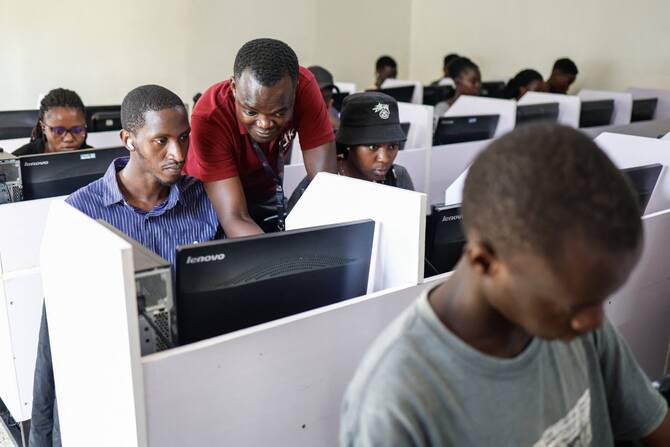
For developing countries, the sensible approach to AI is to deploy the sophisticated frontier models that are already available
Shamika Sirimanne and Taffere Tesfachew
Finally, fiscal limits are biting hard. In many developing economies, up to 80 percent of public spending goes to wages and debt service, leaving little for the long-term investments that industrialization requires. Unlike the US or the EU, poorer countries cannot summon vast subsidy packages or bankroll multibillion-dollar technology programs.
And while technology parks and incubators have multiplied across Africa and Asia, few have delivered meaningful results. As UN Trade and Development observes, such zones succeed only when anchored in established supply chains. Without that grounding, they risk becoming costly white elephants — impressive on paper but inert in practice.
For developing countries, the sensible approach to AI is to deploy the sophisticated frontier models that are already available. Unburdened by legacy infrastructure, developing countries can leapfrog directly into emerging technologies, as many did when they skipped over landlines and went straight to mobile telephony. Deploying AI costs a fraction of what it takes to build it. Anyone can use tools like ChatGPT without erecting data centers or assembling elite engineering teams.
Such targeted applications can be transformative. In healthcare, AI-assisted diagnostics can rationalize the use of scarce clinical capacity. In education, digital platforms can compensate for chronic shortages of teachers. In agriculture, predictive analytics can support farmers navigating climate volatility. These uses may not dazzle those on the technological cutting edge, but they can deliver real-world returns where they matter most.
They also represent industrial policy at its most effective — meaning pragmatic, experimental and oriented around domestic realities. As Dani Rodrik argues, “success lies not in following a fixed blueprint but in identifying sectors where public action can unlock hidden potential.”
To be sure, even a modest innovation agenda requires funding and domestic venture capital remains scarce in many developing economies, where private wealth tends to migrate abroad. But governments can build institutions to crowd in more private capital, such as through blended finance, sovereign innovation funds, targeted guarantees and regional technology hubs. Donors, too, can (and should) scale up support. According to the Organisation for Economic Co-operation and Development, the information and communications technology sector receives barely 2 percent of total aid-for-trade disbursements, far short of what is needed to build digital capabilities.
Governments in developing countries must also use digital technologies to increase efficiency, especially in revenue collection, in order to create sorely needed fiscal space. UNCTAD’s work on customs digitalization offers a useful illustration. In Angola, one of Africa’s largest oil-dependent economies, the move to digitalized customs procedures produced striking fiscal gains, with revenues rising 44 percent in one year and 13 percent the next as analog bottlenecks were dismantled.
Governments in developing countries must also use digital technologies to increase efficiency, especially in revenue collection
Shamika Sirimanne and Taffere Tesfachew
In Iraq, the returns were even larger. Once its principal border points were digitized, customs receipts soared more than 120 percent in a year. And in Bangladesh, one of Asia’s fastest-growing manufacturing economies, incremental digital reforms helped deliver average annual revenue growth of about 11 percent over several years, as compliance improved and leakages were stopped.
While international cooperation remains essential, global trade rules also must evolve to be more accommodating of digital and green industrialization strategies. The WTO’s Trade-Related Aspects of Intellectual Property Rights provisions might have made sense for the era in which they were designed, but they now hinder access to critical technologies. Patent regimes should enable broader diffusion, as compulsory licensing once did for lifesaving medicines.
Collaboration among developing countries is also important, because no single country can afford the scale of investment required for AI or clean tech. Shared platforms such as CERN (for research in physics) show how pooled expertise can spread costs, share risks and unlock mutual benefits. A more promising approach lies in collective innovation. For much of the Global South — which shares similar disease burdens and climate exposures, benefits from abundant data and draws on comparatively low-cost technical talent — innovating together is not only cost-effective but strategically prudent in an increasingly multipolar world.
The return of industrial policy marks a major shift in global economic thinking, but for developing countries it is a mixed blessing. The path to industrialization is now steeper, narrower and constrained by more demanding technological and regulatory standards. Yet the challenge is far from insurmountable. By investing in foundational capabilities, targeting high-impact applications of AI, mobilizing innovative financing and using the policy space that already exists, countries can still accelerate their development. Success will depend not on the imitation of rich-country models, but on pragmatic adaptation to local realities.
- Shamika Sirimanne is Senior Adviser to the Secretary-General of UN Trade and Development (UNCTAD).
- Taffere Tesfachew is Senior Adviser at the Tony Blair Institute for Global Change.
Copyright: Project Syndicate