

Tens of thousands flee northwest Pakistan over fears of military operation

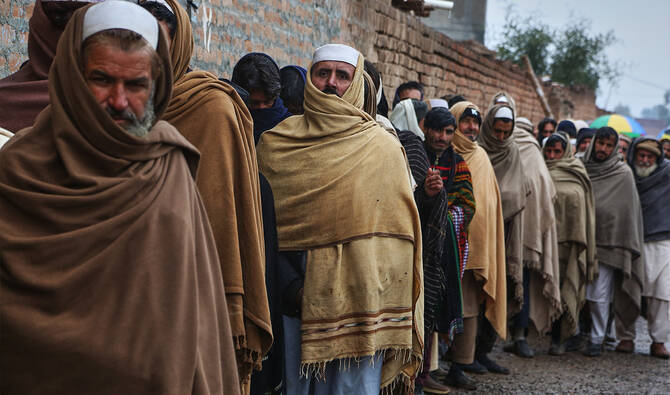
People who fled from Tirah, a town in the Khyber Pakhtunkhwa province, amid uncertainty over a military operation against the Pakistani Taliban, wait for their turn outside a registration center in Bara, a town of Pakistan's northwestern Khyber district, Tuesday, Jan. 27, 2026. (AP)
Short Url
Updated 28 January 2026
Follow

Tens of thousands flee northwest Pakistan over fears of military operation

  • More than 70,000 people, mostly women and children, have fled remote Tirah region bordering Afghanistan 
  • Government says no military operation underway or planned in Tirah, a town in Khyber Pakhtunkhwa province

BARA, Pakistan: More than 70,000 people, mostly women and children, have fled a remote region in northwestern Pakistan bordering Afghanistan over uncertainty of a military operation against the Pakistani Taliban, residents and officials said Tuesday.

Pakistan’s Defense Minister Khawaja Mohammad Asif has denied the claim by residents and provincial authorities. He said no military operation was underway or planned in Tirah, a town in Khyber Pakhtunkhwa province.

Speaking at a news conference in Islamabad, he said harsh weather, rather than military action, was driving the migration. His comments came weeks after residents started fleeing Tirah over fears of a possible army operation.

The exodus began a month after mosque loudspeakers urged residents to leave Tirah by Jan. 23 to avoid potential fighting. Last August, Pakistan launched a military operation against Pakistani Taliban in the Bajau r district in the northwest, displacing hundreds of thousands of people.

Shafi Jan, a spokesman for the provincial government in Khyber Pakhtunkhwa, posted on X that he held the federal government responsible for the ordeal of the displaced people, saying authorities in Islamabad were retracting their earlier position about the military operation.

Khyber Pakhtunkhwa Chief Minister Suhail Afridi, whose party is led by imprisoned former Prime Minister Imran Khan, has criticized the military and said his government will not allow troops to launch a full-scale operation in Tirah.

The military says it will continue intelligence-based operations against Pakistani Taliban, who are known as Tehrik-e-Taliban Pakistan, or TTP. Though a separate group, it has been emboldened since the Afghan

Taliban returned to power in 2021. Authorities say many TTP leaders and fighters have found sanctuary in Afghanistan and that hundreds of them have crossed into Tirah, often using residents as human shields when militant hideouts are raided.

Caught in the middle are the residents of Tirah, who continued arriving in Bara.

So far, local authorities have registered roughly 10,000 families — about 70,000 people — from Tirah, which has a population of around 150,000, said Talha Rafiq Alam, a local government administrator overseeing the relief effort. He said the registration deadline, originally set for Jan. 23, has been extended to Feb. 5.

He said the displaced would be able to return once the law-and-order situation improves.

Among those arriving in Bara and nearby towns was 35-year-old Zar Badshah, who said he left with his wife and four children after the authorities ordered an evacuation. He said mortar shells had exploded in villages in recent weeks, killing a woman and wounding four children in his village. “Community elders told us to leave. They instructed us to evacuate to safer places,” he said.

At a government school in Bara, hundreds of displaced lined up outside registration centers, waiting to be enrolled to receive government assistance. Many complained the process was slow.

Narendra Singh, 27, said members of the minority Sikh community also fled Tirah after food shortages worsened, exacerbated by heavy snowfall and uncertain security.

“There was a severe shortage of food items in Tirah, and that forced us to leave,” he said.

Tirah gained national attention in September, after an explosion at a compound allegedly used to store bomb-making materials killed at least 24 people. Authorities said most of the dead were militants linked to the TTP, though local leaders disputed that account, saying civilians, including women and children, were among the dead.


Pakistan urges UN Security Council to sanction separatist BLA group after recent attacks

Updated 05 February 2026
Follow

Pakistan urges UN Security Council to sanction separatist BLA group after recent attacks

  • Separatist BLA launched attacks in multiple Balochistan cities last week, killing over 50 as per official figures
  • Pakistan envoy says since Taliban assumed control of Afghanistan, BLA, other militant groups have a “new lease of life“

ISLAMABAD: Pakistan’s UN Ambassador Iftikhar Ahmed this week urged the Security Council to impose sanctions against the separatist Baloch Liberation Army (BLA) militant group and designate it as a “terrorist” group, after its recent coordinated attacks in southwestern Balochistan province. 

Pakistan’s military said on Thursday it has concluded security operations in Balochistan against separatists that was launched since Jan. 29, killing 216 militants. The military launched counteroffensive operations in Balochistan after the BLA said it launched coordinated attacks in several parts of the province last Friday and Saturday. 

The attacks killed 36 civilians and 22 law enforcement and security forces personnel, Pakistan’s military said. Pakistan’s government has accused India of being involved in the attacks, charges that New Delhi has dismissed. 

“We hope the Council will act swiftly to designate BLA under the 1267 sanctions regime acceding to the listing request that is currently under consideration,” Iftikhar said on Wednesday during a UNSC briefing on the topic ‘Threats to International Peace and Security caused by Terrorist Acts.’

The 1267 sanctions regime is a UNSC program that seeks to impose sanctions on individuals and entities associated with “terrorism.”

The regime seeks to impose travel bans, freeze assets and impose an arms embargo on individuals and groups primarily associated with Al-Qaeda or the Taliban. 

Ahmad said that after the Taliban takeover of Afghanistan in 2021, “externally sponsored and foreign-funded proxy terrorist groups” such as the Tehreek-e-Taliban Pakistan and the BLA have got a “new lease of life.”

“Operating with virtual impunity from Afghan soil and with the active support of our eastern neighbor, these groups are responsible for heinous terrorist attacks inside Pakistan,” he said. 

The Pakistani envoy said it has become imperative to prevent billions of dollars of sophisticated weapons and equipment, which were left behind by foreign forces in Afghanistan, “from falling into the hands of terrorists.”

“There must be accountability of external destabilizing actors who support, finance and arm these groups, including their proxies in Afghanistan,” Ahmad said in a veiled reference to India. 

Pakistan’s largest and poorest province, mineral-rich Balochistan borders Iran and ‌Afghanistan and is home to China’s investment in the Gwadar deep-water ‍port and other projects.

Balochistan has been the site of a ‍decades-long insurgency led by ethnic Baloch separatists seeking greater autonomy and a larger share of its natural ‍resources. 

They accuse the state of denying locals a fair share of the province’s mineral wealth, charges that are denied by the Pakistani government.