

UN experts denounce Switzerland for sentencing students over Gaza protests

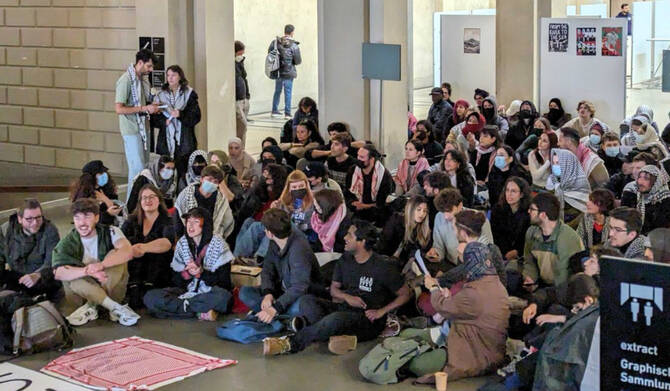
Around 70 students at the Swiss university ETH Zurich took part in a peaceful sit-in in May 2024 ‌as part ‌of student demonstrations in ‌several ⁠cities ​during ‌the Gaza war before being dispersed by police. (X @ETH_en)
Short Url
Updated 27 January 2026
Follow

UN experts denounce Switzerland for sentencing students over Gaza protests

  • “Peaceful student activism, on and off campus, is part ⁠of students’ rights to freedom of expression and peaceful ‌assembly, and must not be ‍criminalized,” the UN ‍experts said

GENEVA: UN human rights experts said on Tuesday they had protested ​to Switzerland after a group of students was sentenced for trespassing after taking part in pro-Palestinian protests at a Swiss-funded university.
Around 70 students at the Swiss university ETH Zurich took part in a peaceful sit-in in May 2024 ‌as part ‌of student demonstrations in ‌several ⁠cities ​during ‌the Gaza war before being dispersed by police.
Students who took part in the protests were opposing the Swiss facility’s partnerships with Israeli universities, the UN experts said.
“Peaceful student activism, on and off campus, is part ⁠of students’ rights to freedom of expression and peaceful ‌assembly, and must not be ‍criminalized,” the UN ‍experts said, adding that they had written ‍to the Swiss government and the university to raise the issue.
A spokesperson for the Swiss Foreign Ministry confirmed it had received the message ​and that it would respond in due course. An ETH Zurich spokesperson ⁠did not immediately respond.
Five students have so far been sentenced for trespassing, resulting in suspended fines of up to 2,700 Swiss francs ($3,516), legal fees of over 2,000 Swiss francs and a criminal conviction on their records which could discourage future prospective employers, the UN experts said.
Ten others who appealed the charges await sentencing ‌and two others were acquitted, they said.


Brazil, India eye critical minerals deal as leaders meet

Updated 1 sec ago
Follow

Brazil, India eye critical minerals deal as leaders meet

  • The two leaders are expected to sign a memorandum on critical minerals and discuss efforts to increase trade links
NEW DELHI: India’s Prime Minister Narendra Modi and Brazilian President Luiz Inacio Lula da Silva are set to meet in New Delhi on Saturday, seeking to boost cooperation on critical minerals and rare earths.
Brazil has the world’s second-largest reserves of these elements, which are used in everything from electric vehicles, solar panels and smartphones to jet engines and guided missiles.
India, seeking to cut its dependence on top exporter China, has been expanding domestic production and recycling while scouting for new suppliers.
Lula, heading a delegation of more than a dozen ministers as well as business leaders, arrived in New Delhi on Wednesday for a global summit.
Officials have said that in talks with Modi on Saturday, the two leaders are expected to sign a memorandum on critical minerals and discuss efforts to increase trade links.
The world’s most populous nation is already the 10th largest market for Brazilian exports, with bilateral trade topping $15 billion in 2025.
The two countries have set a trade target of $20 billion to be achieved by 2030.
With China holding a near-monopoly on rare earths production, some countries are seeking alternative sources.
Rishabh Jain, an expert with the Delhi-based Council on Energy, Environment and Water think tank, said India’s growing cooperation with Brazil on critical minerals complements recent supply chain engagements with the United States, France and the European Union.
While these partnerships grant India access to advanced technologies, finance and high-end processing capabilities, “Global South alliances are critical for securing diversified, on-ground resource access and shaping emerging rules of global trade,” Jain said.
‘Challenges’
Modi and Lula are also expected to discuss global economic headwinds and strains on multilateral trade systems after both of their countries were hit by US tariffs in 2025, prompting the two leaders to call for stronger cooperation.
Washington has since pledged to roll back duties on Indian goods under a trade deal announced earlier this month.
“Lula and Modi will have the opportunity to exchange views on … the challenges to multilateralism and international trade,” said Brazilian diplomat Susan Kleebank, the secretary for Asia and the Pacific.
Brazil is India’s biggest partner in Latin America.
Key Brazilian exports to India include sugar, crude oil, vegetable oils, cotton and iron ore.
Demand for iron ore has been driven by rapid infrastructure expansion and industrial growth in India, which is on track to become the world’s fourth largest economy.
Brazilian firms are also expanding in the country, with Embraer and Adani Group announcing plans last month to build aircraft in India.
Lula addressed the AI Impact summit in Delhi on Thursday, calling for a multilateral and inclusive global governance framework for artificial intelligence.
He will travel on to South Korea for meetings with President Lee Jae Myung and to attend a business forum.