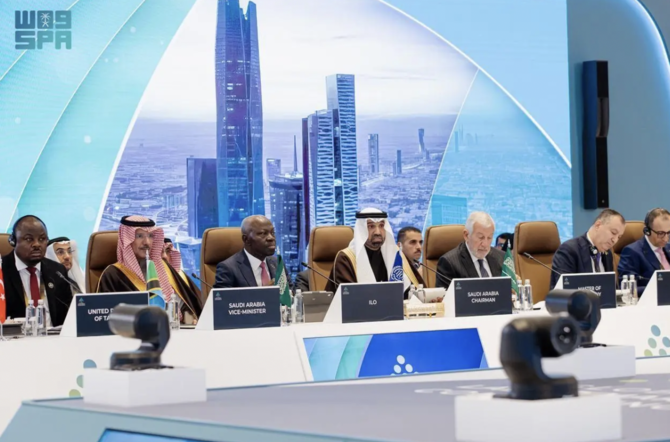

RIYADH: The ministerial meeting of the third International Labour Conference concluded Jan. 26 in Riyadh.
The meeting was chaired by Saudi Arabia’s Minister of Human Resources and Social Development Ahmed bin Sulaiman Al-Rajhi and attended by the Director-General of the International Labour Organization, Gilbert Houngbo, and 40 labor ministers from countries representing the G20, Europe, and Asia as well as the Middle East, Africa, and the Americas.
In his opening remarks, Al-Rajhi emphasized the importance of constructive dialogue, stressing that the ministerial meeting is a cornerstone for strengthening international cooperation.
He explained that it aims to facilitate the exchange of constructive visions and experiences among ministers and senior officials, focusing on practical experiences in current labor markets and areas of future cooperation capable of achieving tangible results.
The meeting’s discussions focused on a number of key themes, aiming to stimulate the practical exchange of experiences among participating countries and align employment policies with future workforce readiness requirements. It also focused on identifying the most effective factors for successful employment programs and determining the mechanisms necessary to ensure consistency and integration among labor market policies.
The gathering also resulted in an agreement among the participating ministers on six crucial actions. These include developing methodologies for skills recognition and transferability by improving skills recognition and enhancing their flexibility in the labor market to facilitate mobility between sectors and across borders.
They also agreed on guiding the responsible use of artificial intelligence in labor market systems by employing AI in workforce decisions while ensuring transparency, governance, and oversight.
An additional action focuses on adapting social protection systems to support mobility and career transitions by ensuring that social protection is transferred with workers as the nature of work and career paths change.
In addition, the ministers agreed on promoting the use of data to actively connect individuals with opportunities and strengthening the labor market infrastructure through data and analytics to support the link between employment and skills development.
They further agreed on enhancing workforce planning to anticipate periods of disruption by preparing employment systems to withstand economic shocks and structural shifts.
Finally, they committed to improving pathways to first employment and return to the labor market by enabling pathways that connect individuals with meaningful and valuable career advancement opportunities.
The ministerial meeting is a pivotal element of the International Labour Conference, which has become a leading global platform for promoting evidence-based dialogue and supporting international cooperation on the future of labor markets.
This is achieved in partnership with leading international organizations, including the ILO, the World Bank, and the Organization for Economic Co-operation and Development as well as the UN Development Program, the International Organization for Migration, and the UN Tourism Organization.
Additional organizations include the King’s Trust Fund International and the Mohammed bin Salman Foundation.
The International Labour Conference, taking place on Jan. 26 to 27 at the King Abdulaziz International Conference Center, is themed “Shaping the Future.” It features high-level participation from labor ministers, heads and representatives of international organizations, the private sector, and academic institutions as well as policymakers, thought leaders, and experts from around the world.
More than 200 speakers are participating in over 50 dialogue sessions, with an expected attendance of over 10,000 participants from within the Kingdom and abroad.