Jordan king orders restructuring of armed forces

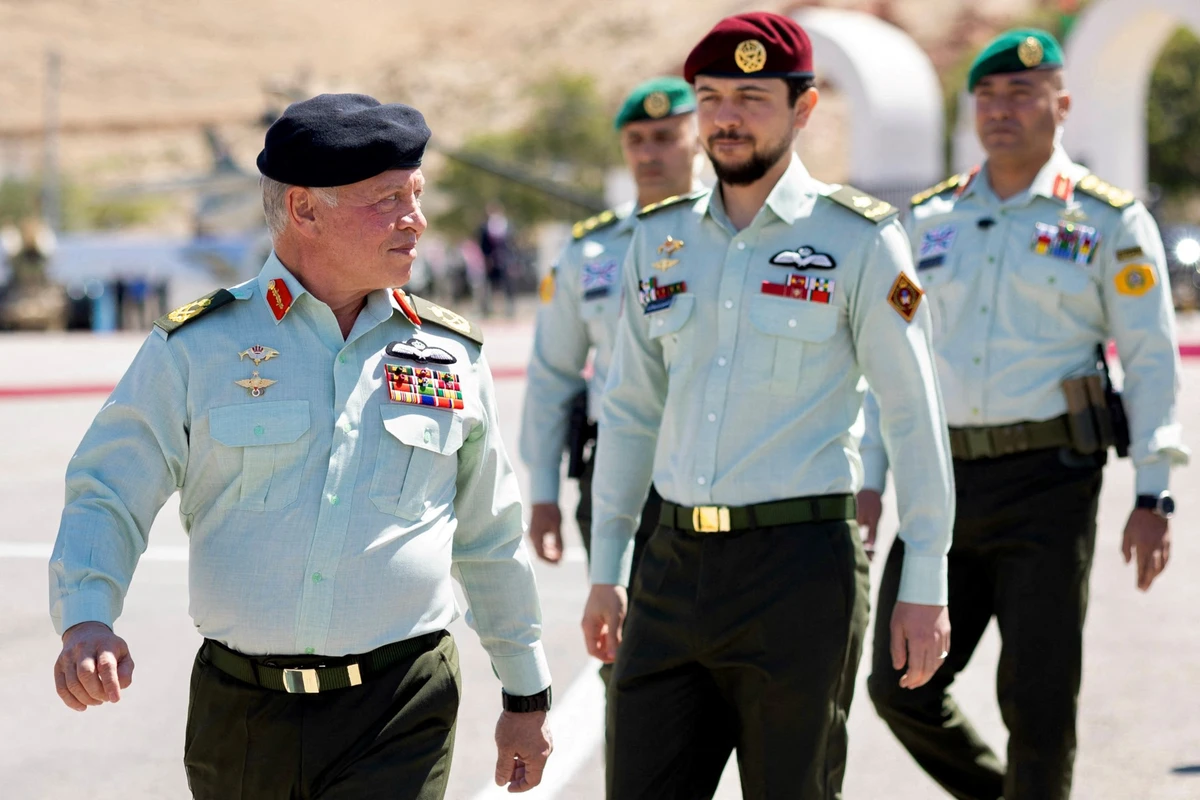
This handout picture released by the Jordanian Royal Palace shows Jordan's King Abdullah II (L) and his son Crown Prince Hussein (C) attending a ceremony marking the 57th anniversary of the Battle of al-Karamah during the War of Attrition with Israel, held by the Jordan Armed Forces-Arab Army at the Martyrs’ Memorial in al-Karamah in western Jordan on March 23, 2025. (AFP)
Short Url
Updated 24 January 2026
Follow

Jordan king orders restructuring of armed forces

  • Jordan's king orders strategy to transform army structure within three years

CAIRO: Jordan’s King Abdullah II announced Saturday the restructuring of the armed forces within three years, the Perta News Agency reported. 

King Abdullah, the Supreme Commander of the Jordan Armed Forces-Arab Army, announced a strategy “to achieve a structural transformation in the armed forces over the course of the next three years,” Petra said.

In a letter to the Chairman of the Joint Chiefs of Staff, the King wrote: “Our Arab Army is a national institution that every Jordanian is proud of.”

“We must examine the requirements for modernizing and developing our Armed Forces, while restructuring them to keep pace with combat demands within various environments of operation,” the king wrote. 

The king also said the army must have sufficient reserve forces reinforced with the necessary capabilities.

“Our Armed Forces must have sufficient reserve forces, equipped with the various needed capabilities to execute their operations efficiently.”
Dozen people entered Egypt from Gaza on first day of Rafah opening: source

Updated 7 sec ago
Follow

Dozen people entered Egypt from Gaza on first day of Rafah opening: source

RAFAH: A handful of injured Palestinians and their companions entered Egypt from Gaza on Monday, the first day of a limited reopening of the Rafah border crossing, a source on the Egyptian side of the border told AFP.
“Five injured people and seven companions” crossed the border, the source said on Tuesday.
The reopening, demanded by the United Nations and aid groups, is a key part of the second phase of US President Donald Trump’s truce plan for Gaza, where humanitarian conditions remain dire after two years of war.
The number of patients allowed to enter Egypt through the crossing was limited to 50 on Monday, each accompanied by two companions, according to three officials at the Egyptian border.
An Egyptian health official told AFP on Monday that three ambulances had arrived with Palestinian patients who were screened upon arrival to determine which hospital to be taken to.
AlQahera News, citing Egypt’s health ministry, reported that 150 hospitals and 300 ambulances had been prepared to receive Palestinian patients.
It said 12,000 doctors and 30 rapid deployment teams had been allocated to work with those transferred.
The director of Gaza City’s Al-Shifa Hospital, Mohammed Abu Salmiya, said there were 20,000 patients in the territory in urgent need of treatment, including 4,500 children.
There was no official announcement of the number of people who returned to Gaza via the crossing.
AFP images on Monday showed empty buses crossing back to Egypt after transporting Palestinians to Gaza earlier in the day.
The partial resumption of operations at the crossing comes after Israeli forces seized control of the gateway to Egypt in May 2024 during the war with Hamas.
Gaza’s civil defense reported dozens killed in a wave of Israeli strikes over the weekend, in what the military said was retaliation for Palestinian fighters exiting a tunnel in Rafah city.
Ali Shaath, the head of a Palestinian technocratic committee established to oversee the day-to-day governance of Gaza, said Rafah’s reopening offered a “window of hope” for the territory.