TACLOBAN, Philippines: A young Philippine journalist who spent nearly six years in a crowded provincial prison was found guilty of terror financing on Thursday in a case rights groups and a UN expert labelled a “travesty of justice.”
Community journalist and radio broadcaster Frenchie Cumpio, 26, is the first Filipino journalist to be prosecuted under the terror financing laws, which defense lawyer Julianne Agpalo said have become the government’s “weapon of choice” for silencing dissent.
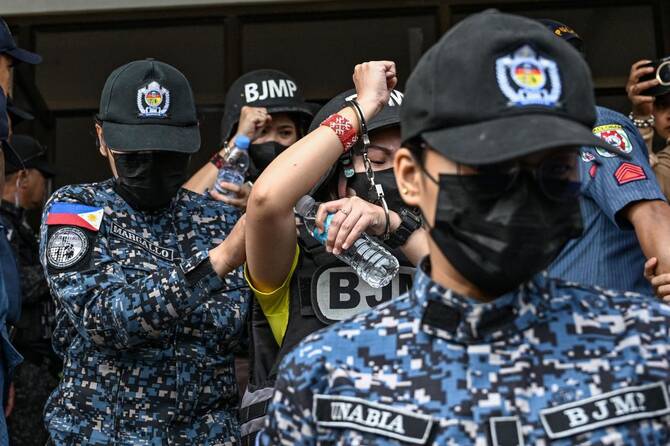
Cumpio and former roommate Marielle Domequil broke down in tears and hugged each other as the guilty verdict was read and they were sentenced to up to 18 years in prison by judge Georgina Uy Perez of the Tacloban regional court.
The duo, who were both acquitted on a lesser weapons charge, will be eligible for parole in about 12 and a half years.
In a copy of the decision seen by AFP, the court said it was convinced by the testimony of former rebels who said the pair had provided the New People’s Army (NPA), a designated terrorist group, with cash, arms and fabric for clothing.
The Samar-Leyte region that is home to Tacloban is one of the last remaining operating areas of the Maoist insurgency.
Both Cumpio and her advocates have insisted she was a victim of “red-tagging,” in which the government links its critics to the communist forces to silence them.
Speaking outside the courthouse, lawyer Norberto Robel said his team would file an appeal.
“Despite this (ruling), there is still a legal remedy and pending application for bail,” he said.
The case has been closely monitored by human rights groups including Amal Clooney’s Clooney Foundation for Justice, which in October questioned the lengthy detainment, citing “repeated postponements and slow progress.”
UN Special Rapporteur Irene Khan had previously said the charges against Cumpio appeared to be “in retaliation for her work as a journalist.”
Cumpio and Domequil were arrested in February 2020 on weapons charges, accused of possessing a handgun and a grenade.
More than a year later, the terror financing charge, which carried a potential 40-year jail sentence, was added.
‘Absurd verdict’
On Thursday, Beh Lih Yi, Asia-Pacific director of the Committee to Protect Journalists (CPJ), condemned the court’s decision.
“This absurd verdict shows that the various pledges made by President Ferdinand Marcos Jr. to uphold press freedom are nothing but empty talk,” she said, adding it was the first time a journalist had been charged with financing terrorism in the Philippines.
“The ruling underscores the lengths that Philippine authorities are willing to go to silence critical reporting.”
Aleksandra Bielakowska, advocacy manager for Reporters Without Borders, said the verdict demonstrated a “blatant disregard for press freedom.”
“The Philippines should serve as an international example of protecting media freedom — not a perpetrator that red-tags, prosecutes and imprisons journalists simply for doing their work,” she said.
Prosecutors declined to speak with AFP outside the courthouse.
In September, more than 250 journalists and media groups called on President Marcos to release Cumpio, calling the charges “trumped up.”
Following an evening mass on Wednesday, Cumpio’s mother, Lala, told AFP that she visited her daughter in prison once each month, bringing her groceries, medication and chicken from Jollibee.
Bringing in the gravy and soft drinks that accompanied the fast food meals was prohibited by guards, she added.
“Of course, I’m worried,” Lala said of the looming decision. “My youngest keeps asking when his big sister will come home.”
She broke down in tears alongside her two sons outside the courthouse as the verdict was announced.


Philippines convicts journalist on terror charge called ‘absurd’
https://arab.news/z3dvw
Philippines convicts journalist on terror charge called ‘absurd’

- Community journalist and radio broadcaster Frenchie Cumpio is the first Filipino journalist to be prosecuted under the terror financing laws


NATO wants ‘automated’ defenses along borders with Russia: German general
- That zone would act as a defensive buffer before any enemy forces advanced into “a sort of hot zone,” said Lowin
- The AI-guided system would reinforce existing NATO weapons and deployed forces, the general said
FRANKFURT: NATO is moving to boost its defenses along European borders with Russia by creating an AI-assisted “automated zone” not reliant on human ground forces, a German general said in comments published Saturday.
That zone would act as a defensive buffer before any enemy forces advanced into “a sort of hot zone” where traditional combat could happen, said General Thomas Lowin, NATO’s deputy chief of staff for operations.
He was speaking to the German Sunday newspaper Welt am Sonntag.
The automated area would have sensors to detect enemy forces and activate defenses such as drones, semi-autonomous combat vehicles, land-based robots, as well as automatic air defenses and anti-missile systems, Lowin said.
He added, however, that any decision to use lethal weapons would “always be under human responsibility.”
The sensors — located “on the ground, in space, in cyberspace and in the air” — would cover an area of several thousand kilometers (miles) and detect enemy movements or deployment of weapons, and inform “all NATO countries in real time,” he said.
The AI-guided system would reinforce existing NATO weapons and deployed forces, the general said.
The German newspaper reported that there were test programs in Poland and Romania trying out the proposed capabilities, and all of NATO should be working to make the system operational by the end of 2027.
NATO’s European members are stepping up preparedness out of concern that Russia — whose economy is on a war footing because of its conflict in Ukraine — could seek to further expand, into EU territory.
Poland is about to sign a contract for “the biggest anti-drone system in Europe,” its defense minister, Wladyslaw Kosiniak-Kamysz, told the Gazeta Wyborcza daily.
Kosiniak-Kamysz did not say how much the deal, involving “different types of weaponry,” would cost, nor which consortium would ink the contract at the end of January.
He said it was being made to respond to “an urgent operational demand.”


