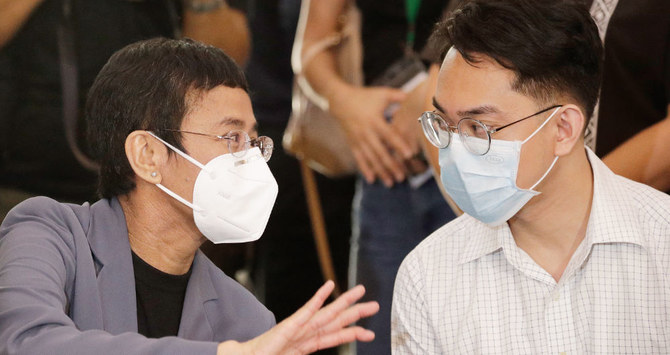
MANILA: Two Philippine journalists were found guilty of cyber libel in a Manila court on Monday.
Judge Rainelda Estacio Montesa sentenced Maria Ressa, editor of the news website Rappler, and former researcher/reporter Reynaldo Santos Jr. to jail time ranging from six months and one day to six years.
They were also ordered to pay 400,000 Philippine pesos ($8,000) in damages to the complainant, businessman Wilfred Keng.
The two were permitted to apply for bail pending an appeal.
The case stemmed from a 2012 article written by Santos, titled: “CJ using SUVs of controversial businessman.”
It accused Keng of being involved in human trafficking, drug and counterfeit cigarette smuggling, selling access to investor visas, and being the mastermind behind a 2002 killing of a Manila councilor.
Keng denied the claims and reached out to Rappler to air his side of the story.
The news organization did not respond.
In her 37-page decision, Montesa said the prosecution was able to establish all the elements of cyber libel, adding that Rappler did not offer a scintilla of proof to back up the allegations against Keng.
Montesa added that “the right to free speech and freedom of the press cannot and should not be used as a shield against accountability.”
In a later press briefing, Ressa said the decision was “devastating,” adding, “I still face seven criminal charges. It’s not unexpected, and at the same time ... we will keep fighting.”
The editor appealed to fellow journalists and called on Filipinos to “protect your rights.”
She added: “We are meant to be a cautionary tale. We are meant to make you afraid.”
Groups and public figures have criticized the decision.
“This is a dark day not only for independent Philippine media but for all Filipinos. The verdict kills freedom of speech and freedom of the press. But we will not be cowed,” said the National Union of Journalists of the Philippines.
The Foreign Correspondents Association of the Philippines said it was “extremely alarmed” over the conviction.
“It’s a menacing blow to press freedom in the Philippines and adds a new weapon in a growing legal arsenal against constitutionally guaranteed civil liberties in an Asian outpost of democracy,” the association said in a statement.
Caoilfhionn Gallagher, a barrister at the Doughty Street Chambers, one of Ressa’s counsels, said: “This is a very dark day for the rule of law and freedom of expression in the Philippines ... This is an ugly stain on the Philippines’ reputation and the international community must condemn this grave attack on independent journalism and media freedom in the strongest terms.”
Gallagher said Ressa was convicted on baseless charges for an article she did not write, “under a draconian law that did not exist when the article was published.”
Meanwhile, Harry Roque, spokesperson for President Rodrigo Duterte, said the leader “supports the freedom of expression and freedom of the press.”
He added that the president has “never filed a libel case” against a journalist throughout his political career.

Philippines editor found guilty of cyber libel
https://arab.news/ztnws
Philippines editor found guilty of cyber libel
- Verdict raises key questions, but govt says country supports press freedom
Pakistan killed over 80 militants in strikes on TTP camps in Afghanistan — official
- Saturday’s airstrikes followed a series of attacks inside Pakistan amid a surge in militancy
- The Afghan Taliban authorities accuse Pakistani forces of killing civilians in the airstrikes
ISLAMABAD: Pakistan’s airstrikes in Afghanistan destroyed seven Tehreek-e-Taliban Pakistan (TTP) camps and killed over 80 militants, a Pakistani security official said on Sunday, with the Afghan Taliban accusing Pakistani forces of killing civilians in the assault.
Saturday’s airstrikes followed a series of attacks inside Pakistan amid a surge in militancy. Authorities say the attacks, particularly in Khyber Pakhtunkhwa province and the Pakistani capital of Islamabad, were carried out by the TTP and allied groups that Islamabad alleges are operating from sanctuaries in Afghanistan. Kabul denies this.
According to Pakistan’s information ministry, recent incidents included a suicide bombing at a Shiite mosque in Islamabad, separate attacks in Bajaur and Bannu, and another recent incident in Bannu during the holy month of Ramadan, which started earlier this week. The government said it had “conclusive evidence” linking the attacks to militants directed by leadership based in Afghanistan.
“Last night, Pakistan’s intelligence-based air strikes destroyed seven centers of Fitna Al-Khawarij TTP in three provinces of Nangarhar, Paktika and Khost, in which more than eighty Khawarij (TTP militants) have been confirmed killed, while more are expected,” a Pakistani security official, who spoke on condition of anonymity, told Arab News.
An earlier statement from Pakistan’s information ministry said the targets included a camp of a Daesh regional affiliate, the Islamic State Khorasan Province (ISKP), which claimed a suicide bombing at an Islamabad Shiite mosque that killed 32 people this month.
In an X post, Afghan government spokesperson Zabihullah Mujahid said Pakistani forces had violated Afghan territory.
“Pakistani special military circles have once again trespassed into Afghan territory,” Mujahid said. “Last night, they bombed our civilian compatriots in Nangarhar and Paktika provinces, martyring and wounding dozens of people, including women and children.”
The Afghan Taliban’s claims of civilian casualties could not be independently verified. Pakistan did not immediately comment on the allegation that civilians had been killed in the strikes.
In a post on X, Afghanistan’s foreign ministry said it had summoned Pakistan’s charge d’affaires to Afghanistan Ubaid-ur-Rehman Nizamani and lodged protest through a formal démarche in response to the Pakistani military strikes.
“IEA-MoFA (The Islamic Emirate of Afghanistan’s Ministry of Foreign Affairs) vehemently condemns the violation of Afghanistan’s airspace and the targeting of civilians, describing it as a flagrant breach of Afghanistan’s territorial integrity & a provocative action,” it said in a statement.
“The Pakistani side was also categorically informed that safeguarding Afghanistan’s territorial integrity is the religious responsibility of the Islamic Emirate of Afghanistan; henceforth, the responsibility for any adverse consequences of such actions will rest with the opposing side.”
Tensions between Islamabad and Kabul have escalated since the Afghan Taliban returned to power in 2021. Pakistan says cross-border militant attacks have increased since then and has accused the Taliban of failing to honor commitments under the 2020 Doha Agreement to prevent Afghan soil from being used for attacks against other countries. The Taliban deny allowing such activity and have previously rejected similar accusations.
Saturday’s exchange of accusations marks one of the most direct confrontations between the two neighbors in recent months and risks further straining already fragile ties along the volatile border.