Russia will examine Trump’s ‘Board of Peace’ invite: Putin

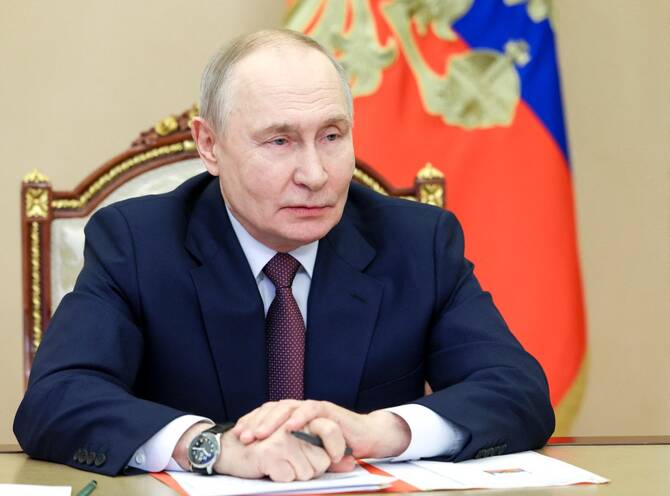
Russia’s President Vladimir Putin chairs a Security Council meeting via videolink in Moscow, Jan. 21, 2026. (AFP)
Short Url
Updated 21 January 2026
Follow

Russia will examine Trump’s ‘Board of Peace’ invite: Putin

  • Invites were sent to dozens of world leaders with a request for $1 billion for a permanent seat on the board

MOSCOW: President Vladimir Putin on Wednesday said Russia would study US President Donald Trump’s invitation to join his “Board of Peace.”
“The Russian foreign ministry has been charged with studying the documents that were sent to us and to consult on the topic with our strategic partners,” Putin said during a televised government meeting. “It is only after that we’ll be able to reply to the invitation.”
He said that Russia could pay the billion dollars being asked for permanent membership “from the Russian assets frozen under the previous American administration.”
He added that the assets could also be used “to reconstruct the territories damaged by the hostilities, after the conclusion of a peace agreement between Russia and Ukraine.”
Invites were sent to dozens of world leaders with a request for $1 billion for a permanent seat on the board.
Although originally meant to oversee Gaza’s rebuilding, the board’s charter does not seem to limit its role to the Palestinian coastal enclave and appears to want to rival the United Nations, drawing the ire of some US allies including France.


NATO wants ‘automated’ defenses along borders with Russia: German general

Updated 24 January 2026
Follow

NATO wants ‘automated’ defenses along borders with Russia: German general

  • That zone would act as a defensive buffer before any enemy forces advanced into “a sort of hot zone,” said Lowin
  • The AI-guided system would reinforce existing NATO weapons and deployed forces, the general said

FRANKFURT: NATO is moving to boost its defenses along European borders with Russia by creating an AI-assisted “automated zone” not reliant on human ground forces, a German general said in comments published Saturday.
That zone would act as a defensive buffer before any enemy forces advanced into “a sort of hot zone” where traditional combat could happen, said General Thomas Lowin, NATO’s deputy chief of staff for operations.
He was speaking to the German Sunday newspaper Welt am Sonntag.
The automated area would have sensors to detect enemy forces and activate defenses such as drones, semi-autonomous combat vehicles, land-based robots, as well as automatic air defenses and anti-missile systems, Lowin said.
He added, however, that any decision to use lethal weapons would “always be under human responsibility.”
The sensors — located “on the ground, in space, in cyberspace and in the air” — would cover an area of several thousand kilometers (miles) and detect enemy movements or deployment of weapons, and inform “all NATO countries in real time,” he said.
The AI-guided system would reinforce existing NATO weapons and deployed forces, the general said.
The German newspaper reported that there were test programs in Poland and Romania trying out the proposed capabilities, and all of NATO should be working to make the system operational by the end of 2027.
NATO’s European members are stepping up preparedness out of concern that Russia — whose economy is on a war footing because of its conflict in Ukraine — could seek to further expand, into EU territory.
Poland is about to sign a contract for “the biggest anti-drone system in Europe,” its defense minister, Wladyslaw Kosiniak-Kamysz, told the Gazeta Wyborcza daily.
Kosiniak-Kamysz did not say how much the deal, involving “different types of weaponry,” would cost, nor which consortium would ink the contract at the end of January.
He said it was being made to respond to “an urgent operational demand.”