

Pakistan courts global payments giant Visa, Gulf investors at Davos as it pivots toward growth

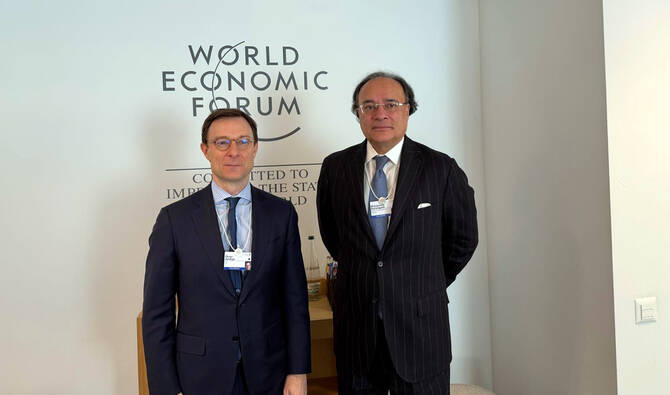
Finance Minister, Muhammad Aurangzeb, meets the Group President of Visa, Oliver Jenkyn (left), on the sidelines of the World Economic Forum Annual Meeting in Davos on January 21, 2026. (Finance Ministry)
Short Url
Updated 21 January 2026
Follow

Pakistan courts global payments giant Visa, Gulf investors at Davos as it pivots toward growth

  • Finance minister holds talks with Visa, ADB, Kuwait as Pakistan signals shift from stabilization to digital- and investment-led growth
  • Meetings at World Economic Forum highlight Islamabad’s push to attract long-term capital and modernize its economy

ISLAMABAD: Pakistan is utilizing the World Economic Forum in Davos this week to project itself as a stabilizing, reform-oriented economy, with Finance Minister Muhammad Aurangzeb holding separate meetings with global payments giant Visa, the ADB and Kuwait’s finance minister to attract digital investment and long-term Gulf capital.

The meetings on Wednesday in Davos come as Pakistan seeks to convert recent macroeconomic stabilization into sustained growth, using the World Economic Forum as a platform to re-engage global investors, multilateral lenders and strategic partners. After securing an International Monetary Fund stabilization program last year, Islamabad is now pitching reforms in taxation, privatization, digital payments and energy to attract long-term capital, strengthen financial inclusion and avoid past boom-and-bust cycles that have repeatedly undermined economic confidence

On Wednesday, Aurangzeb met Visa Group President Oliver Jenkyn on the sidelines of the annual forum to discuss cooperation in digital payments, financial innovation and Pakistan’s transition toward a modern, digitally enabled economy, according to a statement from the finance ministry.

During the meeting, Jenkyn reaffirmed Visa’s long-term interest in Pakistan, highlighting the global shift toward digital payments and the importance of enabling policy frameworks, the finance minister said. 

“Expanding trade reflects a strong foundation that highlights the positive impact of US economic engagement in Pakistan and globally. The United States and Pakistan are pursuing a fair and balanced trade relationship that creates prosperity for both our nations,” the ministry statement quoted Jenkyn as saying, adding that Visa remained keen to support Pakistan’s next phase of growth through innovation, secure payment solutions and knowledge transfer.

Aurangzeb told the Visa delegation policy consistency and a clear reform roadmap were central to Pakistan’s economic strategy, noting that the government was strengthening digital infrastructure, connectivity and regulatory frameworks to support innovation and private sector participation.

The finance minister also emphasized Pakistan’s efforts to promote transparency, documentation of the economy and digitization across sectors, which he said were creating opportunities for trusted global partners to scale market-ready solutions.

Separately, Aurangzeb held talks with Kuwait’s Finance Minister Subaih Abdul Aziz Al-Mukhaizeem, as Pakistan sought to deepen economic and investment cooperation with Gulf partners increasingly looking beyond traditional markets.

According to the finance ministry, the Kuwaiti minister shared a positive assessment of Pakistan’s economic potential and described Kuwait’s investment approach as long-term and partnership-oriented.

Aurangzeb briefed his counterpart on Pakistan’s improving macroeconomic indicators, saying the country had moved toward stability and was now focused on achieving sustainable and inclusive growth while avoiding past boom-and-bust cycles.

He highlighted strengthening external accounts, rising remittances, growing information technology exports and renewed momentum in structural reforms, including privatization initiatives that had attracted strong interest from domestic investors.

The finance minister said new opportunities were emerging across priority sectors such as agriculture, minerals and mining, pharmaceuticals and technology, offering scope for long-term investment partnerships.

Aurangzeb also met Asian Development Bank President Masato Kanda in Davos, where both sides reviewed Pakistan’s reform agenda, macroeconomic stabilization and their long-standing development partnership. The finance minister cited improving indicators including easing inflation, lower policy rates, stronger foreign exchange reserves and rising investor confidence, while briefing Kanda on progress in structural reforms, privatization and private sector participation. 

Kanda welcomed Pakistan’s progress and reaffirmed the ADB’s commitment to continued support, including cooperation on energy reforms, sustainable development and access to international capital markets, the finance ministry said.

The meetings come as Pakistan seeks to rebuild investor confidence after years of economic volatility, high inflation and external financing pressures.

Officials say outreach to global financial platforms such as Visa and sovereign-linked Gulf investors reflects a broader strategy to align digital reform, private sector participation and long-term capital inflows as Pakistan seeks a transition from stabilization toward growth.


Qatar, Pakistan resolve to boost strategic, economic cooperation at Doha talks

Updated 24 February 2026
Follow

Qatar, Pakistan resolve to boost strategic, economic cooperation at Doha talks

  • Both countries urge dialogue on Afghanistan amid renewed border tensions between Islamabad and Kabul
  • Discussions focus on bilateral trade and investment, energy, defense, manpower and labor and culture

ISLAMABAD: Pakistan and Qatar on Tuesday agreed to deepen their strategic and economic cooperation during high-level talks between Prime Minister Shehbaz Sharif and his Qatari counterpart Sheikh Mohammed bin Abdulrahman bin Jassim Al Thani, Sharif’s office said.

Sharif visited Qatar along with a high-level delegation on the invitation of Qatari emir Sheikh Tamim bin Hamad Al Thani. The Pakistani premier also held meetings with Qatar’s trade and defense ministers to discuss cooperation in various domains.

The visit came at a time when Pakistan is seeking closer economic engagement with Gulf partners amid its broader push to stabilize the economy and attract investment, while maintaining security and defense cooperation with key regional states.

During their meeting in Doha, PM Sharif and Qatar’s Sheikh Mohammed discussed bilateral relations and exchanged views on regional and international developments, according to the Pakistan prime minister’s office.

“They reaffirmed the strong brotherly relations between Pakistan and Qatar and expressed satisfaction at the growing momentum in political, economic and institutional ties,” Sharif’s office said.

“Discussions focused on enhancing cooperation in the fields of trade and investment, energy, defense, manpower and labor and culture, with both sides stressing the importance of their task force to accelerate cooperation in all these areas.”

Pakistan and Qatar maintain strong trade and investment ties. In 2022, the office of Qatar’s emir said the Qatar Investment Authority planned to invest $3 billion in Pakistan, targeting sectors including transport, aviation, education, health, media, technology and labor.

Nearly 300,000 Pakistanis live and work in Qatar, according to Pakistan’s foreign office, with many employed in health, education, engineering and public services, as well as construction and transport. The two countries engage through forums such as the Bilateral Political Consultations and the Joint Ministerial Commission.

Sharif said he had productive discussions with Qatar’s emir, Sheikh Tamim bin Hamad Al Thani, on how the two sides could transform their brotherly ties into mutually beneficial economic relationships. 

“We also took stock of the regional situation,” he said on X. “Pakistan and Qatar will continue to work together for peace and stability in the region and beyond.”

Prime Minister Shehbaz Sharif (second right) meets the Qatari Emir Qatar’s emir Sheikh Tamim bin Hamad Al Thani (left) in Doha, Qatar, on February 24, 2026. (PID)

DIALOGUE WITH AFGHANISTAN

Earlier, Sharif and Qatar’s Deputy PM Sheikh Saoud Al-Thani discussed the situation in Afghanistan and called for dialogue to support regional stability.

The meeting took place amid renewed tensions after Islamabad carried out airstrikes last week on what it described as Tehreek-e-Taliban Pakistan (TTP) targets inside Afghanistan. Kabul said the strikes killed civilians and vowed to respond to what it called a violation of its sovereignty.

“Regional developments were also discussed, in particular the situation in Iran and Afghanistan,” Sharif’s office said in a statement. “Both sides emphasized the importance of dialogue, de-escalation and collective efforts to promote peace and stability in the region.”

This was the second time in less than six months that Pakistan conducted airstrikes in Afghanistan. The last strikes triggered heavy, weeklong clashes between the neighbors along their border before Qatar and Turkiye mediated a ceasefire between them in Oct. last year.

Separately, Sharif held meetings with Qatar’s State Minister for Trade Dr. Ahmed bin Mohammed Al-Sayed and a delegation of the Qatar Businessmen Association (QBA), highlighting Pakistan’s investment-friendly reforms.

He invited QBA members to explore opportunities in infrastructure, logistics, energy, agriculture, technology and export-oriented manufacturing, his office said.