


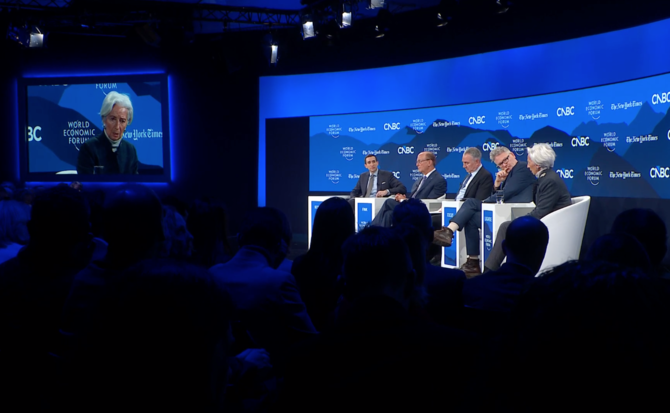

DUBAI: The parallels between today’s economy and that of the 1920s was discussed by Christine Lagarde, president of the European Central Bank, in Davos on Wednesday.
The session compared the impact of artificial intelligence on today’s economy with technological breakthroughs in the 1920s which altered global trade and stock markets in the aftermath of the First World War.
Lagarde and other panelists discussed the parallels between the economy now and then in the wake of technological changes.
“The technological breakthroughs that took place in the 1920s, whether you look at the size and scope of the electrical grid, the combustion engine and its developments, the assembly line [manufacturing], those were technological breakthroughs that took place in those years. At the same time, you also had a stock market that was doing very well,” she said.
“What we're looking at now is galloping digitalization of our economies, with a particular focus on artificial intelligence. We’re seeing stock markets not doing extremely well. And we are seeing a fragmentation of geopolitics, which is accompanied by an increase of the tariff of the import and export restrictions in almost all categories of products.”

The session, moderated by Andrew R. Sorkin, editor and columnist at the New York Times, also hosted a select group of leading figures in finance, including Ken Griffin, founder and CEO of Citadel LLC; Laurence D. Fink, chair and CEO of BlackRock; and Adam Tooze, director of the European Institute at Columbia University.
Lagarde said the significant difference between the 1920s and the present day, which makes the current situation “more unpredictable,” was that the breakthroughs of the 1920s “could diffuse within boundaries, within national territories.”
“You did not necessarily, back in those days, [need] the scale, the network that you need now,” she said. “Now, if you ask the big spenders on AI: What do they need? They will say access to data, as large as possible. They will say scale, in order to really amortize the investment cost of the development of models.
“That would be significantly jeopardized if we have limited access to data because of different privacy laws around the world. And more protectionist barriers that would prevent the scaling of these investments.”
Lagarde said she was not denying that investment in artificial intelligence “can be extremely net positive.”
“It will deliver productivity gains, the amount of which is questionable and you have a spectrum that is quite large as to how much it will deliver,” she said. “We have to consider that it’s capital intensive, energy intensive, and data intensive. And we have to be mindful of the three. In terms of energy intensity, what kind of energy is being used to manage data will matter. What the consequences will be on the people will matter as well.”
The session was moderated by Andrew R. Sorkin, editor and columnist at the New York Times.
It also hosted a select group of leading figures in finance, including Ken Griffin, founder and CEO of Citadel LLC; Laurence D. Fink, chair and CEO of BlackRock; and Adam Tooze, director of the European Institute at Columbia University.

Session titled “The Intelligent Co-Worker” at the forum on Wednesday also discussed AI (Screengrab)
Another session titled: “The Intelligent Co-Worker” at the forum on Wednesday also discussed AI, evolving from a tool to a co-worker, transforming how individuals work and how organizations operate.
The session addressed how humans are thriving alongside their digital co-workers.
Kian Katanforoosh, Founder and CEO at Workera, said he was not a fan of calling AI a co-worker.
“I’m not a fan of calling AI agents, agents. Either I’m a fan of calling it a coworker.”
Citing publications that come out of frontier labs, Katanforoosh said that as they all concern tasks, results show AI is good at tasks but the human factor still makes a difference.
“Humans have jobs that can make up 100s of tasks at times. And it turns out that AI being good at a set of tasks is very different than AI taking on an entire job. And in fact, most of the predictions on Job X, YZ is going away over the last few years has been wrong. We still have translators; we still have customer support managers. We still have a lot of couriers that we thought we go away way faster than they actually did.”
Kate Kallot, founder and CEO of Amini, agreed with Katanforoosh, saying “AI is always a tool, not a coworker.”
She gave an example on radiology, saying it was believed that radiologists at some point were going to disappear because computer vision and AI started to surpass recognizing certain diseases and reading radiographies better than the human eye.
“But actually today, they are more radiologists actually getting into the profession. And what happened is that the [AI] tool has made that profession [attractive] again,” she noted.
“And I’m thinking that I do believe that we’re going to see this happening everywhere. We are seeing this happening in governments we work with. As we start deploying AI systems and AI tools across governors, governments workers, civil servers, are finding a renewed interest of doing their works differently with a different interface.”


