

UK’s Starmer calls Trump’s remarks on allies in Afghanistan ‘frankly appalling’

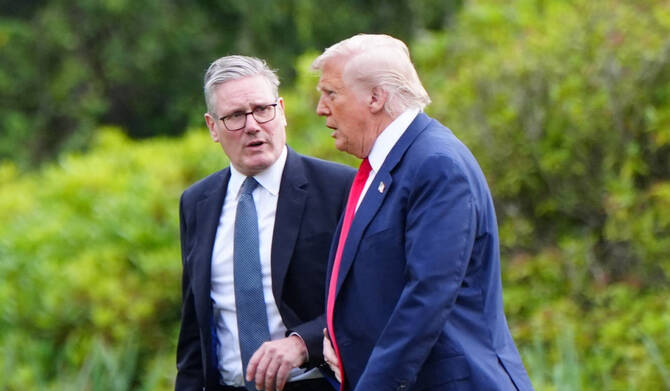
US President Donald Trump and British Prime Minister Keir Starmer walk at Trump International Golf Links, in Aberdeen, Scotland, Britain, July 28, 2025. (REUTERS)
Short Url
Updated 24 January 2026
Follow

UK’s Starmer calls Trump’s remarks on allies in Afghanistan ‘frankly appalling’

  • Britain lost 457 service personnel killed in Afghanistan, its deadliest overseas war since the 1950s

LONDON: British Prime Minister Keir Starmer called ​US President Donald Trump’s comments about European troops staying off the front lines in Afghanistan insulting and appalling, joining a chorus of criticism from other European officials and veterans.

“I consider President Trump’s remarks to be insulting and frankly appalling, and I’m not surprised they’ve caused such hurt for the loved ones of those who were killed or injured,” Starmer told reporters.

When asked whether he would demand an apology from the US leader, Starmer said: “If I had misspoken in that way or said those words, I would certainly apologize.”

Britain lost 457 service personnel killed in Afghanistan, its deadliest overseas war since the 1950s. For several of the war’s most intense years it led the allied campaign in Helmand, Afghanistan’s biggest and most violent province, ‌while also fighting as ‌the main US battlefield ally in Iraq.

Starmer’s remarks were notably strong coming ‌from ⁠a ​leader who has ‌tended to avoid direct criticism of Trump in public.

Trump told Fox Business Network’s “Mornings with Maria” on Thursday the United States had “never needed” the transatlantic alliance and accused allies of staying “a little off the front lines” in Afghanistan.

His remarks added to already strained relations with European allies after he used the World Economic Forum in the Swiss ski resort of Davos to again signal his interest in acquiring Greenland.

Dutch Foreign Minister David van Weel condemned Trump’s remarks on Afghanistan, calling them untrue and disrespectful.

Britain’s Prince Harry, who served in Afghanistan, also weighed in. “Those sacrifices deserve to be spoken about truthfully and with respect,” he said in a statement.

‘We paid in ⁠blood for this alliance’

“We expect an apology for this statement,” Roman Polko, a retired Polish general and former special forces commander who also served in Afghanistan and ‌Iraq, told Reuters in an interview.

Trump has “crossed a red line,” he added. “We ‍paid with blood for this alliance. We truly sacrificed our ‍own lives.”

Britain’s veterans minister, Alistair Carns, whose own military service included five tours including alongside American troops in Afghanistan, called ‍Trump’s claims “utterly ridiculous.”

“We shed blood, sweat and tears together. Not everybody came home,” he said in a video posted on X.

Richard Moore, the former head of Britain’s MI6 intelligence service, said he, like many MI6 officers, had operated in dangerous environments with “brave and highly esteemed” CIA counterparts and had been proud to do so with Britain’s closest ally.

Under NATO’s founding treaty, members are bound by a collective-defense clause, Article ​5, which treats an attack on one member as an attack on all.

It has been invoked only once — after the September 11, 2001 attacks on New York and Washington, when allies pledged to support ⁠the United States. For most of the war in Afghanistan, the US-led force there was under NATO command.

Polish sacrifice ‘must not be diminished’

Some politicians noted that Trump had avoided the draft for the Vietnam War, citing bone spurs in his feet.

“Trump avoided military service 5 times,” Ed Davey, leader of Britain’s centrist Liberal Democrats, wrote on X. “How dare he question their sacrifice.”

Poland’s sacrifice “will never be forgotten and must not be diminished,” Defense Minister Wladyslaw Kosiniak-Kamysz said.

Trump’s comments were “ignorant,” said Rasmus Jarlov, an opposition Conservative Party member of Denmark’s parliament. In addition to the British deaths, more than 150 Canadians were killed in Afghanistan, along with 90 French service personnel and scores from Germany, Italy and other countries. Denmark — now under heavy pressure from Trump to transfer its semi-autonomous region of Greenland to the US — lost 44 troops, one of NATO’s highest per-capita death rates.

The United States lost about 2,460 troops in Afghanistan, according to the US Department of Defense, a figure on par per capita with those of Britain and Denmark.


Greenland crisis boosts Danish apps designed to identify and help boycott US goods

Updated 57 min 54 sec ago
Follow

Greenland crisis boosts Danish apps designed to identify and help boycott US goods

  • Boycott campaigns are usually short-lived and real change often requires an organized effort rather than individual consumers

COPENHAGEN: The makers of mobile apps designed to help shoppers identify and boycott American goods say they saw a surge of interest in Denmark and beyond after the recent flare-up in tensions over US President Donald Trump’s designs on Greenland.
The creator of the “Made O’Meter” app, Ian Rosenfeldt, said he saw around 30,000 downloads of the free app in just three days at the height of the trans-Atlantic diplomatic crisis in late January out of more than 100,000 since it was launched in March.
Apps offer practical help
Rosenfeldt, who lives in Copenhagen and works in digital marketing, decided to create the app a year ago after joining a Facebook group of like-minded Danes hoping to boycott US goods.
“Many people were frustrated and thinking, ‘How do we actually do this in practical terms,’” the 53-year-old recalled. “If you use a bar code scanner, it’s difficult to see if a product is actually American or not, if it’s Danish or not. And if you don’t know that, you can’t really make a conscious choice.”
The latest version of “Made O’Meter” uses artificial intelligence to identify and analyze several products at a time, then recommend similar European-made alternatives. Users can set preferences, like “No USA-owned brands” or “Only EU-based brands.” The app claims over 95 percent accuracy.
“By using artificial intelligence, you can take an image of a product … and it can make a deep dive to go out and find the correct information about the product in many levels,” Rosenfeldt told The Associated Press during a demonstration at a Copenhagen grocery store. “This way, you have information that you can use to take decisions on what you think is right.”
‘Losing an ally’
After an initial surge of downloads when the app was launched, usage tailed off. Until last month, when Trump stepped up his rhetoric about the need for the US to acquire Greenland, a strategically important and mineral-rich Arctic island that is a semiautonomous territory of Denmark.
Usage peaked Jan. 23, when there were almost 40,000 scans in one day, compared with 500 or so daily last summer. It has dropped back since but there were still around 5,000 a day this week, said Rosenfeldt, who noted “Made O’Meter” is used by over 20,000 people in Denmark but also by people in Germany, Spain, Italy, even Venezuela.
“It’s become much more personal,” said Rosenfeldt, who spoke of “losing an ally and a friend.”
Trump announced in January he would slap new tariffs on Denmark and seven other European countries that opposed his takeover calls, only to abruptly drop his threats after he said a “framework” for a deal over access to mineral-rich Greenland was reached with NATO Secretary-General Mark Rutte’s help. Few details of that agreement have emerged.
The US began technical talks in late January to put together an Arctic security deal with Denmark and Greenland, which say sovereignty is not negotiable.
Rosenfeldt knows such boycotts won’t damage the US economy, but hopes to send a message to supermarkets and encourage greater reliance on European producers.
“Maybe we can send a signal and people will listen and we can make a change,” he added.
The protest may be largely symbolic
Another Danish app, “NonUSA,” topped 100,000 downloads at the beginning of February. One of its creators, 21-year-old Jonas Pipper, said there were over 25,000 downloads Jan. 21, when 526 product scans were performed in a minute at one point. Of the users, some 46,000 are in Denmark and around 10,000 in Germany.
“We noticed some users saying they felt like a little bit of the pressure was lifted off them,” Pipper said. “They feel like they kind of gained the power back in this situation.”
It’s questionable whether such apps will have much practical effect.
Christina Gravert, an associate professor of economics at the University of Copenhagen, said there are actually few US products on Danish grocery store shelves, “around 1 to 3 percent”. Nuts, wines and candy, for example. But there is widespread use of American technology in Denmark, from Apple iPhones to Microsoft Office tools.
“If you really want to have an impact, that’s where you should start,” she said.
Even “Made O’Meter” and “NonUSA” are downloaded from Apple’s App Store and Google’s Play Store.
Gravert, who specializes in behavioral economics, said such boycott campaigns are usually short-lived and real change often requires an organized effort rather than individual consumers.
“It can be interesting for big supermarket brands to say, OK, we’re not going to carry these products anymore because consumers don’t want to buy them,” she said. “If you think about large companies, this might have some type of impact on the import (they) do.”
On a recent morning, shoppers leaving one Copenhagen grocery store were divided.
“We do boycott, but we don’t know all the American goods. So, it’s mostly the well-known trademarks,” said Morten Nielsen, 68, a retired navy officer. “It’s a personal feeling … we feel we do something, I know we are not doing very much.”
“I love America, I love traveling in America,” said 63-year-old retiree Charlotte Fuglsang. “I don’t think we should protest that way.”