Jordan signs 2 mineral exploration MoUs in Southern regions 

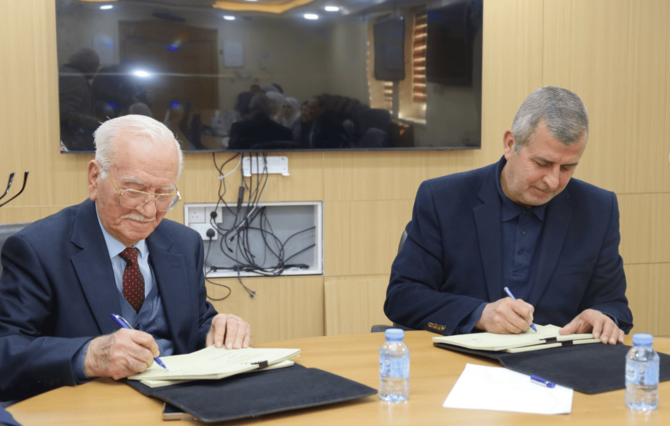
The deals were signed by Minister of Energy and Mineral Resources Saleh Kharabsheh and Bassam Fakhouri, director general of the Chemical and Mining Industries Co. X/@PetranewsEN
Short Url
Updated 21 January 2026
Follow

Jordan signs 2 mineral exploration MoUs in Southern regions 

JEDDAH: Jordan signed two agreements to explore mineral resources in Wadi Abu Al-Buraq and Samra Al-Taybeh in the southern part of the country, aiming to attract investment and create jobs. 

The first memorandum of understanding allows prospecting for base, precious, critical and strategic minerals — including rare earth elements — across 13.9 sq. km in the Jabal Samra Al-Taybeh area for a period of 67 weeks, the Jordan News Agency, also known as Petra, reported. 

The second MoU covers the exploration of gold ore, as well as base, precious, critical, and strategic minerals, and rare earth elements, over 106 sq. km in the Jabal Abu Al-Buraq area for 98 weeks. 

Mining is a central pillar of Jordan’s Economic Modernization Vision, which aims to raise the sector’s contribution to gross domestic product to 2.1 percent by 2033, expand employment to 27,000 workers and lift exports to 3.4 billion Jordanian dinars ($4.8 billion).

The government estimates untapped opportunities at about $1.14 billion, including in calcium phosphate and specialized phosphate products. 

The deals were signed by Minister of Energy and Mineral Resources Saleh Kharabsheh and Bassam Fakhouri, director general of the Chemical and Mining Industries Co. 

“At the signing ceremony, Kharabsheh said the step will strengthen the mining sector’s contribution to the national economy and support investment, knowledge transfer, and job creation under an integrated national program to develop and utilize Jordan’s mineral resources,” Petra reported. 

He added that the MoUs support the government’s strategy to expand responsible investment and foster partnerships with qualified national and international firms, facilitating technology transfer and creating jobs for Jordanians. 

The minister said the agreements build on earlier MoUs covering gold, copper, rare earth elements, phosphate and lithium, with three additional agreements currently under negotiation. 

Jordan’s mining industries currently export to 61 countries, with India accounting for 44 percent of shipments, followed by Indonesia, China, Egypt and Brazil, according to a Jordan Chamber of Industry report cited by Petra. Exports rose 12 percent in the first nine months of the year to 859 million dinars. 

The sector, which includes phosphate, potash and chemical minerals, employs around 8,000 people directly and supplies most of Jordan’s domestic demand. 


Oman inflation at 1.6%, latest figures show

Updated 5 sec ago
Follow

Oman inflation at 1.6%, latest figures show

RIYADH: Oman’s consumer price index rose by 1.6 percent in December compared with the same month a year earlier, reflecting moderate inflationary pressures at year’s end.

Average inflation for the January–December 2025 period increased by 1 percent, according to official data.

Figures released by the National Center for Statistics and Information showed that miscellaneous personal goods and services recorded the sharpest price increase, rising by 10 percent year on year. 

This was followed by transport at 2.8 percent, restaurants and hotels at 2.6 percent, and furniture, household equipment and routine maintenance at 2.4 percent, as well as education at 2.2 percent. 

Food and non-alcoholic beverages prices increased by 1.1 percent, while clothing and footwear rose by 0.2 percent and health by 0.1 percent. In contrast, prices in the culture and recreation group declined by 0.1 percent. 

Housing, water, electricity, gas and other fuels, as well as tobacco and communications, remained unchanged over the period. 

Within the food and non-alcoholic beverages category, December prices compared with the same month of 2024 showed notable increases in fish and seafood at 6 percent and fruits at 4 percent. 

Sugar, jam, honey and confectionery rose by 3.5 percent, milk, cheese and eggs by 2.1 percent, and non-alcoholic beverages by 0.9 percent.

Meat prices increased by 0.8 percent, bread and cereals, oils and fats by 0.7 percent, and other unclassified food products by 0.4 percent, while vegetable prices fell by 5.8 percent. 

Regionally, Al Dhahirah governorate recorded the highest inflation rate at 2.5 percent by the end of December compared with a year earlier. 

Inflation also rose by 2.1 percent in Al Dakhiliyah, 1.7 percent in Muscat and Al Buraimi, and 1.5 percent in South Al Batinah. 

South Al Sharqiyah and Musandam each posted increases of 1.1 percent, while North Al Sharqiyah and North Al Batinah rose by 0.9 percent. Al Wusta and Dhofar recorded inflation of 0.8 percent. 

The report highlights the relative importance of expenditure groups within the consumer price index basket, underscoring why movements in certain categories have a greater impact on overall inflation.

Housing, water, electricity, gas and other fuels carry the largest weight at 31.7, followed by food and non-alcoholic beverages at 20.6 and transport at 14.5.

Together, these three groups account for more than two-thirds of the CPI basket, meaning price stability in housing and utilities can significantly moderate headline inflation even when sharper increases are recorded in smaller-weight categories such as miscellaneous goods and services. 

The analysis also notes that around 56,640 individual price quotations were collected from 3,907 sources across the Sultanate during the reference period. 

In addition, rental data were gathered from a dedicated sample of 1,509 rented housing units, providing a detailed and representative measure of housing costs, which remain the most heavily weighted component of the inflation basket.