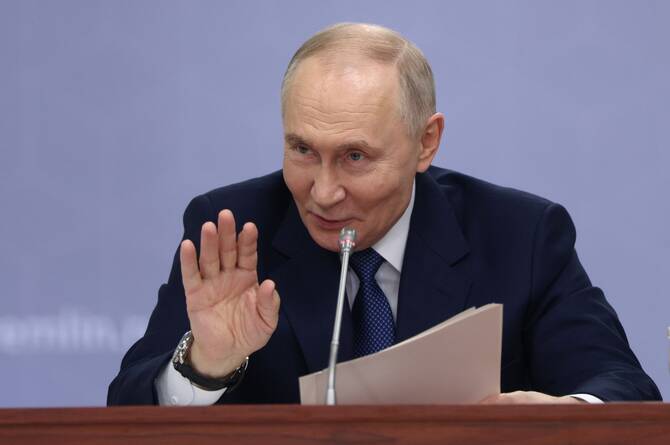
MOSCOW: Russian President Vladimir Putin has been invited to join US President Donald Trump’s “Board of Peace” aimed at resolving conflicts globally and oversee governance and reconstruction in Gaza, the Kremlin said Monday.
Moscow for years tried to balance relations with all major players in the Middle East — including Israel and the Palestinians.
But since the Israel-Hamas war and Russia’s assault on Ukraine, Putin has moved away from Israel, boosting ties with its foes like Iran.
Moscow has also sought closer relationships with the Gulf states amid growing Western isolation.
“President Putin also received an invitation to join this Board of Peace,” spokesman Dmitry Peskov told journalists, including AFP.
Russia was seeking to “clarify all the nuances” of the offer with Washington, he said, without adding if the Kremlin chief as inclined to join.
The White House has reached out to various figures around the world to sit on the so-called “Board of Peace,” chaired by the US president himself.
Putin has previously praised Trump’s efforts to resolve conflicts.
“He’s really doing a lot to resolve these complex crises, which have lasted for years, even decades,” Putin said last October.
Referring to the situation in the Middle East, Putin said: “If we succeed in achieving everything Donald has strived for... it will be a historic event.”
The assault on Ukraine and the war in Gaza have strained Moscow’s traditionally good relations with Israel, home to a large Russian-born community.
The Kremlin has repeatedly criticized Israel’s response to the October 7 attacks and called for restraint.
“The Gaza Strip is experiencing a humanitarian catastrophe in the full sense of the word,” Putin was quoted as saying by the news agency RIA Novosti, at a meeting with Palestinian leader Mahmud Abbas last May.
“Russia, as a friend of the Palestinian people, is trying to provide regular assistance,” the Russian president added.

Putin invited to Trump’s ‘Board of Peace’: Kremlin
Short Url
https://arab.news/97r6w
Putin invited to Trump’s ‘Board of Peace’: Kremlin
- The White House has reached out to various figures around the world to sit on the so-called “Board of Peace,” chaired by the US president himself
Vietnam’s ruling Communist Party re-elects To Lam as general secretary
HANOI: Vietnam’s leader To Lam was re-elected Friday as the general secretary of its ruling Communist Party, securing a new five-year term in the country’s most powerful position and pledging to rev up economic growth in the export powerhouse.
Lam, 68, was reappointed unanimously by the party’s 180-member Central Committee at the conclusion of the National Party Congress, the country’s most important political conclave.
In a speech, he said he wanted to build a system grounded in “integrity, talent, courage, and competence,” with officials to be judged on merit rather than seniority or rhetoric.
No announcement was made about whether Lam will also become president. If he were to get both positions, he would be the country’s most powerful leader in decades, similar to Chinese leader Xi Jinping.
The Congress was framed by Vietnam’s defining national question: whether the country can transform itself into a high-income economy by 2045. During the meeting, Vietnam set a target of average annual GDP growth of 10 percent or more from 2026 to 2030.
The gathering brought together nearly 1,600 delegates to outline Vietnam’s political and economic direction through 2031. It also confirmed a slate of senior appointments, electing 19 members to the Politburo, the country’s top leadership body.
Beyond settling the question of who will lead Vietnam for the coming years, the Congress will also determine how the country’s single-party system responds to world grown increasingly turbulent as China and the United States wrangle over trade and Washington under President Donald Trump challenges a longstanding global order.
Vietnam’s transformation into a global manufacturing hub for electronics, textiles, and footwear has been striking. Poverty has declined and the middle class is growing quickly.
But challenges loom as the country tries to balance rapid growth with reforms, an aging population, climate risks, weak institutions and US pressure over its trade surplus. At the same time it must balance relations with major powers. Vietnam has overlapping territorial claims with China, its largest trading partner, in the South China Sea.
Lam has overseen Vietnam’s most ambitious bureaucratic and economic reforms since the late 1980s, when it liberalized its economy. Under his leadership, the government has cut tens of thousands of public-sector jobs, redrawn administrative boundaries to speed decision-making, and initiated dozens of major infrastructure projects.
Lam spent decades in the Ministry of Public Security before becoming its minister in 2016. He led an anti-corruption campaign championed by his predecessor, Nguyen Phu Trong. During his rise, Vietnam’s Politburo lost six of its 18 members during an anti-graft campaign, including two former presidents and Vietnam’s parliamentary head.
Lam, 68, was reappointed unanimously by the party’s 180-member Central Committee at the conclusion of the National Party Congress, the country’s most important political conclave.
In a speech, he said he wanted to build a system grounded in “integrity, talent, courage, and competence,” with officials to be judged on merit rather than seniority or rhetoric.
No announcement was made about whether Lam will also become president. If he were to get both positions, he would be the country’s most powerful leader in decades, similar to Chinese leader Xi Jinping.
The Congress was framed by Vietnam’s defining national question: whether the country can transform itself into a high-income economy by 2045. During the meeting, Vietnam set a target of average annual GDP growth of 10 percent or more from 2026 to 2030.
The gathering brought together nearly 1,600 delegates to outline Vietnam’s political and economic direction through 2031. It also confirmed a slate of senior appointments, electing 19 members to the Politburo, the country’s top leadership body.
Beyond settling the question of who will lead Vietnam for the coming years, the Congress will also determine how the country’s single-party system responds to world grown increasingly turbulent as China and the United States wrangle over trade and Washington under President Donald Trump challenges a longstanding global order.
Vietnam’s transformation into a global manufacturing hub for electronics, textiles, and footwear has been striking. Poverty has declined and the middle class is growing quickly.
But challenges loom as the country tries to balance rapid growth with reforms, an aging population, climate risks, weak institutions and US pressure over its trade surplus. At the same time it must balance relations with major powers. Vietnam has overlapping territorial claims with China, its largest trading partner, in the South China Sea.
Lam has overseen Vietnam’s most ambitious bureaucratic and economic reforms since the late 1980s, when it liberalized its economy. Under his leadership, the government has cut tens of thousands of public-sector jobs, redrawn administrative boundaries to speed decision-making, and initiated dozens of major infrastructure projects.
Lam spent decades in the Ministry of Public Security before becoming its minister in 2016. He led an anti-corruption campaign championed by his predecessor, Nguyen Phu Trong. During his rise, Vietnam’s Politburo lost six of its 18 members during an anti-graft campaign, including two former presidents and Vietnam’s parliamentary head.
© 2026 SAUDI RESEARCH & PUBLISHING COMPANY, All Rights Reserved And subject to Terms of Use Agreement.


