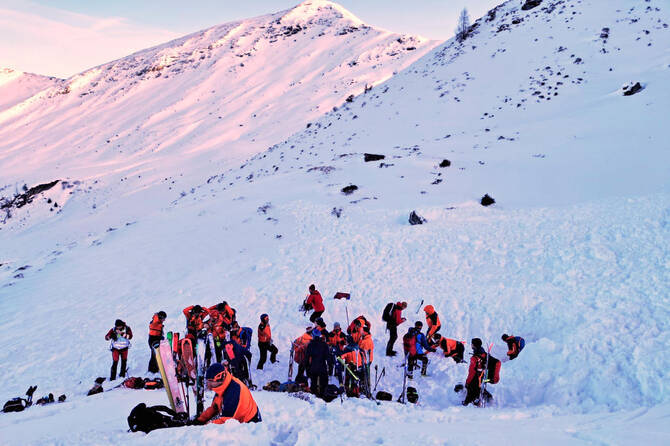
8 skiers killed in avalanches in Austria

In this photo provided by the Bergrettung Pongau (Mountain Rescue Pongau), rescuers search for people after an avalanche in the Salzburg Pongau region of western Austria, Saturday, Jan. 17, 2026. (Bergrettung Pongau via AP)
Short Url
Updated 18 January 2026
Follow

8 skiers killed in avalanches in Austria

VIENNA: Three avalanches across Austria killed eight skiers, authorities said.
A female skier was fatally buried by an avalanche in the Bad Hofgastein area in western Austria, at an altitude of about 2,200 meters (7,200 feet), around 12:30 p.m. Saturday, according to the Pongau mountain rescue service.
Roughly 90 minutes later, an avalanche in nearby Gastein Valley, south of the city of Salzburg, swept away seven people. Four were killed, two seriously injured and one escaped unharmed.
In the town of Pusterwald in central Austria, three Czech skiers were killed in an avalanche shortly before 4:30 p.m., police said. Four of their companions were evacuated to safety.
“This tragedy painfully demonstrates how serious the current avalanche situation is,” said Gerhard Kremser, district head of the Pongau mountain rescue service, noting the “clear and repeated warnings” about avalanche risk.


New START nuclear treaty ‘was flawed’: senior US official

Updated 3 sec ago
Follow

New START nuclear treaty ‘was flawed’: senior US official

  • The New START treaty ended at the turn of the calendar on February 5
  • Russia and the US together control more than 80 percent of the world’s nuclear warheads
GENEVA: A senior US official on Friday criticized the last nuclear treaty between Russia and the United States for failing to include Beijing, speaking at the United Nations a day after the New START deal expired.
“In a nutshell, New START was flawed,” said Thomas G. DiNanno, US Under Secretary of State for Arms Control and International Security, pointing out that it had not covered all nuclear weapons, “and it didn’t include China.”
Speaking to reporters in Geneva before addressing the Conference on Disarmament, he said US President Donald Trump “has been pretty clear that he wants a better agreement,” and “clarified again last night that he wants a new treaty.”
“He’s been crystal clear. He’s been consistent on it too, since his first administration,” DiNanno said.
“So we’ll see how it plays out.”
Asked if China had agreed to anything, DiNanno said: “We’re always willing to talk to them.”
China said on Thursday it would not join nuclear talks “at this stage” after the treaty’s expiry that day triggered fears of a new global arms race.
Campaigners have warned that the expiry, which ended decades of restrictions on how many warheads Russia and the United States deploy, could encourage China to expand its own arsenal.
The New START treaty ended at the turn of the calendar on February 5, after Trump did not follow up on Russian counterpart Vladimir Putin’s proposal to extend warhead limits in the agreement for one year.
Russia and the United States together control more than 80 percent of the world’s nuclear warheads, but arms agreements have been withering away.
New START, first signed in 2010, limited each side’s nuclear arsenal to 1,550 deployed strategic warheads — a reduction of nearly 30 percent from the previous limit set in 2002.
It also allowed each side to conduct on-site inspections of the other’s nuclear arsenal, although these were suspended during the COVID-19 pandemic and have not resumed since.
The Conference on Disarmament negotiating forum, which is comprised of 65 member states and meets in Geneva.